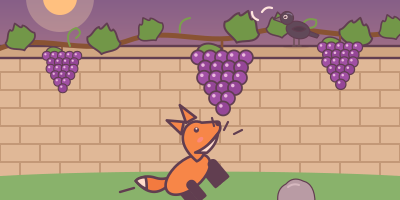
The Grapes Up High
Fox was hot and hungry. He went down a dusty road.
He saw a wall with a vine on top.
Big purple grapes hung from the vine.
"Yum!" said Fox. "I will have those grapes!"
He stood up tall and reached. But the grapes were too high.
So Fox jumped. Snap! His teeth got nothing but air.
He jumped and jumped. He ran, and he jumped higher.
Then he got on a rock. He jumped once more.
But the grapes were still up high.
A crow on the wall said, "Caw, caw!"
It sounded like a laugh.
Fox sat in the dust. His legs hurt, and he was tired.
He looked at the grapes. Then he put his nose up.
"Who wants grapes?" he said. "I bet they are sour!"
And off he went, with his tail up high.
The crow ate a grape. It was sweet.
Questions
- On a vine on a wall
- In a boat
- In a bag
- A box
- A rock
- A log
- A crow
- A hen
- A cat
- He tasted them
- He could not get them
- The crow told him
- Foxes can jump
- Some say they did not want what they can not get
- Crows like grapes
Words to know
- grapes: small round fruit
- vine: a plant that climbs
- sour: not sweet
Answer key: The Grapes Up High
- A. On a vine on a wall
- B. A rock
- A. A crow
- B. He could not get them
- B. Some say they did not want what they can not get
For the teacher: how this passage is levelled
“The Grapes Up High” is a reading level 5 story. Every Peabody story at this level is written and checked to keep sentences to 10 words or fewer, to aim at an average of 5 words a sentence, and to show 1 to 12 words on a screen. At most 6% of its words may be off the familiar-word list. Children in 2nd grade start at this level.
| This passage | 147 words, 16 screens, 5 multiple-choice questions with an answer key, and 3 vocabulary words with kid-sized meanings |
|---|---|
| Longest sentence at this level | 10 words |
| Words on a screen | 1 to 12 |
| Skills practised at this level | phonics (sounding words out), first sounds, sight words |
Reading level 5: the limits, a real sample and the free games. Peabody is a learning app, not an assessment: use the questions to talk about the story, not to grade a child.