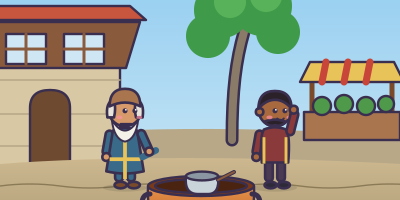
The Hodja's Cauldron
In Turkey, people have been telling stories about Nasreddin Hodja for hundreds of years. He was a teacher and a thinker who looked a little bit like a fool and sometimes acted like one, and yet nobody could ever quite get the better of him. Whenever someone in town was puzzled by a problem, they said, "Let us ask the Hodja," and then they stood around grinning, because they knew that his answer would be something they had never expected.
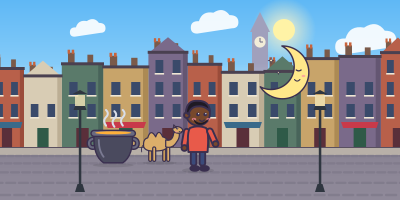
One sunny morning, the Hodja was strolling through the marketplace when a neighbor stopped him. "Hodja," said the neighbor, "I have a question that has kept me awake. When there is a new moon in the sky, what happens to the old one?" Everyone nearby stopped talking to listen. The Hodja stroked his chin and gazed thoughtfully at the clouds. "That is easy," he said. "They cut the old moon into little pieces, and each piece is made into forty stars."
The crowd was delighted with this answer. A merchant, who had been listening from behind his stall of melons, asked another question. "Hodja, what is the moon's day today? Is it the third or the fourth?" The Hodja shrugged. "I am sorry," he said, "but I cannot tell you. I buy and sell many things in this market, but I have never bought or sold the moon." The merchant laughed so hard that two melons rolled off the stall, and the Hodja caught them both.
A little later, they passed a caravan of camels, each of them carrying a tall load of carpets. The Hodja stopped to watch them go by. "My friends," he said to the people around him, "we should be very glad that camels do not have wings." Everybody asked him why. "Because," said the Hodja seriously, "they would perch on our rooftops and chimneys, and the roofs would come tumbling down on our heads." The crowd nodded and agreed that this was a very good reason.
That afternoon the Hodja wanted to cook a large pot of soup for a feast, but his own cooking pot was much too small. So he walked to his neighbor's house and knocked on the door. "Good friend," he said, "could I please borrow your biggest copper cauldron? I will bring it back tomorrow." The neighbor was a careful man who liked to count his coins twice, but he could hardly say no to the Hodja. He fetched the big cauldron, and the Hodja carried it home.
The next day, the Hodja returned the cauldron as he had promised. But inside it, nestled in the bottom like an egg in a nest, sat a tiny little saucepan. "What is this?" asked the neighbor, peering in. The Hodja put on a perfectly serious face. "I am happy to tell you the news," he said. "Your cauldron has had a baby, and it was born in my kitchen last night. Of course, the little saucepan belongs to the mother, and therefore it belongs to you."
The neighbor could hardly believe his luck. He did not stop to think that cauldrons do not have babies. He thought only that he had been given a free saucepan, and he took it with a happy grin. "A baby cauldron!" he said to himself, as he put it on his shelf. "How very wonderful! Nobody else in town has such a clever cauldron." And for the rest of the day he told everyone who passed his house what had happened.
A few days later, the Hodja knocked at the neighbor's door once more. "Good friend," he said, "may I borrow the cauldron again?" The neighbor, still thinking about the baby saucepan, hurried to give it to him. This time he did not even ask when he would get it back. In fact, he was already thinking about what other babies the cauldron might have, and how rich he might become. The Hodja thanked him politely and walked home, carrying the cauldron under his arm.
One day passed, and then two days, and then five. The neighbor waited and waited, but the Hodja did not bring the cauldron home. At last the neighbor lost patience, put on his coat, and went to the Hodja's house. "Hodja," he said, as soon as the door opened, "where is my cauldron? You have had it for nearly a week!" The Hodja bowed his head. He looked as sad as a man could look, and his voice trembled when he answered.
"My dear friend," he said, "I am sorry to be the one to tell you this, but your cauldron has died." The neighbor's mouth fell open. "Died?" he cried. "What do you mean, died? Cauldrons cannot die! It is made of copper, and it is as hard as a rock!" The Hodja looked at him with large, calm eyes. "Well," he said gently, "you believed it could have a baby. Why should you not believe that it can die?"
The neighbor opened his mouth to argue, and then he closed it again. He looked at the Hodja, and he thought about the little saucepan on his shelf, and slowly his face turned a deep shade of red. Everyone in the street had heard what was said, and they began to chuckle. A few of them laughed out loud. The neighbor scratched his head, muttered something to himself, and walked home in silence, and he never lent anything to the Hodja again.
The Hodja stood in his doorway and watched him go. Then he went back inside and stirred his soup, humming a little tune. When the news reached the marketplace, people told it over and over, and everyone agreed that it was the cleverest thing the Hodja had ever done. And the Hodja's soup, everyone agreed, was the best in town, and it had been cooked in a very large pot.
Questions
- It is cut into stars
- It sinks into the sea
- It turns into a new moon
- A bag of coins
- A little saucepan
- A cup of soup
- He liked getting something for nothing
- He had seen it happen before
- He was too sleepy to think
- "I never said it was copper"
- "You believed it could have a baby"
- "Then you must have lost it"
- sells things at a stall
- tells old stories
- carries heavy carpets
Words to know
- caravan: line of travelers
- cauldron: big cooking pot
- nestled: tucked in snugly
- merchant: seller of goods
- chuckle: laugh softly
Answer key: The Hodja's Cauldron
- A. It is cut into stars
- B. A little saucepan
- A. He liked getting something for nothing
- B. "You believed it could have a baby"
- A. sells things at a stall
The story in pictures
- Part One · Questions in the Market
- Part Two · The Baby Saucepan
- Part Three · The Cauldron Dies
For the teacher: how this passage is levelled
“The Hodja's Cauldron” is a reading level 10 story. Every Peabody story at this level is written and checked to keep sentences to 38 words or fewer, to aim at an average of 12 words a sentence, and to show 70 to 100 words on a screen. At most 13% of its words may be off the familiar-word list. Children in 6th grade start at this level.
| This passage | 982 words, 12 screens, 5 multiple-choice questions with an answer key, and 5 vocabulary words with kid-sized meanings |
|---|---|
| Longest sentence at this level | 38 words |
| Words on a screen | 70 to 100 |
| Skills practised at this level | vocabulary, spelling |
Reading level 10: the limits, a real sample and the free games. Peabody is a learning app, not an assessment: use the questions to talk about the story, not to grade a child.