The Clock That Struck Thirteen
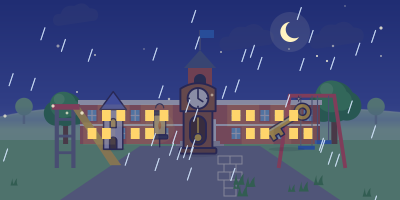
The clock in the Founders' Tower at Ashgrove School had struck twelve at every midnight for a hundred and forty years. On the second Thursday in March, it struck thirteen. I did not hear it, being a sound sleeper and a person of regular habits, but Jun did, and Jun does not make mistakes about sounds. This is my account of the second case of the Locked Room Club, written up in the usual form and with the usual promise. Every clue that solved it is set down on these pages before the solution, so that a careful reader may arrive at the answer a little ahead of Ravi, which is not difficult, and perhaps even a little ahead of me, which is considerably harder.
Jun had been lying awake, as he frequently does when the weather is tempestuous. It had been raining since half past eleven, in great slanting bucketfuls, and when the tower began to strike he counted the strokes, as he always does, because he is constitutionally incapable of doing otherwise. "Twelve," he told us afterward. "Then a pause about as long as a breath. Then one more." Ravi, who sleeps in the next bed, maintained that he had counted fourteen, but Ravi had also been reading under his blankets with a torch, and he did admit that he had consulted his wristwatch at the moment the rain finally stopped, which was twenty minutes past twelve. His watch, he added, is set by the radio, which is more than could be said for mine.
On Friday morning, the thirteenth stroke turned out to be the smaller of our problems. Dr. Whitlock, the headmaster, had traveled to a conference in Edinburgh and was due back at noon. At half past seven, the caretaker, Mr. Tarrant, went to open the headmaster's study and discovered that the key turned perfectly well but the door would not move, because somebody had shot the bolt on the inside. He lifted the whole door off its hinges, which is a feat he can accomplish single-handed. Inside, the window stood wide open and the carpet beneath it was soaked. The glass case on the mantelpiece, where the school's most precious possession had stood, undisturbed, for a hundred years, was empty, and there was nobody in the room.
The missing object was the Founder's Chronometer. A chronometer, I should explain, is an instrument built so precisely that a ship's captain can calculate his position on the open ocean by it, and this one had belonged to Captain Ashgrove himself, who had founded the school with the money from a lucky voyage and kept the clock on his desk until the day he died. It is about the size of a loaf of bread, in a box of dark wood, with a brass face and a tick like a pulse. Ms. Fairweather informed us that it was undoubtedly worth more than the new chapel roof, and that Mrs. Ogilvie, the deputy head, had deliberately resolved to wait until noon before calling anyone else. "She would like," said Ms. Fairweather, "to hear what five clever people think first."
We went to look at the study, and then we went outside to look at the study from below. The window is on the second floor of the east wing, perhaps fifteen meters above the quad, in a wall as smooth and unforgiving as a dinner plate. Tobias examined it through the binoculars that he keeps for watching birds, and reported that the ivy was unbroken, the stone was bare of scratches, and nobody had brought a ladder, because the lawn beneath was soft with rain and showed no holes. "Then he flew," said Ravi. Mr. Tarrant, who was standing close by with his arms folded, said, without looking at any of us, "There is the Walk." We turned and stared at him. "The Winder's Walk," he said. "Nobody uses it but me."
He showed it to us from the doorway of the study, without letting a single one of us step onto it. It is a precarious ledge of old stone, about as wide as a doormat, with an iron rail along the outer edge, and it runs from the headmaster's window around the corner of the tower to a small weather door at the foot of the clock room. The door is kept locked. Mr. Tarrant had painted the rail green on Thursday afternoon, and it was still tacky enough to stick to a finger, which he demonstrated, to his own considerable annoyance. "Anybody who crossed it last night would be wearing it," he said. "I told nobody it was wet, because nobody goes there."
There were four keys to the weather door, Mr. Tarrant said, and he could account for every one of them. His own lived on his belt. Dr. Whitlock's was on Dr. Whitlock's ring, in Edinburgh. A third hung on the board of master keys in the bursar's office, where Mr. Pym, the bursar, could fetch it in a moment, and the fourth had been lent months ago to Cedric Whitlock, the headmaster's seventeen-year-old nephew, who runs the Astronomy Society and sometimes observes the stars from the roof of the clock room. Four keys, four people, and Ms. Fairweather had given us two more names, neither of them with a key: Ms. Adair, the music teacher, and Miss Rook, a visiting valuer, who had spent Tuesday examining the Chronometer and had left on the evening train.
Our witnesses could be gathered in a morning, and we gathered them. Matron had woken at the thirteenth stroke, she told us, and had looked from the infirmary window at the dial of the tower, which is lit all night by a small lamp behind the glass, and the dial had said one o'clock exactly. Across the quad, in the window of the headmaster's study, she had seen a light moving, and she had thought, "He is home early," and gone straight back to bed. That was all: it was only a light in a window, she said, and she had been half asleep, but about the clock she was perfectly certain. "I remember thinking, one in the morning, and the poor man still working."
Next came the alibis, which I set down in the order they were given. Mr. Pym, a cheerful and scrupulously tidy man who hums while he counts, said that at one o'clock he had been in his office, on the telephone to his mother in Brisbane, where it was already breakfast. The telephone exchange keeps a printed record of every call, with the times, and he showed us the page: twelve forty-eight to one twenty. Mr. Tarrant said that he had been standing at the kitchen gate from five minutes to twelve until a quarter past, tasting new bread with Mr. Bianchi the baker, whose delivery slip said so. Cedric Whitlock had been in the prefects' room, playing cards with seven others, until half past twelve by the room's own battery clock, and had then gone to bed alone.
At the long table in the library, we assembled our five rival theories. Ravi's was Mr. Tarrant, who alone understood the Walk, who held a key, and who, according to a prefect whom Ravi considered an unimpeachable source, had been told by Dr. Whitlock that he would retire in June. After a quarter past twelve, Ravi pointed out, the baker had gone, and Mr. Tarrant had nobody with him. Tobias's was Cedric, who had asked his uncle for money to take the Astronomy Society to Chile and been refused, and who had been alone from half past twelve. Ngozi's was Miss Rook, with a hired climber. Tobias observed that the wall had no marks. Ngozi said that was exactly what a very good climber would leave.
Jun's theory was that we ought to stop speculating about the suspects and begin investigating the clock. "If somebody was in the study at one," he said, "then who made the tower strike thirteen?" Ravi replied that it had probably been a mistake, since old clocks make mistakes. Jun said nothing, which is what he does when he is right, and I added a line to the minutes that said ASK MR. TARRANT HOW A CLOCK COUNTS, and we did. Mrs. Ogilvie gave permission for the Club to climb the tower, in single file, with Mr. Tarrant going first, on the strict understanding that nobody would so much as breathe near the weather door.
The clock room is a square of brick and iron at the top of a hundred and nine stairs, and it is full of the most patient and deliberate noise I have ever heard. A great brass wheel turns with a slow and heavy tock, and a pendulum as long as a canoe swings from a beam above. Mr. Tarrant explained the strike. A wheel with twelve notches, he said, called the count wheel, tells the hammer how many times to hit the bell; the hands do not tell it anything. After eleven, the wheel gives twelve, and after twelve, it goes round again to one. "It strikes whatever comes next," he said. "She cannot strike thirteen on her own. Only a hand can do that."
He demonstrated the procedure. If you push the minute hand forward on its spindle until it passes the hour, the clock believes that an hour has gone by, and it strikes. Whoever had done it must have stood in this room at midnight, with the twelve strokes already finished, and pushed the hands on to one o'clock, which obliged the wheel to give a single, belated stroke. "I tell every new apprentice," said Mr. Tarrant, "never to push a hand past the hour in a hurry. She will strike every hour you pass." So the thirteenth stroke had been neither a mistake nor a ghost, and somebody had been standing here at midnight, with a key, and a reason to touch the hands.
Then Jun laid a hand on my sleeve and indicated the floor beside the pendulum. There was a spatter of white wax, no larger than a coin. There was a saucer, and in the saucer stood the stump of a plain white household candle, with a loop of black thread tied round it, an inch below the old flame, and the other end of the thread was still knotted to the pendulum rod. It had been burned through, just above the knot. Tobias measured the inch, with the ruler from his sock. Mr. Tarrant, who uses these candles in the chapel, said that one burns about an inch an hour. Then he turned rather pale, and examined the contraption twice. "I have never lit a candle in this room," he said. "It is full of oil."
I should add that the clock, when we arrived, showed the correct time, and had done so all morning, and that it had sustained no damage whatever, for Mr. Tarrant had wound the weights on Sunday and had found nothing wrong at six on Friday, apart from a feeling of unease that he could not account for. Jun said one thing more, quietly, as we stood there. At one o'clock, he said, he had been lying awake, waiting for the tower to strike, because he wanted to find out whether it would strike thirteen again. And it had not struck. "I lay there until ten past," he said. "There was no stroke at all."
Here is everything we had by lunchtime, in the order we learned it. If you would like to find the answer before I give it, stop at the end of the list; the answer begins on the next page. First: the clock struck twelve and then one more, which is what happens when somebody pushes the hands on past the hour. Second: the clock was found right, not an hour fast, and did not strike at one o'clock. Third, and this one matters: the thread. Beside the pendulum stood a candle stump with a thread tied an inch below the flame and knotted to the pendulum rod, and the thread was burned through. Fourth, and this one matters too: the rain, which fell from half past eleven until twenty past twelve, by Ravi's watch, which was set by the radio.
Fifth: the study carpet beneath the window was soaked. Sixth: Matron saw a light in the study, and the tower said one o'clock exactly. Seventh: the alibis. Mr. Tarrant was with the baker until a quarter past twelve, by the baker's slip. Cedric was with seven prefects until half past twelve, by a battery clock. Mr. Pym was on the telephone from twelve forty-eight until one twenty, by the printed record. Eighth: Dr. Whitlock, who also had a key, was in Edinburgh. Ninth: the rail of the Walk was painted green on Thursday and was still wet. And tenth, which I had set down without reading: there was a green smear on the cuff of Mr. Pym's jacket, which he said came from the chapel door. The chapel door is oak. It has not been painted since 1890.
Here is what I explained to Ms. Fairweather, on the library stairs. For precisely one hour, the tower clock had been telling a deliberate lie. Somebody had pushed its hands round to one, which made it strike thirteen, and if that had been all, it would have been an hour fast, and would have struck two at one o'clock, and Mr. Tarrant would have noticed in the morning. It had done neither. It was right in the morning, and silent at one. A clock can only lose an hour if somebody stops it, and the thread showed how: it held the pendulum pulled aside, so that the clock could not run, and when the candle burned down to the thread an hour later, the thread parted, and the pendulum swung, and the clock walked on, correct.
For that whole hour, from just after midnight until just after one, the tower dial said one o'clock and never moved. Anybody who looked would read it as one. So when Matron saw a light in the study at one o'clock exactly, she had seen it at some moment inside that stopped hour, and the clock could not say when. That left the rain, and the rain was decisive. The carpet beneath the window was soaked, which meant that whoever crossed the Walk had come in while the rain was still falling, and it stopped at twenty past twelve. The light had been seen before then. By the tower it was one o'clock. In truth, it was a few minutes after midnight.
Now we had only to set the genuine times beside the alibis, and the picture rearranged itself. At five minutes past midnight, Mr. Tarrant was tasting bread at the kitchen gate, with a baker and a slip of paper. Cedric was playing cards with seven witnesses, in a room whose clock was not the tower's. Dr. Whitlock was three hundred miles away. Mr. Pym's telephone call began at twelve forty-eight, and before that he had nobody. He had also, as it happened, been given an alibi by the clock, because anyone who believed the light was seen at one o'clock would believe it was seen while he was talking to Brisbane. Somebody had made the clock lie for exactly one hour, and the only person who gained by it was the man with a telephone call waiting at the end.
The bolt, I added, was the last piece. A room found open at dawn is merely a theft, but a room bolted from inside is a puzzle, and a puzzle sends people looking for a flying man instead of a key. Mr. Pym had shot the bolt from within and left by the window, the Walk, the clock room and the hundred and nine stairs. The green on his cuff had come from the rail. I did not say more than that, because it was not for the Club to say, and Ms. Fairweather listened to the whole of it, then walked across the quad to Mrs. Ogilvie's office, and I did not see what happened there.
What I saw was Mr. Pym, in the corridor, being asked politely for the keys to the school strongroom, and handing them over without a word, and humming nothing at all. When the door was opened, the Founder's Chronometer was inside, wrapped in a gray scarf, ticking. What Mr. Pym said afterward was said behind a closed door, and Ms. Fairweather says that is where it ought to stay. At noon, Dr. Whitlock's taxi came up the drive. The Chronometer was back in its case on the mantelpiece, and the case had a new lock, and Mr. Tarrant was out on the Walk with a rag, taking the green off the rail.
That night, all five of us lay awake in our beds, with our ears turned toward the tower, and at midnight the clock struck twelve, slowly and gravely and with no embellishment, and then it was quiet. Mr. Tarrant, we heard later, had sat up in the clock room with a cup of tea, daring it to do otherwise. I have it in the minutes that there were twelve strokes and no more, and Jun agrees. The minutes also record that the case was closed at ten past two, and that Ravi's theory had been mistaken in every particular, a point he disputes. Ravi says that he is still counting, and that he makes it fourteen.
Questions
- Its bell is too small
- Its count wheel only has twelve notches
- Its hammer is broken
- The clock did not strike at all
- The clock struck twice
- The bell was muffled by rain
- Someone had stopped the pendulum for an hour
- Someone had oiled the clock
- Someone had been reading in the clock room
- very loud
- very late
- very small
- It put out the candle
- It kept everyone indoors
- The wet carpet showed the light in the study was seen before the rain stopped, at twenty past twelve
- Mr. Tarrant
- Mr. Pym
- Cedric
Words to know
- chronometer: very exact clock
- pendulum: swinging weight
- alibi: proof elsewhere
- belated: very late
- tacky: slightly sticky
Answer key: The Clock That Struck Thirteen
- B. Its count wheel only has twelve notches
- A. The clock did not strike at all
- A. Someone had stopped the pendulum for an hour
- B. very late
- C. The wet carpet showed the light in the study was seen before the rain stopped, at twenty past twelve
- B. Mr. Pym
The story in pictures
- Part One · The Thirteenth Stroke
- Part Two · What Everyone Saw
- Part Three · Inside the Clock
- Part Four · The List
- Part Five · The Hour That Was Stopped
For the teacher: how this passage is levelled
“The Clock That Struck Thirteen” is a reading level 13 story. Every Peabody story at this level is written and checked to keep sentences to 62 words or fewer, to aim at an average of 15 words a sentence, and to show 100 to 145 words on a screen. At most 19% of its words may be off the familiar-word list. Readers reach this level by climbing, not by grade.
| This passage | 2937 words, 23 screens, 6 multiple-choice questions with an answer key, and 5 vocabulary words with kid-sized meanings |
|---|---|
| Longest sentence at this level | 62 words |
| Words on a screen | 100 to 145 |
| Skills practised at this level | vocabulary, spelling |
Reading level 13: the limits, a real sample and the free games. Peabody is a learning app, not an assessment: use the questions to talk about the story, not to grade a child.