Where Words Grow
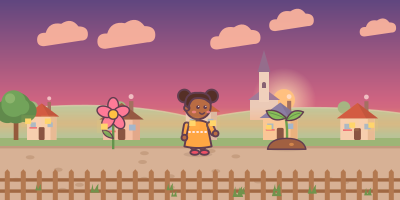
In Dunmere, whatever you say takes root. A small word makes a small green thing. Say "hello" at the gate and a daisy opens by your boot, and say "thank you" and a clover leaf unrolls beside it. Linnet Vale had grown up stepping around them. Every doorstep in town was dotted with the little plants of morning, each one a word somebody had said. She liked the mornings best, when the whole town looked freckled with green.
By evening they had gone to seed and blown away. Big words grew big, and sharp words grew sharp. Fifty years ago, in what the old people called the Loud Winter, two families had shouted across the mill road for a week. By Sunday the road was a wall of thorns higher than a horse, and the mill stood shut for a year. Since then Dunmere had spoken softly and not often. People nodded and pointed, and said "tea" and "salt" and "bread," and kept their gardens tidy.
Linnet's house had the tidiest garden in town. Her mother said six words before breakfast and her father said four, and by noon the step held ten small plants in a row. Linnet said almost nothing. She had learned that a word, once out, could not be taken back, because it stood there on the step, green and plain, where anyone could read it. So she kept hers folded up inside her, the way you keep a coin in a pocket, and turned them over when she was nervous.
Her friend Oren was the opposite. Oren talked to the cat, to the clouds, to the baker's horse. His yard was a jungle of sunflowers and beans and nettles and one wild rosebush, a tangle of things said in a hurry. The neighbors frowned over their fences, but Linnet did not frown. She sat with him on the wall behind the school while he talked, and she watched the green curl around her ankles, and she thought it was the best thing in Dunmere. She was too shy to say so.
On the last day of term, Mr. Harrow the baker sent for her. He was ninety-one, and he had lived alone above the shop for eleven years. There was no garden at his door, none at all, only bare dirt swept clean. "Come in, Linnet Vale," he called from the stairs. "You are the quietest child in Dunmere, and that is why I want you. I have a great deal to say, and I need somebody who will not talk over me."
He lay propped on pillows under a faded patchwork quilt, with the window open. "My son lives over the mountains," he said. "He left when he was nineteen. Every day I meant to tell him what I felt, and every day I kept it, because I thought there would be time." He looked at the bare floor and the bare dirt beyond the glass. "Sit by me, child. I would like to say it all once, to somebody."
Then he began. The first word came up through the floorboards as a green thread. By the tenth, a vine had wound around the bedpost. He said he was sorry, and white lilies opened at the foot of the bed. He described the coat his wife had worn the morning they met, and a fern the exact green of that coat unrolled down the wall. He said he was proud, and a sunflower shouldered up through the quilt, taller than the headboard. Linnet sat in the middle of it, and the room filled up like a summer.
He spoke for three hours. By the end, the little bedroom was a green and golden forest with light coming through it, and his voice had worn down to a thread. He took her wrist in his floury hand. "Tell my son it is all here," he said, "if he wants to come and see." Then he closed his eyes, and he died as the window turned gray, quietly, with the sunflower leaning over him, and Linnet sat beside him until the first bakers' carts came rattling down the lane.
She walked home through streets freckled with morning words. Behind every window sat a person with a garden of almost nothing. At supper her mother said, "Bread," and her father said, "Thank you," and two small clovers opened by their plates, and that was all. Linnet looked at their careful, tired faces, and she had a whole room of green inside her and not one word to put it in. She had not said a single thing since the baker's house.
The next afternoon she found Oren on the wall behind the school, kicking his heels, and she sat down and told him. She told him about the lilies and the fern and the sunflower, and about the empty cups on her parents' table and the words she could feel in her like pebbles in a streambed. She told him things she had not known that she knew. Oren said nothing at all. He only looked at her face the whole time, and the ground around her came up green.
By the time she stopped, she was sitting in a thicket of her own saying, as high as her knees. Oren laid his hand over hers. "That is the loudest thing I have ever seen in Dunmere," he said, "and it is the best." Linnet laughed, and a daisy opened. It was the first time she had heard herself laugh in a year, a small, surprised sound, like a door that had been shut a long time.
That night Linnet went down Long Lane to the baker's shop, where a green thread had pushed out under the door and was creeping along the ground toward the mountain road. She did not know if the son would come. She stood at the gate and said, in a voice she had not used before, "Come and see." A shoot came up at her feet, and as she watched, it leaned toward the mountains.
Questions
- A plant grows where they stand
- Nothing at all
- A bell rings
- After the Loud Winter, angry words had grown into a wall of thorns
- They had no words
- They were all asleep
- He had said almost nothing for years
- He hated flowers
- It rained too much
- She was finally saying what she had kept inside
- Oren planted seeds
- It was spring
- A thick tangle of plants
- A small hill
- A kind of tea
- Whether the baker's son will come
- Where Dunmere is
- What Oren's cat is called
Words to know
- thorns: sharp, spiky plants
- propped: held up
- freckled: dotted with spots
- thicket: thick bushes
- patchwork: made of patches
Answer key: Where Words Grow
- A. A plant grows where they stand
- A. After the Loud Winter, angry words had grown into a wall of thorns
- A. He had said almost nothing for years
- A. She was finally saying what she had kept inside
- A. A thick tangle of plants
- A. Whether the baker's son will come
The story in pictures
- Part One · The Quiet Town
- Part Two · The Baker's Room
- Part Three · Say It
For the teacher: how this passage is levelled
“Where Words Grow” is a reading level 10 story. Every Peabody story at this level is written and checked to keep sentences to 38 words or fewer, to aim at an average of 12 words a sentence, and to show 70 to 100 words on a screen. At most 13% of its words may be off the familiar-word list. Children in 6th grade start at this level.
| This passage | 1014 words, 12 screens, 6 multiple-choice questions with an answer key, and 5 vocabulary words with kid-sized meanings |
|---|---|
| Longest sentence at this level | 38 words |
| Words on a screen | 70 to 100 |
| Skills practised at this level | vocabulary, spelling |
Reading level 10: the limits, a real sample and the free games. Peabody is a learning app, not an assessment: use the questions to talk about the story, not to grade a child.