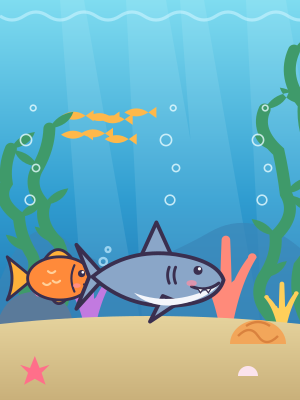
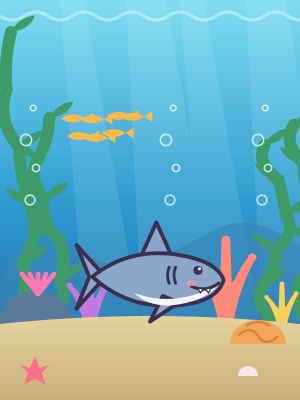
A great white shark eats many kinds of food. Over a lifetime, it eats fish, other sharks, rays, sea turtles, shellfish, seabirds and dead whales. Young great whites eat fish, including bottom fish and schooling fish. They eat rays, too. Big great whites eat mostly seals and sea lions.
Great whites are apex predators, at the top of the ocean food chain. Big great whites often gather to feed near colonies of seals and sea lions.
Pups and young great whites tend to stay in shallow water near the coast. Adults usually live farther out in the open ocean. But they visit shorelines where seals or sea lions live.
A great white often swims underneath a seal at the surface. A seal has a harder time seeing a shark below it. The shark's dark back and white belly are called countershading, and they help it blend in with the water.
A great white finds food with more than eyesight. It can sense the faint electric fields that other animals give off. This sense comes from organs called the ampullae of Lorenzini. A lateral line, a row of canals along the body, feels water moving and pressure changing. Sharks also have a remarkable sense of smell.
Many great whites migrate, traveling long distances with the seasons. Some gather at the White Shark Cafe. It is a spot in the open Pacific Ocean about halfway between Mexico and Hawaii. As of November 2026, scientists do not yet know exactly why they gather there.
Great whites grow slowly and are slow to have young. A mother gives birth to live pups only every two or three years. A newborn pup is about 4 feet long. It is on its own from the start. Scientists think a great white may live 70 years or more, as of November 2026.
The IUCN lists the great white shark as Vulnerable, as of November 2026. An international treaty called CITES controls trade in great whites. In most U.S. waters, it is illegal to keep one caught while fishing. Along the California coast, great white numbers appear to be growing, as of November 2026.
Words to know
- migrate: travel with seasons
- countershading: hiding colors
- vulnerable: at risk
- apex: top
- treaty: an agreement