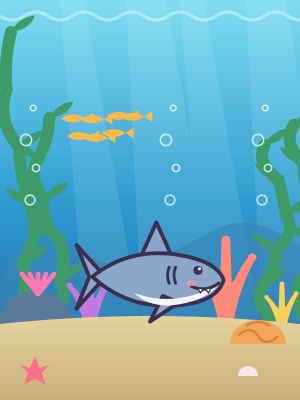
How does a great white find its food? As of November 2026, it is the largest predatory fish in the world, and although it is one of the most well-studied sharks, the first steps of its hunt are not well understood. Its body is shaped like a torpedo and it has a strong tail. Follow a great white as it hunts for seals.
What a great white eats changes as it grows. Young great whites eat fish, including bottom fish and schooling fish, and rays. As the sharks grow they change from rays and schooling fish to seals, and young white sharks can be seen in Monterey Bay in warm years. Big great whites eat mostly seals and sea lions. Over a lifetime the menu also includes other sharks, sea turtles, shellfish, seabirds and dead whales.
Scientists describe a hunt in five stages: detection, identification, approach, subjugation and consumption. In white sharks, the first two stages are poorly understood, so how a great white first notices its food, and how it decides what the food is, remain questions for researchers.
Near the coast, a great white is thought to rely mainly on sight. It cruises near the bottom and looks up at the surface. A seal has a harder time seeing a shark below it, so a great white often swims underneath a seal at the surface. Its dark gray back and white belly, a pattern called countershading, help it blend in with the water. Researchers describe white sharks as camouflaged while stalking from below, because low light, a dark grey back and a dim rocky reef help them stay unseen by seals at the surface.
A great white often uses an underwater approach, swimming just below the surface until about 1 meter from its prey and then rising up. Great whites also sometimes lift their heads out of the water, apparently to look at what is happening above the surface.
Experiments have tested what a white shark goes for. When white sharks were offered a square target and a seal-shaped target, they chose the seal shape, which is the shape more common in their natural environment.
At Dyer Island, South Africa, white sharks were first drawn by the smell of tuna bait, and then they chose a seal-shaped decoy, which the authors credit to their sight.
Sight is not the only sense. A great white can sense the faint electric fields that other animals give off, using special organs called the ampullae of Lorenzini. This sense is most useful at close range, for finding hidden prey that other senses cannot detect. Sharks also have a lateral line, a row of canals along the body that feels water moving and pressure changing, and they have a remarkable sense of smell.
A great white's teeth are triangle-shaped, with jagged, saw-like edges. The serrations let it cut its food into chunks. A great white keeps growing new teeth for as long as it lives, so lost teeth are replaced.
The great white is one of the most well-studied sharks in the world. Even so, the opening stages of its hunt are poorly understood. How a great white first notices its food, and how it decides what that food is, are still questions for scientists.
Words to know
- countershading: dark-over-light shading
- serrations: with saw-like edges
- lateral: at the side
- ampullae: electric sensors
- camouflaged: blended in