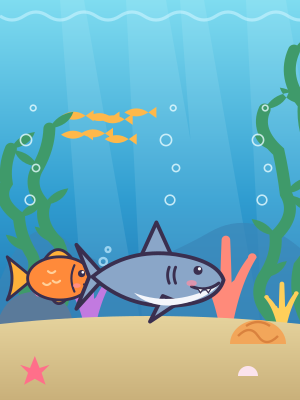
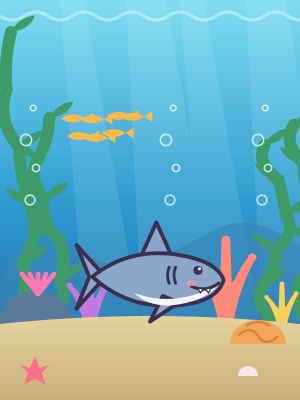
The great white is a mackerel shark, in a family that also includes makos, porbeagles and salmon sharks. As of November 2026, it is the largest predatory fish in the world. NOAA and National Geographic both list its length as up to 21 feet and its weight as up to 4,500 pounds. Female great whites are generally larger than males.
A great white has a torpedo-shaped body and a strong tail. It is dark gray to brown on top and white underneath. This countershading helps the shark blend in with the water. A great white is also partly warm-blooded, so it can keep its body warmer than the water around it.
A great white can sense the faint electric fields that other animals give off. This sense comes from organs called the ampullae of Lorenzini. Sharks also have a lateral line, a row of canals that feels water moving and pressure changing, and a remarkable sense of smell. A great white often swims underneath a seal at the surface, because a seal has a harder time seeing a shark below it.
Great whites eat a wide range of food. Over a lifetime, they eat fish, other sharks, rays, sea turtles, shellfish, seabirds and dead whales. Big great whites eat mostly seals and sea lions, and they often gather to feed near colonies of them. White sharks tagged off California spend part of the year near the coast feeding on seals and sea lions. Then they head out into the open ocean.
Great whites grow slowly and are slow to have young. Mothers give birth to live pups only every two or three years. Female great whites may not start having young until about age 30 or later, as of November 2026. A newborn pup is about 4 feet long and is on its own from the start. Scientists think a great white may live 70 years or more, as of November 2026.
Many great whites migrate, traveling long distances with the seasons. White sharks gather at the White Shark Cafe, a spot in the open Pacific Ocean about halfway between Mexico and Hawaii. As of November 2026, scientists do not yet know exactly why they gather there. The great white is one of the most well-studied sharks in the world.
The IUCN lists the great white shark as Vulnerable, as of November 2026. In U.S. waters the great white is not at risk of becoming endangered, though the IUCN calls it vulnerable worldwide. Great whites are sometimes caught by accident in fishing gear meant for other fish. In most U.S. waters it is illegal to keep one caught while fishing. Numbers along the California coast appear to be growing, as of November 2026.
Words to know
- mackerel: a shark family
- countershading: hiding colors
- ampullae: electric sense organs
- migrate: travel with seasons
- vulnerable: at risk