How big can a green anaconda grow? Green anacondas are one of the largest snakes in the world. As of November 2026, one reference says the true maximum size of a green anaconda is the subject of much dispute. Biologist Jesus Rivas began the Anaconda Project in 1992 to learn the basics of anaconda biology, as of October 2024. Rivas's long-term study found that the largest size expected, and the largest recorded, are well below the biggest sizes reported in the literature. As of February 2024, Reptiles of Ecuador gives the maximum total length, snout to tail tip, as 3.39 meters for males and 6.6 meters for females.
As of February 2024, Reptiles of Ecuador gives the greatest weight of a green anaconda as up to 104.4 kilograms. As of November 2026, Reptiles of Ecuador says that reports of green anacondas 11.4 meters long or weighing 227 kilograms have not been confirmed. As of November 2026, the U.S. Geological Survey says large female green anacondas can reach a total length of up to 26 feet (8 meters). Zoo fact sheets say a green anaconda can reach 30 feet (9 meters) in length. In 2022 a team led by researchers from New Mexico Highlands University and the University of Queensland collected anaconda samples in the Ecuadorian Amazon on a 10-day expedition after a rare invitation from the Waorani people. On that expedition one female green anaconda was measured at 6.3 meters (20.7 feet) long.
As of November 2026, the green anaconda is the heaviest snake in the world. You may have heard that the green anaconda is also the longest snake. In fact, National Geographic says, as of November 2026, that a reticulated python can reach slightly greater lengths than a green anaconda, but the green anaconda is much heavier. As of November 2026, breeding female green anacondas are at least five times the size of breeding males. That is the biggest size gap between the sexes of any land animal with a backbone. Green anaconda males have longer anal spurs (about 7.5 millimeters) than females (about 5 millimeters), even though females are much bigger. Rivas found that very large male anacondas may be mistaken for females and courted by smaller males, which may keep males from getting too big.
Before the 2024 study, four species of anaconda were recognized: the green, yellow, dark-spotted and Beni (Bolivian) anacondas. In 2024 researchers reported that green anacondas are two species that split almost 10 million years ago and differ genetically by 5.5%. The Rivas team studied samples from all anaconda species across nine countries. The new species was named Eunectes akayima, the northern green anaconda, in a paper in the journal Diversity in February 2024 by Rivas and colleagues. Rivas says the two green species look almost identical, but males of the southern species grow larger than males of the northern species, as of October 2024.
Green anacondas are mostly solitary, which means they live alone, except when they breed. Sometimes many male anacondas gather around one female in a group called a breeding ball. Green anaconda mating groups hold 1 to 13 males around one female and can last up to four weeks. Rivas argued that polyandry, where many males mate with one female, is the dominant mating system in snakes. Green anacondas can also reproduce by facultative parthenogenesis, where embryos develop from unfertilized eggs. Larger female anacondas produce larger clutches of larger young, but breed less often than smaller females. Green anacondas breed about every other year, which lets the female recover from the energy that breeding takes.
The green anaconda belongs to the boa family. Anacondas are primitive boas, and they lack the supraorbital bone in the roof of the skull. Boas, including green anacondas, have an external horny claw that is a leftover of a hind limb. Green anacondas have very narrow ventral scales, which separates them from other Amazonian boas. Rivas used anaconda data to estimate that the extinct giant snake Titanoboa started breeding at 5 meters long.
Green anacondas live east of the Andes in tropical South America, mainly in the Amazon and Orinoco basins and the Guianas, and on the island of Trinidad. In Ecuador green anacondas have been recorded at elevations between 167 and 481 meters. Green anacondas are found at higher densities in savannas, up to 0.36 per hectare, than in rainforests. In the dry season a green anaconda's home range is about 0.25 square kilometers. In the wet season it is about 0.35 square kilometers. Green anacondas migrate an average of 1.3 kilometers between the areas they use in the dry and rainy seasons.
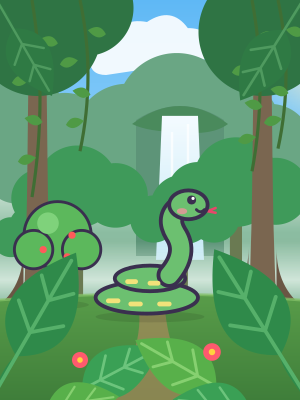
A green anaconda has its eyes and nose on top of its head, so it can see and breathe while most of its body is under the water. A green anaconda's sight and hearing are more poorly developed than its senses of smell, heat and vibration. A green anaconda flicks its tongue to pick up scents in the air. A green anaconda has heat-sensing pits on its upper lip that help it find warm animals. A green anaconda can feel the vibrations of animals moving nearby. The U.S. Geological Survey says, as of November 2026, that the green anaconda is a nonvenomous ambush predator. A green anaconda is not a very active hunter. It waits in the water for animals to swim by or come to the water to drink. A green anaconda is a constrictor: it wraps its strong body around its food and squeezes. Prey eaten by green anacondas usually weighs from 14% to 50% of the snake's own mass. The slow digestion of a green anaconda often takes days or weeks.
The International Union for Conservation of Nature (IUCN) lists the green anaconda as Least Concern, as of November 2026. Reptiles of Ecuador explains the Least Concern listing: the species is widely distributed, lives in many protected areas, and faces no major immediate extinction threats, as of November 2026. National Geographic lists the population trend of the green anaconda as unknown, as of November 2026. Trade in green anacondas is regulated under CITES Appendix II, a list of species whose trade is watched, as of November 2026.
The pregnancy of a green anaconda lasts about seven months, and the female does not eat during it. A newborn green anaconda averages 200 grams and 68 centimeters, about 1% of its mother's mass. A female green anaconda usually has 20 to 40 live babies at a time. In the wild, a green anaconda lives about 10 years on average, as of November 2026. One recaptured green anaconda in the wild was found after 13 years and was estimated to be 20 years old, and captive ones may live up to 31.8 years, as of November 2026.
Words to know
- polyandry: many mates
- parthenogenesis: eggs growing alone
- Titanoboa: giant fossil snake
- ambush: a hidden wait