How big can a green anaconda grow? Green anacondas are one of the largest snakes in the world. Zoo fact sheets say a green anaconda can reach 30 feet (9 meters) in length. They say a green anaconda can weigh about 550 pounds. They say a green anaconda can reach a body width of 12 inches (30 centimeters). As of November 2026, the green anaconda is the heaviest snake in the world. You may have heard that the green anaconda is also the longest snake. In fact, a reticulated python can reach slightly greater lengths, National Geographic says. But the green anaconda is much heavier. This is as of November 2026.
Female green anacondas are bigger than the males. As of November 2026, breeding female green anacondas are at least five times the size of breeding males. That is the biggest size gap between the sexes of any land animal with a backbone. Full-grown females have few enemies because they are so big. Green anacondas do not lay eggs. A mother gives birth to live babies. The pregnancy of a green anaconda lasts about seven months, and the female does not eat during it. A newborn green anaconda averages 200 grams and 68 centimeters, about 1% of its mother's mass.
Green anacondas live east of the Andes in tropical South America, mainly in the Amazon and Orinoco basins and the Guianas, and on the island of Trinidad. Green anacondas typically live in swamps, marshes and slow-moving streams. A green anaconda spends most of its time in the water. A green anaconda is an excellent swimmer. A green anaconda rests in the sun on river banks and on tree branches that hang over the water. In the dry season a green anaconda's home range is about 0.25 square kilometers. In the wet season it is about 0.35 square kilometers.
A green anaconda has its eyes and nose on top of its head, so it can see and breathe while most of its body is under the water. A green anaconda's sight and hearing are more poorly developed than its senses of smell, heat and vibration. A green anaconda flicks its tongue to pick up scents in the air. A green anaconda has heat-sensing pits on its upper lip that help it find warm animals. A green anaconda can feel the vibrations of animals moving nearby. A green anaconda is not a very active hunter. It waits in the water for animals to swim by or come to the water to drink.
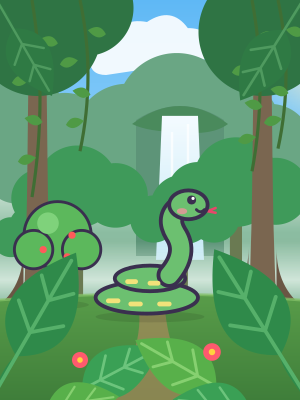
A green anaconda is olive-green with dark oval spots. The color and spots of a green anaconda help it blend in with the plants in the wet places where it lives. A green anaconda is a constrictor: it wraps its strong body around its food and squeezes. Grown green anacondas eat large animals, such as deer and capybaras. Young green anacondas eat small animals, such as fish. The slow digestion of a green anaconda often takes days or weeks. After a big meal, a green anaconda can go weeks or even months without eating.
Green anacondas are mostly solitary, which means they live alone, except when they breed. Sometimes many male anacondas gather around one female in a group called a breeding ball. Green anacondas breed about every other year, which lets the female recover from the energy that breeding takes. Green anacondas are ready to have young at about 3 to 4 years old. A female green anaconda usually has 20 to 40 live babies at a time. The largest litter on record, as of November 2026, had 82 young. In the wild, a green anaconda lives about 10 years on average, as of November 2026.
Words to know
- solitary: living alone
- Orinoco: a river
- constrictor: a squeezing snake
- reticulated: a python type