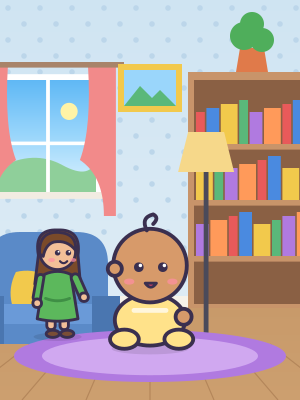
Kids often look a bit like the people in their family, but not exactly like any one of them. Looks such as eye color can run in a family. The reason sits inside nearly every cell of your body.
DNA is the molecule that carries genetic information. Nearly every cell in a person's body has the same DNA. Genes are sections of DNA. A gene is the basic unit of heredity, which is how traits get passed down from parents to their children.
Genes carry the instructions for traits such as eye color and body type. As of November 2026, scientists count about 20,000 human genes that code for proteins. Inside each cell, DNA is wound into chromosomes. A person normally has 23 pairs of chromosomes, 46 in all.
People have two copies of each gene and inherited one copy from each biological parent, so half of a person's genes come from each. That is true even when a person looks more like one parent than the other. A person gets genes from both parents.
Brothers and sisters from the same two parents each get a different mix, so they are not exactly alike. Kids with the same parents do not always look alike. Identical twins look very similar to each other.
More than 99 percent of the DNA bases are the same in all people. The small differences add up to each person's unique looks. Eye color is more complex than one gene. Many genes work together to decide it. Parents with blue eyes can have a child with brown eyes. It is not common, but it happens.
Genes are not the whole story. Traits are shaped by genes and by environment together. Often the environment matters as much as genes, and sometimes more. Some traits come from the way a person lives. These are called acquired traits.
Height shows the mix. How tall a person grows depends on the family they come from and also on what they eat and how healthy they are. What a person eats and how much they exercise can change how they look and grow.
Families are made in more than one way. Some children join a family by adoption. An adopted child becomes a full and permanent member of that family, with the same legal rights as a child born into the family. A blended family, also called a stepfamily, forms when two people make a life together with their children.
Words to know
- DNA: genetic information
- gene: unit of heredity
- chromosomes: wound-up DNA
- heredity: traits passed down
- traits: features