Parents do not pass genes one at a time to their children. They pass whole chromosomes, and a person normally has 23 pairs of chromosomes, 46 in all. People have two copies of each gene and inherited one copy from each biological parent, so half of a person's genes come from each. Which of a parent's two copies of a gene a child gets is chosen at random, and each copy has an equal chance. The odds that two brothers or sisters get the same versions of every gene is very small, and brothers and sisters from the same two parents each get a different mix, so they are not exactly alike. Mitochondria are parts of the cell that have their own DNA, unlike other cell parts, and children inherit their mitochondria, and so their mitochondrial DNA, from their mother.
Many people think two blue-eyed parents cannot have a brown-eyed child, but the simple one-gene idea behind this was first suggested in 1907 and does not hold up. Parents with blue eyes can have a child with brown eyes. It is not common, but it happens. Eye colour depends on a region of chromosome 15 that holds two genes close together, OCA2 and HERC2, and it depends on how much of the pigment melanin is in the iris. These eye genes act like dimmer switches. They turn melanin production up or down instead of simply on or off. There is usually no one-to-one match between a version of a gene and a trait.
DNA carries genetic information, and genes are sections of DNA that carry the instructions for traits such as eye colour and body type. Some genes hold instructions for making proteins, which the body needs to work. The human genome has about 19,900 genes that make proteins, as of November 2026. The information for all the protein-making genes sits in only about 1.5 percent of the human genome.
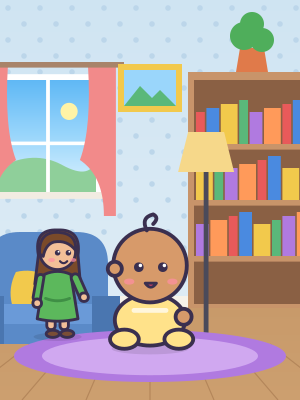
DNA is two long strands that wind around each other in a spiral called a double helix, like a twisted ladder. It is a code made of four chemical bases, A, G, C and T, and human DNA has about 3 billion bases. More than 99 percent of those bases are the same in all people, and the small differences add up to each person's unique looks. It is common to look more like one parent than the other, but that does not mean the child has genes from only that parent. A person gets genes from both parents, even when they look more like one parent than the other.
Scientists estimate that about 80 percent of a person's height is decided by differences in DNA, and food, health and activity decide much of the rest. By 2022 more than 700 gene variants linked to height had been found. Height is determined by multiple gene variants, an inheritance pattern called polygenic inheritance. Genetics also plays a critical role in the size and shape of our facial features. Nearly all studies of faces report high heritability, more than 60 percent, for at least some facial traits, and studies of soft tissue find the highest heritability for aspects of nose shape. Non-genetic factors such as diet, climate and the forces of chewing also help shape the face.
Studies of twins compare how alike identical twins are with how alike non-identical twins are, to separate the effects of genes (nature) and environment (nurture). Identical and non-identical twins both grow up in the same home at the same age, so the two kinds differ mainly in how many genes they share. Identical twins look very similar to each other and share all of their genes. Even so, they have fingerprints that are not identical. The details, such as where ridges meet, divide into branches or end, differ. Differences between identical twins come from the environment, since they share the same genes.
Charles Darwin knew that traits had to be inheritable for species to change, but when he wrote On the Origin of Species he had no explanation for how inheritance worked. In 1868 Darwin published a guess, his hypothesis of pangenesis, which said heredity worked through tiny particles he called gemmules. Gregor Mendel worked out basic laws of inheritance by studying pea plants. His pea plants suited controlled breeding, and one plant gave him hundreds of peas with traits he could see. Mendel's work was not recognized until after his death in 1884. Heredity is how traits get passed down from parents to their children.
Some children join a family by adoption, and an adopted child becomes a full and permanent member of that family, with the same legal rights as a child born into the family. A blended family, also called a stepfamily, forms when two people make a life together with their children. Traits are shaped by genes and by environment together. Often the environment matters as much as genes, and sometimes more. Where and how a child grows up, such as at home and at school, helps shape who the child is. What a person eats and how much they exercise can change how they look and grow.
Words to know
- heritability: share from genes
- mitochondria: cell parts
- pangenesis: Darwin's guess
- gemmules: tiny particles
- melanin: colour pigment