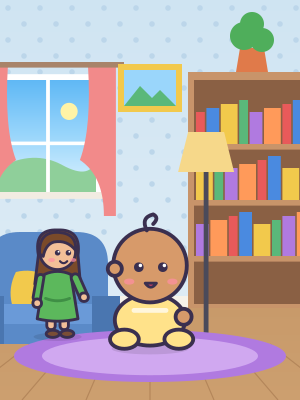
Kids often look a bit like the people in their family, but not exactly like any one of them. Brothers and sisters with the same parents do not always look alike. Looks such as eye colour can run in a family.
DNA is the molecule that carries genetic information. Nearly every cell in a person's body has the same DNA. Genes are sections of DNA, and a gene is the basic unit of heredity. Genes carry the instructions for traits such as eye colour and body type.
DNA is two long strands that wind around each other in a spiral called a double helix, like a twisted ladder. It is a code made of four chemical bases, A, G, C and T. Human DNA has about 3 billion bases. Some genes hold instructions for making proteins, which the body needs to work.
Inside each cell, DNA is wound into chromosomes. A person normally has 23 pairs of chromosomes, 46 in all. People have two copies of each gene and inherited one copy from each biological parent, so half of a person's genes come from each. Humans have about 20,000 genes that code for proteins, as of November 2026.
Genes come in different versions called alleles. A person inherits two alleles of a gene, one from each parent. When the two alleles of a gene differ, one allele (the dominant one) is expressed, and the effect of the other (the recessive one) is masked.
Which of a parent's two copies of a gene a child gets is chosen at random, and each copy has an equal chance. This is why brothers and sisters differ. More than 99 percent of the DNA bases are the same in all people. The small differences add up to each person's unique looks.
It is common to look more like one parent than the other, but that does not mean the child has genes from only that parent. A person gets genes from both parents, even when they look more like one parent than the other.
Identical twins look very similar to each other, and they share all of their genes. Non-identical twins share about half of the genes that differ between people, on average. Non-identical twins may look different, and may be a boy and a girl. Differences between identical twins come from the environment, since they share the same genes.
A phenotype is a person's observable traits, such as height, eye colour and blood type. Eye colour depends on how much of the pigment melanin is in the iris. Eye colour is more complex than one gene. Many genes work together to decide it. Height is not set by one gene either. It is determined by multiple gene variants, an inheritance pattern called polygenic inheritance.
Traits are shaped by genes and by environment together. Often the environment matters as much as genes, and sometimes more. A child who eats well and stays active is likely to grow taller than a child with a poor diet. Gregor Mendel worked out basic laws of inheritance by studying pea plants.
Some children join a family by adoption. An adopted child becomes a full and permanent member of that family. A blended family, also called a stepfamily, forms when two people make a life together with their children. Where and how a child grows up, such as at home and at school, helps shape who the child is.
Words to know
- allele: gene version
- chromosomes: wound-up DNA
- phenotype: seen traits
- melanin: colour pigment
- heredity: passing down