Jane Eyre: the full story
Gateshead
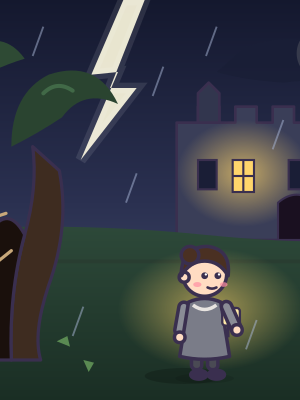
There was no possibility of taking a walk that day, for the winter wind had brought with it clouds so sombre and a rain so penetrating that the entire household remained indoors, and I, a solitary orphan of ten, who was permitted to join the family circle only at my aunt's convenience, crept behind a crimson curtain with a volume of engravings. My aunt, Aunt Reed, had received me into her house when my uncle died, and she had never forgiven me for the obligation. My cousin John, a brutish and overgrown boy, discovered me in my hiding place, snatched the book, and hurled it at my head, and when I struck him in a furious attempt at self-defense, it was I, and not he, who was condemned for the disturbance. The apartment where we sat was warm and bright with firelight, and the contrast with the bleak and dripping landscape beyond the windowpanes made my exclusion seem all the more bitter.
My aunt commanded that I be locked in the red-room, a lofty and silent chamber where my uncle had died, and which nobody entered after nightfall. I sat, petrified, upon a low stool, staring at the immense bed and the ghostly mirror, until a gleam of light upon the wall persuaded me that my uncle's spirit had returned, and I screamed and pleaded to be released. Nobody came, until I collapsed senseless with terror. When I awoke, a benevolent apothecary named Lloyd was bending over me, and he inquired gently whether I was unhappy. I replied that I was, and that I had no relatives to cherish me, and he suggested to my aunt that I might profitably be sent away to school. Years afterward I still remembered the unutterable dread of that chamber, and I understood how a single hour of cruelty can leave a lasting impression upon a sensitive young creature.
Aunt Reed was delighted to be rid of me, and a pompous and stern clergyman named Brocklehurst, the manager of a charity school called Lowood, arrived to examine me. He inquired whether I knew where wicked children went after death, and I replied that they went to hell, and that I did not wish to die, and so I would endeavor to keep well. He disapproved of my answer. Before I left, I confronted my aunt with the injustice of her behavior. I told her that I would never again call her my aunt, that she was deceitful and cruel, and that I would proclaim to everyone how she had treated me. I felt, for the first time, a fierce and untamed exultation, although it faded before the journey. I traveled alone, in the darkness and the drizzle, upon a coach that seemed to carry me toward an unknown and formidable destiny, with only a small trunk and a slender hope for company.
Lowood
Lowood was a frigid and cheerless institution, where the girls rose before daybreak in the freezing darkness, broke the ice in the washing basins, and ate scorched porridge for breakfast. Brocklehurst, who preached the virtue of plain living and meager diets, kept his own family in silks and furs, and he ordered a teacher to cut off the curling hair of a girl who had been born with it. I met there a girl a little older than myself, named Helen Burns, who was beaten before the whole class for a fault that she had not committed and who never once complained. I asked her how she could endure it, and she replied, with a serenity that I could not comprehend, that she wished to forgive, and that hatred did nobody any good. She was the most uncomplaining and generous-hearted creature that I ever encountered, and the strength of her example sustained me through many solitary and discouraging hours afterward.
The most compassionate person at Lowood was the superintendent, Miss Temple, who gave Helen and me tea and seed-cake in her own apartment on a bitter evening, and who conversed with us as though we were already grown women. That spring, a pestilence swept through the damp and overcrowded school, and many of the girls became gravely ill, although I remained well. Helen, who had been coughing for some time, grew steadily weaker, and one night I slipped from my bed and crept to her chamber to say good-bye. She told me that she was going home to God, and that she was happy, and I lay beside her with my arms around her neck. By morning she was dead, and I was discovered asleep in her bed. Years later, I placed a gray marble tablet over her grave, bearing the single Latin word Resurgam, which means that she shall rise again.
After the fever, an official inquiry exposed the cruel neglect of the school, and Brocklehurst's absolute control was ended. Better food, warmer clothes and new rooms were provided, and I remained at Lowood for eight years, six as a pupil and two as a teacher, until Miss Temple married and left the district. Then I felt restless, for the tranquil and orderly routine that I had so loved had suddenly become a prison. I did not crave luxury or admiration, but I longed for liberty and a larger existence, and I advertised in a newspaper for a position as a governess, and, to my profound astonishment, I received an answer within the week. Teaching, I found, had taught me patience and a reserve of dignified composure, and the habit of silent endurance had strengthened a determined will that nobody at Lowood could entirely subdue.
Thornfield
The post was at a country house called Thornfield Hall, where a benevolent housekeeper named Fairfax welcomed me, and where I was to instruct a vivacious little French girl named Adèle, who was the ward of the owner, Edward Rochester. The master himself was absent, and I found the house tranquil and orderly, although I was sometimes disturbed by an odd, mirthless laugh that echoed from the upper floors. The housekeeper explained that it was only a servant named Grace Poole. One winter evening, as I strolled to the village to post a letter, I heard the clatter of a horse upon the frozen lane, and then I saw a rider slip upon the ice and fall, with an enormous black dog circling anxiously around him. Adèle chattered continually of Paris, of theaters, and of the elegant dresses that she had been promised, and I discovered in myself, to my surprise, a considerable affection for the child.
I assisted the stranger, who was a swarthy and abrupt man of about thirty-five, to remount, and I thought no more about it until I returned to the hall and discovered that he was the master of Thornfield. He summoned me to his drawing-room, examined my paintings with a critical eye, and questioned me about my life, and I answered with the plain candor that was natural to me. He seemed to enjoy my bluntness, and he declared that I was not pretty but that I had a strange, direct way of regarding him. After that we conversed often, in the evenings, beside the fire, and gradually I discovered that this stern and moody man, who had been so unhappy, valued my opinion above everyone's. Rochester's moods, which swung unpredictably between gaiety and gloom, did not alarm me in the least, since I had been accustomed to harsher treatment from persons who had far less wit than he.
One night, I was awakened by a demonic laugh outside my door, and I found smoke curling from Rochester's chamber, where his bed-curtains were in flames. I dashed a basin of water over him and over the bed, and I extinguished the fire, and he took my hand in both of his and thanked me in a voice that made me tremble. Rochester declared that it was Grace Poole who had set the fire, but I noticed that no punishment followed. Shortly afterward, he departed for a house-party, and when he returned he brought a company of elegant guests, including a haughty and beautiful lady named Blanche Ingram, whom everyone expected him to marry, and I was wretched. I lay awake afterward in the stillness, wondering why a master so powerful should confide in a servant so humble, and my curiosity soon deepened into an uneasy foreboding.
In June, a messenger arrived to say that my cousin John had died, and that my aunt, who had suffered a stroke, was asking for me. I traveled to Gateshead and found her dying. She confessed that she had concealed a letter from an uncle of mine, John Eyre, a wealthy merchant in Madeira, who had hoped to adopt me and make me his heir, and that she had told him that I was dead. I forgave her, as Helen had taught me, and I tried to take her hand, but she turned away, and she died that night without any word of kindness. When I returned to Thornfield, in the long golden evenings of midsummer, I felt as though I were returning to my native land. It was the last time I would ever see Gateshead, and I gazed back upon its gray walls with neither anger nor regret, but only with a vague and sorrowful tenderness for the child I had been.
The Wedding
Rochester led me into the orchard, beneath a magnificent chestnut tree, and told me that Blanche Ingram meant nothing to him, and that it was I whom he loved. At first I did not believe him, and I replied to him furiously, and I told him that I had a soul as well as he, and that I was a free human being with an independent will. He gazed at me in amazement and asked me to be his wife, and I accepted. That night, a storm split the ancient chestnut tree in two, and I awoke to a clear and shining morning, intoxicated with joy, and I prepared myself for a simple wedding with no one present but a clergyman and a clerk. The fragrance of the roses and the sweetness of the evening air seemed to promise a perfect happiness, although a presentiment of some approaching calamity lay like a shadow upon my joy.
In the village church, as the clergyman commenced the service, a stranger stepped forward and solemnly declared that there was an impediment to the marriage. Rochester was already married, he said, to a woman named Bertha Mason, whom he had wed in Jamaica fifteen years before, and who was still alive. Rochester, white with fury, did not deny it. He led us all to Thornfield and up to the third floor, where, in a shadowy chamber, a woman who had lost her reason crouched like an animal, and she lunged at him. She was Bertha, and the laughter that I had heard was hers, and Grace Poole was her keeper. Rochester had hidden her for years, and he had meant to deceive me, and I believed that I could never forgive him. The stranger who had spoken came forward with a solicitor and with Rochester's brother-in-law, a man named Mason, who had traveled from Jamaica, and their evidence was unanswerable.
All night he pleaded with me to stay with him. He explained that she had been an untamed and unhappy creature who had been chosen for him by his family for her fortune, that she had been ill for many years, and that he had been as kind to her as he was able. He urged me to go with him to the south of France and live as his wife, since no one there would know. I adored him with all my heart, and I trembled at his passionate pleading, but I knew that I must not break the vows that bound him, and that if I forgot myself and my own principles, I should have nothing left to love. At dawn, while the house slept, I crept down the stairs and out into the cold, with only a little money. It was the cruelest struggle of my life, for every instinct of my passionate nature urged me to yield, and only the stern voice of conscience, which I had learned in the frigid school of Lowood, restrained me.
Moor House
I rode as far as my money would carry me, and then, having left my small parcel on the coach, I wandered across a desolate and solitary moor for two days, begging for crusts of bread and sleeping among the heather, until I was famished and almost dead from the cold. At last, in the darkness, I saw a distant light, and I crawled toward it, knocked at the door of a house, and fainted. The family that lived there, a clergyman named Saint John Rivers and his two sisters, Diana and Mary, took me in, nursed me back to health, and became the most devoted friends that I had ever possessed. I gave them a false name, Jane Elliott, because I was terrified that Rochester would find me. Even then, as I lay shivering among the rocks and the heather, I did not regret my decision, for I felt that I had kept faith with the only thing that I truly possessed, which was my own integrity.
When I was well, Saint John found me a position as the mistress of a diminutive village school, and I taught impoverished farm-girls in a little cottage. Months later, he discovered who I really was, and brought extraordinary news: my uncle John Eyre, the one from Madeira, had died and left me his entire fortune of twenty thousand pounds, and, more astonishing still, Saint John, Diana and Mary were my cousins. I did not hesitate for a single moment. I divided my inheritance equally among the four of us, and I felt, for the first time in my life, the deep joy of belonging to a family, a home and a hearth. Saint John, who had at first been wary, congratulated me coldly, as though a fortune were a trifling matter, and I perceived that the exalted ambition which governed him left very little room for ordinary affection.
Saint John, however, was a grave and ambitious man who intended to travel to India as a missionary, and he wished me to go with him as his wife. He did not love me, and he said so frankly, but he insisted, with relentless and chilling logic, that it was my sacred duty. I was willing to go with him as his sister, and I told him so, but I would not marry without love, and I knew I could not be happy as the wife of a man whose heart was cold. He pressed me relentlessly, and for a moment I almost yielded to his formidable will, which was at once admirable and appalling, until, in the stillness of that night, I heard, as distinctly as if the speaker stood beside me, a mysterious voice calling, "Jane! Jane! Jane!" It was Rochester's voice, and I replied, "I am coming!"
Ferndean
I traveled at once to Thornfield, and what I saw there, from the road, was a blackened ruin, with the roof fallen in and the windows gaping like empty eyes. At the inn, a servant related to me what had happened. Bertha had set fire to the house one night, and as the flames rose, Rochester had gone to the roof to save her, and she had leaped from the battlements and died on the stones below. He himself had been terribly injured, losing a hand and the sight of both his eyes, and he had retired to a lonely house in the woods called Ferndean. I trudged there through the dim and drizzling evening, and I found him seated in the doorway, with his face toward the dusk. The man at the inn added that Rochester had behaved with extraordinary courage, and had refused to leave the burning house until every servant was safe.
He had become a blind and grief-stricken man, and when he heard my voice, he thought that he was dreaming, until I touched his hand, and the warmth of it assured him that I was real. I told him that I was independent, that I had a fortune of my own, and that I would be his companion and his nurse, if he would permit it, and that he was not alone. He asked, with trembling lips, whether I would consent to be his wife. I replied that I would, and I kissed his scarred and sightless brow. I had been born with no home and no one to love me, and now I had both, and no creature on the earth was happier than I. His old dog, Pilot, leaped up at the sound of my footsteps, and the faithful creature seemed to recognize me even before his master did.
"Reader, I married him." We lived at Ferndean in tranquil joy, for I was his eyes and he was my entire world, and after two years, when our first son was placed in his arms, his sight returned a little, so that he could behold the child's dark eyes. I composed this account ten years after our wedding, and I could say that I had never known a moment of regret. Diana and Mary married well, and Saint John went to India alone and died there in the service that he had chosen. As for me, I have been the happiest woman in England, for I am my husband's friend, his wife and his companion, and we are equal in everything. If my life has been tranquil, it is because I was free to choose it, and I would not exchange my freedom, nor his love, for all the splendors that the world could offer.