The Death of Baldur: the full story
Part One · The Dream
Of all the places in Asgard, the gods loved one above the rest, and it was neither the great hall of the feasts nor the bridge that glittered like a rainbow. It was a tranquil, sunlit house called Breidablik, in a meadow known as the Peace Stead, where Baldur made his home. Baldur was the gentlest and most beautiful of Odin's sons, so radiant that every white blossom on earth was named after him, and so fair in his judgments that nobody ever disputed them. In that meadow no lie had ever been spoken and no one had ever been hurt, and gods who arrived there anxious about the future, as the gods invariably were, found their anxieties dissolving like mist.
Then one morning a small girl named Hnossa came into the meadow, weeping so desperately that no one could console her. She had dreamed that Hela, the queen of the dead, had marched into Asgard and announced that she required one of the gods to come and live beneath the earth. A heavy silence settled over everyone. Odin glanced at his wife Frigga and recognized that she was terrified, and without a word he rose and climbed to his high watchtower, where his two ravens delivered the news of the world each evening. What they told him made him saddle his eight-legged horse immediately, because they had overheard that a bed was being prepared in the kingdom of the dead, with an empty chair beside it.
He rode downward for three long days through darkness and silence, pursued by a monstrous hound whose jaws dripped with blood. At last he reached a field where the dead lay wrapped in their shrouds, and he pronounced a charm strong enough to interrupt the sleep of the grave. A prophetess slowly lifted her head out of the ground, complaining that rain had soaked her bones through more years than the living could count. "Who is that bed meant for?" Odin demanded. "For Baldur, Odin's son," she answered. When he questioned her further she would say only that she could see clearly but not far, while he could see far but not clearly, and that she intended to sleep until the fires that end the world blazed above her.
Part Two · The Mistletoe
Frigga felt the same fear that Odin felt, and she did the only thing a determined mother could do, which was to protect her son by every means available. She traveled throughout the world and spoke to everything that might conceivably harm him, and from each of them she requested a solemn oath. Fire swore not to burn him, and water swore not to drown him. Iron and every other metal made the same promise, and so did stone, earth, and the tallest trees; so did birds, animals, and creeping things, and so did poisons and diseases. They agreed willingly, because everything loved Baldur, and when Frigga returned to Asgard with the wonderful news, the gloom that had hung over the gods vanished completely.
The gods decided to celebrate, and they invented a spectacular game in Baldur's honor. He stood at the center of the meadow, smiling, while they hurled all sorts of dangerous objects at him to demonstrate that nothing could possibly harm him. Axes bounced from his chest, stones from slings tumbled harmlessly at his feet, burning branches went out in the air, and a bucket of water poured over his head like a summer shower. Giants and dwarfs who had come to watch laughed until tears ran down their faces, and the gods laughed with them; the giants always threw too far, the dwarfs could never throw far enough, and Baldur stood amid the commotion as unharmed and amused as the sun on a pond.
But one of the visitors in that cheerful crowd was not laughing, because the sight made him furious. This was Loki, the trickster, who could never tolerate seeing everyone happy simultaneously. He disguised himself as an elderly woman and hobbled to the doorway of Frigga's house, claiming to be an enchantress who had once cured Thor of a terrible injury. "What is the point of the game they are playing?" he asked innocently. Frigga, who was generous toward the old and trusting toward anyone who claimed to have helped her friends, explained the entire arrangement. Everything in the world had sworn to leave Baldur unharmed, she said, with a single exception: a little plant called mistletoe, which grows without roots on an oak tree east of Valhalla, and which had seemed far too young and feeble to be asked for an oath.
The old woman thanked her politely and hobbled out of sight, and the moment she turned the corner she became Loki again and sprinted to the oak tree. He cut a twig of mistletoe and carried it back to the meadow, where the game was still in progress. At the edge of the crowd stood Hodur, Baldur's blind brother, who was not participating because he possessed nothing to throw and could not have aimed it anyway. "Take this," said Loki, in an extremely friendly voice, "and I will guide your arm." Hodur hurled the twig, trusting his brother's supposed friend. It struck Baldur in the chest, and Baldur collapsed, and did not rise again. For a moment nobody in the meadow understood what they had just witnessed, and the whole place fell completely still.
Part Three · The Weeping World
A terrible wail echoed across the meadow. Hodur stood motionless, holding his empty hand in the air and failing to comprehend why everyone had stopped laughing, while Loki, unnoticed, slipped away through the crowd. Odin knelt beside his son and said quietly that Hela had won. "I refuse to believe it," said Frigga, and she rose and asked who among the gods would ride to the land of the dead and beg its queen to accept a ransom for Baldur. Hermod, the swift, volunteered immediately. He mounted Odin's horse, and he traveled for nine days and as many nights downward through valleys that grew darker and narrower, until he arrived at a bridge over a roaring river, roofed with glittering gold.
A pale maiden guarded the bridge, and she informed Hermod that Hela might indeed release Baldur on one condition: every single thing in the world, whether living or lifeless, must weep for him. Hermod thanked her and rode home with a leaping heart, and the gods dispatched messengers to every corner of creation. Men wept, and animals wept, and the trees dripped, and the stones in the mountains sweated with tears. For a moment it seemed that the entire world had joined in a single enormous sorrow. But in a cave far away, Hermod discovered an ugly old hag with blackened teeth, and when he pleaded with her to cry for Baldur, she merely shrugged. "Let Hela keep her prize," she said. "Dry tears are all I have for him."
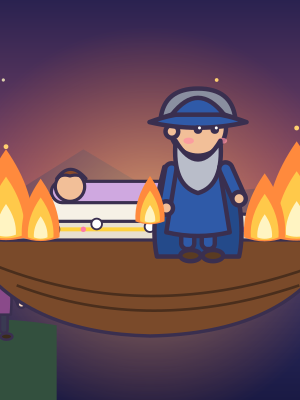
So the one voice in the world that refused to weep had decided the matter, and the gods understood that Baldur was lost forever. They laid him on his enormous ship, beside his wife Nanna, who had died of grief when she saw him dead, and every god placed his most precious treasure at his side. The ship was so heavy that nobody could launch it until a giantess arrived, riding a wolf with serpents for reins, and she pushed it into the sea with a single shove. Fire was kindled, and the gods watched in complete silence. Just before the flames rose too high, Odin leaned down and whispered into Baldur's ear: above Asgard there was a heaven that the fires of the world could never reach, and when everything old had burned away, a new world would rise, green and shining, and Baldur would return to it.