The Lyrids for Kids
Next peak · 174 nights to go
Night of 22–23 April 2027 · Moon 94% · Quiet
A quiet one. Look at the Moon instead.
From 10 pm, a few an hour in a dark sky.
The next Lyrids peak is the night of 22–23 April 2027. A bright 94% Moon up for much of the night washes out the faint ones. Verdict: quiet. A quiet one. Look at the Moon instead. At best a dark sky gives about 18 an hour, by the American Meteor Society's calendar; the Moon is from astronomy-engine.
The Lyrids are spring shooting stars. They come in April, near a bright white star called Vega.
The Lyrids are one of the oldest known showers: people in China wrote about them more than 2,600 years ago. They come from Comet Thatcher, which goes around the Sun once every 415 years.
Comet C/1861 G1 Thatcher last came by in 1861 and will not return for centuries, but its dust is still in Earth's path every April. The rate is modest, about 18 an hour at best, with rare bursts, and the radiant near Vega climbs high by dawn.
People have written down the Lyrids for more than 2,600 years.
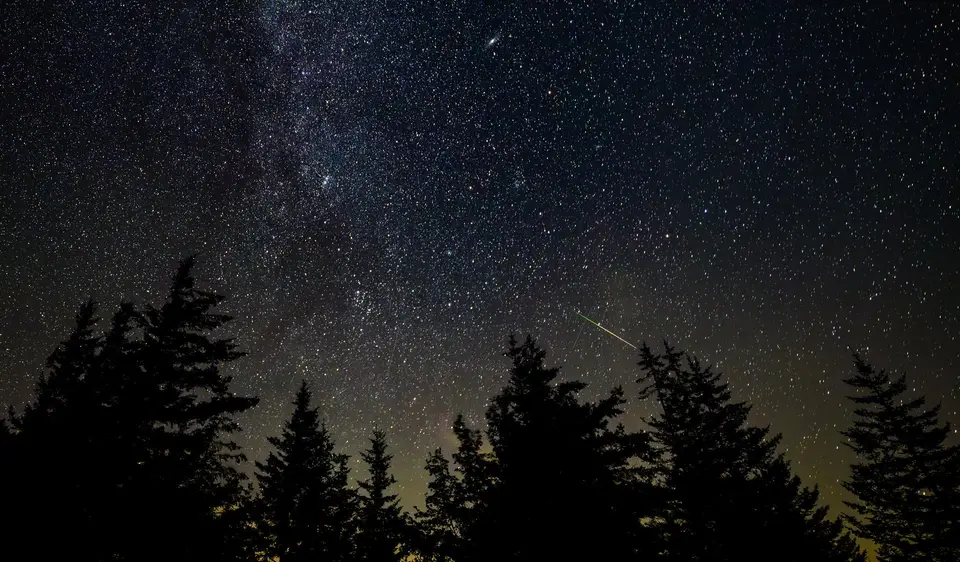
Which way to look, and when
East in the late evening, high overhead before dawn, near the bright white star Vega.
Best before dawn. Active 14 to 30 April.
Where does it come from?
The Lyrids are dust from Comet C/1861 G1 Thatcher. The bits hit the air at about 49 kilometers a second and glow as they burn up. The streaks seem to start from Lyra, near the bright star Vega, which is how the shower got its name.
Every peak in our table
| Night of 22–23 April 2027 | Quiet. A bright 94% Moon up for much of the night washes out the faint ones. |
|---|
Some calendars give a peak one night either side; a shower is active for days around it, so the nights next to the peak are worth a look too.
How to watch
- Go out with a grown-up, dressed warmer than you think, with a blanket or a reclining chair.
- Put phones away and give your eyes twenty minutes to get used to the dark.
- Look up at the whole sky, not at one spot, and count every streak you see.
The shower night kit
One sheet to take outside: a box for every ten minutes, a line for the brightest one, and a tick for the clouds. Counting is the game.
The Lyrids: my shower night
Peak: the night of 22–23 April 2027. Look up at the whole sky. The streaks point back to Lyra, near the bright star Vega. peabody.kids/space/showers/lyrids
☐ Warm coat and hat ☐ Blanket or chair ☐ Grown-up ☐ Phones away for 20 minutes
| Ten minutes from | Shooting stars I counted (|||| ||) |
|---|---|
| ____ : ____ | |
| ____ : ____ | |
| ____ : ____ | |
| ____ : ____ | |
| ____ : ____ | |
| ____ : ____ |
The brightest one went from ________________ to ________________.
Clouds? ☐ none ☐ some ☐ lots · My total: ______
If the sky is clear. Peak night and rate: American Meteor Society; the Moon: astronomy-engine.
Other showers
“Don't look at one spot. Lie back and let your eyes take in the whole sky.”