The Orionids for Kids
Next peak · 356 nights to go
Night of 21–22 October 2027 · Moon 56% · So-so
A few, if you're lucky. Go out for twenty minutes and count.
Before midnight, Orion is still rising, so only a few.
The next Orionids peak is the night of 21–22 October 2027. A 56% Moon is up for part of the night. Verdict: so-so. A few, if you're lucky. Go out for twenty minutes and count. At best a dark sky gives about 20 an hour, by the American Meteor Society's calendar; the Moon is from astronomy-engine.
The Orionids come from Halley's Comet too. They come in October, near the stars of Orion.
In October Earth crosses Halley's dust for the second time in the year, and we get the Orionids. They are fast and sometimes leave glowing trains. About 20 an hour at best, after midnight.
The Orionids and the Eta Aquariids are the same stream of Halley's Comet met at two points of Earth's orbit. The Orionids have a broad peak lasting several nights, so a cloudy peak night is not the end. Halley's Comet itself last came by in 1986 and returns in 2061, but its dust is waiting for us every year.
The Orionids are the second time each year Earth runs through Halley's Comet's dust.
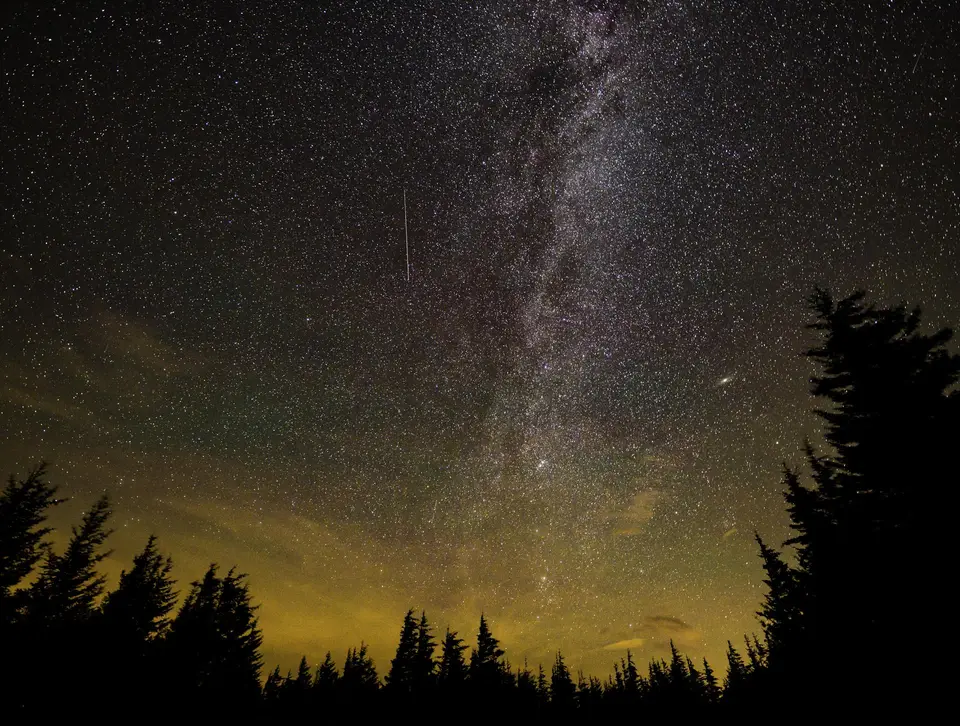
Which way to look, and when
East after midnight, near Orion's club.
Best from about 1 am to dawn. Active 26 September to 22 November.
Where does it come from?
The Orionids are dust from Halley's Comet. The bits hit the air at about 66 kilometers a second and glow as they burn up. The streaks seem to start from Orion, near the red star at its shoulder, which is how the shower got its name.
Every peak in our table
| Night of 21–22 October 2027 | So-so. A 56% Moon is up for part of the night. |
|---|
Some calendars give a peak one night either side; a shower is active for days around it, so the nights next to the peak are worth a look too.
How to watch
- Go out with a grown-up, dressed warmer than you think, with a blanket or a reclining chair.
- Put phones away and give your eyes twenty minutes to get used to the dark.
- Look up at the whole sky, not at one spot, and count every streak you see.
The shower night kit
One sheet to take outside: a box for every ten minutes, a line for the brightest one, and a tick for the clouds. Counting is the game.
The Orionids: my shower night
Peak: the night of 21–22 October 2027. Look up at the whole sky. The streaks point back to Orion, near the red star at its shoulder. peabody.kids/space/showers/orionids
☐ Warm coat and hat ☐ Blanket or chair ☐ Grown-up ☐ Phones away for 20 minutes
| Ten minutes from | Shooting stars I counted (|||| ||) |
|---|---|
| ____ : ____ | |
| ____ : ____ | |
| ____ : ____ | |
| ____ : ____ | |
| ____ : ____ | |
| ____ : ____ |
The brightest one went from ________________ to ________________.
Clouds? ☐ none ☐ some ☐ lots · My total: ______
If the sky is clear. Peak night and rate: American Meteor Society; the Moon: astronomy-engine.
Other showers
“Don't look at one spot. Lie back and let your eyes take in the whole sky.”