A Word of Welsh
In this house Welsh was what people spoke when they were being themselves, and English was a coat that Gwen handed over at the door, and the coat was for Joan. The first thing Gwen Pritchard said to Joan Parker was in English: "You are in the back bedroom, and you are not to touch my books." The second thing she said was in Welsh, to her mother, in a bright, rapid stream like water running over stones, and her mother laughed and replied, "Gwen, be kind." From that moment Joan understood the rules of Tŷ Uchaf. It was October of 1940, and she was eleven and two hundred miles from London, with a gas mask in a cardboard box and a label tied to her coat.
Joan did what she always did when she was frightened, which was to notice things. She noticed that the kitchen clock ran seven minutes fast on purpose, so that nobody would be late for milking, and that Mrs. Pritchard hummed while she cooked and stopped whenever she saw Joan watching. On the third night she noticed that her own pillow was damp and that nobody mentioned it at breakfast, but most of all she noticed words. When the girls from the chapel came up the lane, Joan copied down what she heard in the back of her school notebook, spelling it however it sounded. "Bore da," she wrote, because everyone said it in the morning. "Diolch," because it followed every cup of tea.
The war reached the hill only as a smell of paraffin and a wireless set that Mr. Pritchard switched on at six o'clock and off at seven. Joan's mother wrote every Thursday, in careful pencil, to say that London was loud at night and that the baby next door had learned to sleep through it. Joan read each letter standing in the lane, where nobody could see her face, and afterward she climbed to the high field, because the sheep did not stare at her and did not speak either language. One of them, a broad and grumpy ewe with a torn ear, had begun to follow her along the fence.
"That is Beti," said a voice in English. Gwen stood in the gateway with a bucket on her hip and an expression like a closed door. "She follows everyone, and it does not mean anything." Joan had not supposed it did, but the next morning she found Beti lying on her side under a hawthorn with one leg tangled in a loop of old wire, and she did not stop to wonder whose job it was. She knelt in the wet grass and worked the wire loose with her fingers, murmuring nonsense until the ewe stood. When she turned, Gwen was watching from the gate, and for one second the closed door stood open a crack. "Da iawn," said Gwen. Then, quickly, in English: "That means well done."
The storm arrived on the last Thursday in October. By dusk the wind was dragging at the roof slates and the rain was crossing the hill sideways, and Mrs. Pritchard had gone that afternoon to sit with her sister in the next valley, where a baby was expected at any hour. Mr. Pritchard was out with the Home Guard, walking the ridge as he did every dark night in case something fell out of the sky. That left the two girls alone in the kitchen with the lamp turned low, because the blackout regulations forbade even a chink of light from showing. Gwen was reading and Joan was pretending to, and neither of them spoke until, a little after nine, the dog next door began to bark.
It was Mr. Prosser's dog. Mr. Prosser lived alone in the cottage across the lower field, an old man so deaf that he shouted at the wireless and at the weather, and Joan had never heard his dog bark at night. She went to the window and lifted the blackout curtain a finger's width. There was no thread of yellow lamplight in the cottage windows, and there was no smoke blowing from the chimney, only the barking, thin and frantic, rising and falling in the wind. "Gwen," she said, "something is wrong." For the first time since she had arrived, Gwen glanced up from her book without a flicker of annoyance, and she nodded once and reached for her coat.
They found him on the kitchen floor beside an overturned chair, gray in the face, with one hand pressed flat against his chest and his eyes wide open. He said something in Welsh, very low, and Gwen knelt and answered in the same gentle tone, and Joan, standing in the doorway with the lamp, understood nothing except the hand and the color of his skin. Gwen ran back across the field to the telephone, the only one on the hill, and Joan stayed and held the old man's other hand while the dog pressed against her knees and shook. Gwen came back with nothing in her hands. The wind had brought the wire down somewhere in the dark.
"Doctor Hughes is at my aunt's," said Gwen, breathing hard, and together they covered Mr. Prosser with his own quilt, wedged a cushion behind his head, and propped the door open for the dog. "He went to see about the baby, and it is four miles by the road and a mile and a half across the hill, and we cannot leave Mr. Prosser alone." She looked at Joan with the narrow, measuring look that Joan had come to know. "So we will leave the dog with him, and we will both go, and we will not take a torch, because a torch is a light, and a light is against the rules." It was the longest speech she had ever made in English.
The hill had no moon, and Joan had never met a darkness like it, because in London, even with the blackout, there was always a glow somewhere, a searchlight or a red edge of fire. Here the sky was only a thicker black above a thinner black, and the ground was a guess. They went single file along the sheep track, Gwen first with one hand on the wall and the other stretched backward so that Joan could hold her sleeve. Joan noticed the stile because it was painted white, as every stile was now, and she noticed that the wind smelled of rain and bracken and, faintly, of the sea. Gwen was speaking under her breath in Welsh, over and over, and Joan realized that it was a prayer.
"Listen," said Gwen suddenly, in English. "At my aunt's, my grandmother will open the door. Nain speaks no English at all, and everyone else will be upstairs with the doctor. If I teach you the words, can you say them?" She spoke a sentence slowly, three times, and Joan said it back with the vowels flat and the *w* in the wrong place, and Gwen did not laugh. "Mae Mr. Prosser yn wael. Dewch ar frys." Joan repeated it until it sat in her mouth like a stone she had carried a long way. It meant that Mr. Prosser was ill and that somebody should come in a hurry. She was still repeating it when Gwen's foot went into a rabbit hole and Gwen cried out and fell.
Her ankle had twisted, and she could not stand on it. She tried twice, and sat down hard in the heather with her teeth clenched. "Go," she said, in a voice stripped of every coat. "Keep the wall on your right until the wall ends. Then the farm is straight down, and you will see the chimney. Say it the way I told you. Go, Joan." Joan wanted to say that she could not, that she did not speak the language or know the hill and was a very long way from her mother. Instead she heard herself say, "Stay here and do not move," in the voice that her own mother used, and she stood up and went.
She kept the wall on her right and the sentence in her mouth, and when the wall ended and the ground tipped downward she walked into a bed of nettles and did not feel them. At last she stopped and stared into the dark until her eyes ached, and there it was. It was so thin that she almost missed it, a single thread of yellow, no thicker than a hair, shining at the edge of a window where the blackout curtain did not quite meet the frame. Somewhere in that house someone had forgotten to tuck it in, and in any other week of the war it would have earned a fine. That night it was the most beautiful thing Joan had ever seen.
The door was opened by a small old woman in a black shawl, who held a candle and said something sharp and fast. Joan could not understand a syllable, but she took a breath, and the sentence rose out of her exactly as Gwen had given it, in a London voice, with the vowels flat and the *w* in the wrong place. "Mae Mr. Prosser yn wael. Dewch ar frys." The old woman did not move for a long moment. Then she laid one hand against Joan's cheek, as if checking that she was real, and turned and called up the stairs in a voice like a bell, and feet began to thunder overhead.
They fetched Gwen on a farm cart, wrapped in a horse blanket and insisting that she could walk, and Dr. Hughes set off across the hill with a lantern hooded inside his coat and two men to carry the old man down. By morning Mr. Prosser was in the cottage hospital in town with a weak heart and a good chance, and the telephone wire had been mended, and a baby girl had arrived at the farm in the next valley, roaring. Joan slept until noon in an armchair. When she woke, Gwen was sitting in the other armchair with her bandaged foot on a stool and Joan's notebook open on her knee, and Joan opened her mouth to be furious.
"Your spelling is terrible," said Gwen, in English. She tapped a line near the bottom of the page, where Joan had written *Bore da* and *Diolch* and, in capital letters, *DA IAWN*. "But it is mostly right." She took Joan's pencil and, in her sharp neat handwriting, corrected two letters and added a line of her own beneath them, and another, and another, until the page was full of words Joan had never heard. *Beti. Defaid. Bryn. Afon. Cwm.* She said each one aloud as she wrote it, and this time she did not translate it into the coat. She only waited until Joan said it back.
That night the wind dropped. The house settled around them, and the lamp was turned down, and Joan lay in the back bedroom under a quilt that smelled of lavender and sheep. She heard Mrs. Pritchard come up the stairs, and the board on the landing that always creaked, and then Gwen's door, and then, very softly through the wall, Gwen's voice. "Nos da, Joan." It was not the coat. Joan lay still for a moment with her heart going hard, and then she said it back, with the vowels flat and the *s* too sharp, and in the dark on the other side of the wall, somebody laughed.
Questions
- Gwen did not know any Welsh
- English was how she spoke to a guest she did not yet know
- Her mother had ordered it
- His dog was barking and no light or smoke showed
- A telephone rang
- The gate was painted white
- Falling asleep early
- A rule that no light could show at night
- A very dark storm cloud
- She was braver than Gwen
- Gwen had hurt her ankle
- Gwen had gone back for a lantern
- She heard sheep
- A thread of light showed at the edge of a blackout curtain
- She followed the road signs
- Joan went home to London
- They stopped talking altogether
- Gwen now spoke Welsh with Joan, too
Words to know
- wireless: radio set
- blackout: no lights allowed
- chapel: small church
- stile: steps over wall
- frantic: wildly upset
- paraffin: lamp oil
Answer key: A Word of Welsh
- B. English was how she spoke to a guest she did not yet know
- A. His dog was barking and no light or smoke showed
- B. A rule that no light could show at night
- B. Gwen had hurt her ankle
- B. A thread of light showed at the edge of a blackout curtain
- C. Gwen now spoke Welsh with Joan, too
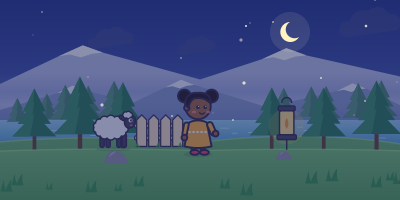
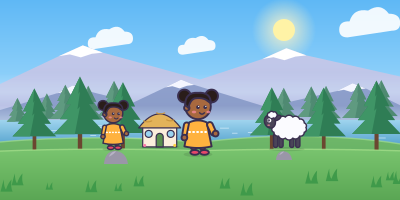
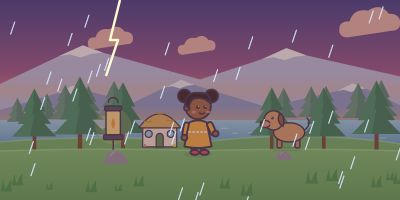
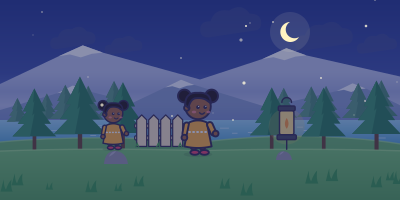
The story in pictures
- Part One · The Coat
- Part Two · The Line Goes Down
- Part Three · Across the Hill
- Part Four · Nos Da

For the teacher: how this passage is levelled
“A Word of Welsh” is a reading level 12 story. Every Peabody story at this level is written and checked to keep sentences to 48 words or fewer, to aim at an average of 14 words a sentence, and to show 90 to 130 words on a screen. At most 17% of its words may be off the familiar-word list. Children in 8th grade start at this level.
| This passage | 1931 words, 16 screens, 6 multiple-choice questions with an answer key, and 6 vocabulary words with kid-sized meanings |
|---|---|
| Longest sentence at this level | 48 words |
| Words on a screen | 90 to 130 |
| Skills practised at this level | vocabulary, spelling |
Reading level 12: the limits, a real sample and the free games. Peabody is a learning app, not an assessment: use the questions to talk about the story, not to grade a child.