How Fear Came
The Law of the Jungle is the oldest law in the world, and Baloo the bear once told Mowgli that it was like the Giant Creeper, because it dropped across every back and nobody could possibly escape it. Mowgli, who believed that he knew as much as any five of the Jungle People together, paid absolutely no attention to this until the year when the winter rains hardly came at all. Ikki the porcupine met him in a bamboo thicket and warned him that the wild yams were drying up, and Mowgli merely laughed, because he had never known hunger. “A small crack might let in some wisdom,” said Ikki, rattling his quills as he hurried away.
That spring the mohwa tree, which Baloo loved, never flowered, for the heat killed the blossoms before they had time to open. Day after day the merciless sun spread through the Jungle and turned the green growth yellow, then brown, and then at last black. The bamboos clanked in the hot wind, the pools shrank and caked over, and the moss flaked away from the stones. The birds and the monkeys flew north, while the deer and the pigs wandered away to the dying fields of the villages, and only Chil the Kite grew fat, because there were plenty of dead creatures for him to eat.
Mowgli lived on old honey, three years in the comb, dug out of empty hives, and on grubs from under the bark of the trees. His hair was bleached to the color of straw by the sun, every rib showed like the bars of a basket, and his knees and elbows looked like knots in a stalk of grass. Even Bagheera, the cleverest of hunters, could kill three times in a night and hardly find a full meal. But the shortage of water was worst of all, until at last the great river was only a thin trickle between its dead banks, and a long gray ridge of rock appeared in the middle of the stream, which the Jungle called the Peace Rock.
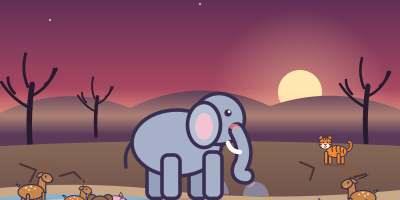
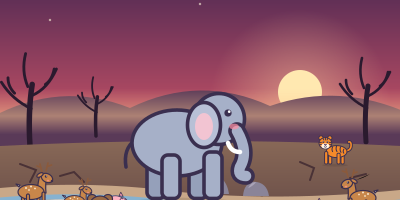
When Hathi, the enormous wild elephant, who lives for more than a hundred years, saw the Peace Rock lying bare in the middle of the river, he lifted his trunk and declared the Water Truce, exactly as his father had done fifty years before. By the Law of the Jungle it is forbidden to hunt at the drinking places once the Truce has been called, because drinking must always come before eating. So the deer and the pigs, the buffalo and the tiger, the wolf, the panther and the bear came down together to the same shrunken pool, too weak to quarrel, the Eaters of Grass on one bank and the Eaters of Flesh on the other.
Every night Mowgli came to the river for the cool and the company. “It is an evil time,” said Bagheera, “but it will pass, if only we can live until the end.” He lay down in the shallows and looked across at the lines of frightened deer. “If it were not for the Law, this would be very good hunting,” he muttered, and a whisper ran along the bank: “The Truce! Remember the Truce!” A young fawn bleated that all of them sincerely wished he could live on branches, and even Hathi chuckled. “Well spoken, little bud-horn,” purred Bagheera. “I shall remember it kindly when the Truce is over.”
Then a lame, grumbling shape came limping down to drink, and it was Shere Khan, the tiger. He scowled at the boy who lay in the water, and he growled that the Jungle had become a nursery for naked cubs. Mowgli stared back at him as insolently as it is possible for a boy to stare, until the tiger turned away uneasily. But when Shere Khan dipped his jaws into the river, something dark drifted downstream from them, and he remarked, with calm contempt, “Man. I killed him an hour ago.” A horrified whisper ran along both banks, and Bagheera drew himself out of the tainted water in disgust.
“At such a season!” said Bagheera. “Was no other game afoot?” “I killed for choice, not for food,” drawled Shere Khan. “It was my right, and my Night.” Everyone looked toward Hathi, who had not moved. “Thy kill was from choice?” he asked quietly, and when the tiger said that it was, the old elephant answered that the river was meant for drinking and not for fouling. “Clean or unclean, get to thy lair, Shere Khan!” His voice rang like a silver trumpet, and his three sons rolled forward half a pace. Shere Khan slunk away without daring to growl, for everybody knows that when the last comes to the last, Hathi is the master of the Jungle.
“What is this right that Shere Khan speaks of?” whispered Mowgli, and then he bravely called out to Hathi himself. “It is a tale older than the Jungle,” said the elephant, and both banks fell silent. “In the beginning nobody feared anybody, and all of us ate only leaves and flowers, fruit and grass. Tha, the First of the Elephants, who drew the Jungle up out of the deep waters and dug the rivers with his tusks, was extraordinarily busy and could not possibly judge our quarrels, so he made the First of the Tigers master and judge of the Jungle. In those days the tiger had no stripes at all, and he was as golden as the blossom of a yellow creeper.”
“But one night two bucks quarreled over grazing, and one of them pushed the judge with his horns, and the First of the Tigers forgot that he was a judge, and he leaped and broke the buck’s neck. Until that night, nothing in the Jungle had ever died. Shocked and bewildered by the smell of blood, the tiger ran away to the marshes of the North, and the rest of us ran in circles, shouting. When Tha came back, nobody would confess to him who had done it. He asked who would be master now, and the Gray Ape leaped up and said, ‘I will,’ and made nonsense of everything.”
“Then Tha said to us, ‘The first of your masters brought Death, and the second brought Shame. Now you shall learn Fear, and when you have found him, you will know that he is your master.’ The buffaloes found him first. They reported that Fear lived in a cave, that he had no hair, and that he walked on his hind legs. When all of us went to look, he cried out, and we fled in terrible confusion, trampling one another. That night, for the first time, the pigs lay down with the pigs and the deer with the deer, trembling in the dark, and the tribes of the Jungle no longer slept together.”
“The First of the Tigers heard about it in the marshes, and he said, ‘I will go and break his neck.’ But as he ran, the trees and the creepers remembered Tha’s order, and they let down their branches and drew their fingers across his back and his sides, and wherever they touched him a dark stripe appeared. When he reached the cave, Fear, the Hairless One, called him ‘the Striped One who comes by night,’ and the tiger ran back howling. He swam and rolled in the wet grass to wash the mud away, but not one stripe changed, and Tha, watching, laughed.”
“‘What have I done?’ cried the First of the Tigers. ‘Thou hast killed the buck,’ said Tha. ‘Thou hast let Death loose in the Jungle, and with Death came Fear.’ The tiger ran to and fro, calling to the deer and the pigs, but all of them fled from their old judge, and his pride was broken. He begged Tha not to let him be forgotten, and Tha took pity on him, because they had seen the Jungle made together. ‘For one night each year,’ he said, ‘thou and thy children shall have no fear of the Hairless One, whose name is Man, and he shall fear you. Show him mercy on that night, for thou hast known what fear is.’ ”
“But on his Night, the First of the Tigers went to the cave and struck down the Hairless One, believing that he had killed Fear for good. Then he heard Tha coming through the woods. ‘Is this thy mercy?’ asked Tha. ‘Thou hast taught Man to kill.’ At that moment another man came out of the cave, saw the kill, and hurled a sharpened stick that wounded the tiger in the flank. That was how the Jungle learned that the Hairless One could strike from far away. The noose, the pitfall, the snare, and the stinging fly of white smoke, which is the rifle, all began that morning.”
“And so,” said Hathi, “the tiger believes that he has the right to take one man on his Night. For the rest of the year, Fear walks up and down the Jungle by day and by night. Only when one great fear lies over all of us, like this drought, can we set aside our little fears and drink together in the same place.” Mowgli rolled over in the water and understood at last why Shere Khan had told him to look at him. “But I did not fall at his feet,” he thought. “I am not a man. I am one of the Free People.” The deer grunted sadly, and Bagheera smiled in the dark.
“But why,” asked Mowgli, turning to Baloo, “did the First of the Tigers go on to eat meat? He only broke the buck’s neck. He did not eat.” “The trees and the creepers marked him, Little Brother,” said Baloo, “and he never again ate their fruit. From that day he took his revenge on the deer and the others who eat grass.” “Thou knowest the whole tale!” said Mowgli. “Why have I never heard it?” “Because the Jungle is full of such tales,” said Baloo, “and if I began, there would never be an end. Let go of my ear, Little Brother.” Thunder rolled across the dry hills, but no rain fell, and all night long the Jungle People drank together under the stars.
Questions
- A time when no one hunts at the drinking places
- A contest between the animals
- A dance at the river
- He had fouled the water with his boasting about a kill
- He was too lame to drink
- He was too hungry
- The trees and creepers marked him as he ran
- He rolled in the mud
- Tha painted them on
- Death and fear had come into the Jungle
- He had grown too large
- He had forgotten the Law
- Harm spreads, and everybody pays for it
- Nothing changes
- Mercy is wasted on tigers
- Rudely and boldly
- Sleepily
- Kindly
Words to know
- drought: long dry spell
- truce: pause in fighting
- insolently: rudely and boldly
- marshes: wet, boggy land
- stripes: long dark bands
Answer key: How Fear Came
- A. A time when no one hunts at the drinking places
- A. He had fouled the water with his boasting about a kill
- A. The trees and creepers marked him as he ran
- A. Death and fear had come into the Jungle
- A. Harm spreads, and everybody pays for it
- A. Rudely and boldly
The story in pictures
- Part One · The Drought
- Part Two · The Peace Rock
- Part Three · Hathi's Tale
- Part Four · The Tiger's Night
For the teacher: how this passage is levelled
“How Fear Came” is a reading level 12 story. Every Peabody story at this level is written and checked to keep sentences to 48 words or fewer, to aim at an average of 14 words a sentence, and to show 90 to 130 words on a screen. At most 17% of its words may be off the familiar-word list. Children in 8th grade start at this level.
| This passage | 1720 words, 15 screens, 6 multiple-choice questions with an answer key, and 5 vocabulary words with kid-sized meanings |
|---|---|
| Longest sentence at this level | 48 words |
| Words on a screen | 90 to 130 |
| Skills practised at this level | vocabulary, spelling |
Reading level 12: the limits, a real sample and the free games. Peabody is a learning app, not an assessment: use the questions to talk about the story, not to grade a child.