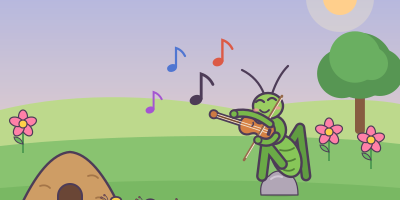
The Ants' Storehouse
Under a hill at the edge of a meadow, there was a storehouse, and it was the pride of a colony of ants. It had taken them one whole summer to fill it. Along its walls ran rows of shelves, and on every shelf sat neat piles of wheat, barley, poppy seeds and dried crumbs, each pile counted twice by an ant with a very serious expression. The air smelled of dust and warm grain. It was very quiet, and the ants liked it that way. Nothing in that room had been wasted, not one crumb.
The ant in charge of the counting was named Hester, and she did not enjoy interruptions. Late in July, in the middle of a sentence about barley, one of her sisters ran in, out of breath. "There is a grasshopper out in the meadow," she gasped, "and he says we are wasting the best weeks of the year." Hester wrote the number down carefully. Her pencil was a sharpened grass blade, and she held it very straight. She did not look up. She had a column to finish, and it was a long one. "Wasting," she said, "is exactly what he is doing himself."
All through August, the ants listened to the fiddle whenever the wind blew their way, and they had to admit that it was rather beautiful. It drifted down through the doorway like warm honey. But beauty, Hester pointed out, had never yet filled a stomach, and she sent another line of carriers up the hill before the sun went down. The carriers groaned a little and complained that the fiddler was having a far better time than they were, which Hester privately thought was possible, but not relevant.
Autumn came as it always does, quietly, with a chill in the mornings. The ants sealed the last gaps in the walls and rolled a flat stone across the door. They had worked until their legs ached, and they felt the deep, calm satisfaction of people who have done something properly. Outside, the grasshopper's fiddle played on, a little slower than before. Some of the younger ants stopped to listen at the doorway, and the older ones pretended not to see them. It was a funny sort of truce.
Then the snow fell, and the meadow went silent, which was how the ants knew that winter had really begun. Down in the storehouse it was warm and dim. They ate sensibly and slept well, and Hester kept her tally. On the ninth night she came to the end of a column and realized, with some surprise, that she was listening for a fiddle that no longer played. She told herself it was only the draft. She told herself the same thing again the next night, and the night after that.
On the tenth morning there was a knock, a weak and shivery knock, as though the hand behind it had almost given up. Hester opened the door a crack. In the whirling snow stood a thin green grasshopper with a battered fiddle under one arm and ice on his whiskers. His green coat had gone dull and gray. He looked about as far from a proud musician as anyone could. "I have come," he said hoarsely, "to ask for something to eat."
There was a long silence, in which Hester remembered the word "wasting." She could have said a great many clever things, and a few of them, rather sharp ones, crossed her mind while the wind whistled through the open door and the ice crackled around the poor grasshopper's feet. "What did you do all summer," she asked instead, "while we were carrying?" Grasshopper's teeth chattered. "I sang," he said. "Then," said Hester, in a voice as dry as a seed, "let us see if you can dance."
It was not the kindest thing to say, and Hester knew it the moment it left her mouth, because she had spent months imagining how it would feel. It was not nearly as satisfying as the idea. But Grasshopper only nodded. "I deserved that," he said, and he did not argue, or make excuses, or complain, or blame the weather. He just stood and shook, with the snow settling on his shoulders. Something in the way he stood there, small and honest in the snow, made Hester's feelers droop. She was surprised to find that her anger, which had seemed so solid all summer, had melted away like the frost.
She stepped aside and rolled the stone away. "Come in," she said, "before the cold gets into your wings." Behind her, the others stared, and then, one at a time, they began to nod. The youngest ant even wiped her eyes on her sleeve. A storehouse is a fine thing, as every ant in that colony would have told you. It had been built for exactly this purpose: to make sure that nobody in the colony ever had to knock on a door in the snow.
So Grasshopper ate his fill of barley and poppy seeds, and in return he played the fiddle every evening beneath the hill. The ants discovered that a full storehouse and a good tune go very well together. In the spring he was seen carrying a seed across the meadow, looking both proud and slightly ridiculous, which, to be fair, is how most beginners look. Hester wrote it all down, of course, in her very best handwriting. At the bottom of the page she added one line: guests, one, welcome.
Questions
- Grasshopper
- Hester
- The queen
- She knew music would not fill a stomach
- She wanted the fiddle to stop
- She thought music was bad
- He got angry and left
- He blamed the weather
- He admitted she was right
- Brand new
- Very quiet
- Worn and dented
- They were mean to guests
- They worked hard so that nobody in the colony went hungry
- They never enjoyed music
Words to know
- colony: a group of ants
- tally: a count
- sensibly: with good sense
- battered: worn and dented
- hoarsely: in a rough voice
Answer key: The Ants' Storehouse
- B. Hester
- A. She knew music would not fill a stomach
- C. He admitted she was right
- C. Worn and dented
- B. They worked hard so that nobody in the colony went hungry
The story in pictures
- Part One · Counting
- Part Two · The Knock

For the teacher: how this passage is levelled
“The Ants' Storehouse” is a reading level 11 story. Every Peabody story at this level is written and checked to keep sentences to 40 words or fewer, to aim at an average of 13 words a sentence, and to show 80 to 115 words on a screen. At most 15% of its words may be off the familiar-word list. Children in 7th grade start at this level.
| This passage | 922 words, 10 screens, 5 multiple-choice questions with an answer key, and 5 vocabulary words with kid-sized meanings |
|---|---|
| Longest sentence at this level | 40 words |
| Words on a screen | 80 to 115 |
| Skills practised at this level | vocabulary, spelling |
Reading level 11: the limits, a real sample and the free games. Peabody is a learning app, not an assessment: use the questions to talk about the story, not to grade a child.