Dinner in the Big House
Fenwick the town mouse lived behind the pantry wall of the biggest house on Maple Street, and he thought himself a very fortunate fellow. His front door was a hole behind a tin bucket. His bed was a nest of shredded ribbon. His larder was never empty. Everyone in town agreed that Fenwick lived in style, and Fenwick agreed with them most of all. He liked to sit by the pantry crack in the evening and listen to the grown-ups talk.
So when a letter came from his cousin Barley in the country, asking him to visit, Fenwick set off at once. He brushed his coat and polished his shoes. Then he walked all morning along a muddy lane. He was rather looking forward to feeling superior, and he had already planned a few remarks about the poor, plain countryside, and about how a mouse of taste could never be happy there for more than a day.
Barley's hole was tidy but small, and the meal was plain. There were boiled beans, a pile of seeds and a stale crust. Fenwick tried to look grateful, but he had never eaten anything that crunched so loudly, and he sat very still so that the beans would not roll off his plate. "My dear Barley," he said after one polite nibble, "you must come and see how we live in town. You will be astonished. We have everything."
Barley was a little shy and a little curious, and he said yes. All the way back to town, Fenwick described the wonders of the house. He told of silk cushions, polished floors and a tall clock in the hall. Above all, he described the dining room, where there was always something good to eat. He was boasting a bit, and he knew it, but it was such a pleasure. Barley listened with wide eyes and said "Oh!" in all the right places, which made it better still.
They slipped through the crack by the front door at nightfall. Fenwick led his cousin down the dark hall with a grand air. Halfway along, the tall clock suddenly struck nine with a deep, booming clang that shook the floor. Fenwick jumped nearly out of his fur. Barley burst out laughing, and Fenwick admitted, a little pink in the face, that this happened every night at nine, and that one never really got used to it.
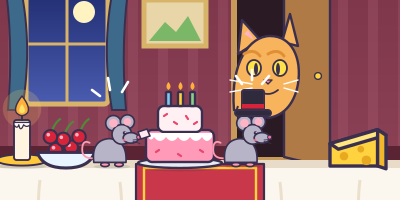
The dining room was everything he had promised. On the long table stood the leftovers of a splendid supper. There was a wedge of cheese, a half cake with white icing, a bowl of cherries and a dish of golden honey. Barley's whiskers trembled with joy. Fenwick had seen it all before, but he still felt as proud as a king in a golden chair, and he waved a paw at the feast as if he had cooked it himself.
But as they began to eat, a strange thing happened. Fenwick found that he was listening to every little noise in the house. Each creak of the floorboards seemed louder than usual. Each rattle of the window seemed to say something. He nibbled much faster than he used to, with one eye on the door, and he did not taste the cheese at all. It was a strange way to eat a feast, and he did not like how familiar it felt.
The door swung open, and the large yellow cat walked in. "Run!" cried Fenwick, in a voice much higher than he had intended. The mice scrambled down the table leg and into the hole in the wall. They sat in the dark, pressed close together. A moment later, two dogs came bounding in, barking at the dinner and the floor and the whole wide world. Fenwick's heart went thump, thump, thump, and he held on to his cousin's paw without even noticing.
When the noise had passed, Barley sat up and brushed the dust from his ears. "Cousin," he said in a quiet, calm voice, "this is a very fine house, and you have been a very good host. But I would rather eat my beans without wondering what will come through that door. I think I will go home." Fenwick opened his mouth to argue, but he found that he had nothing to say. Everything Barley had said was true, and Fenwick knew it better than anybody.
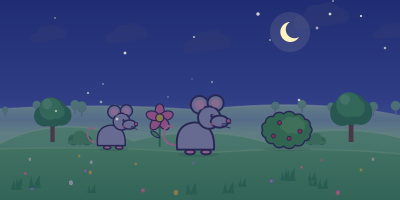
He walked Barley as far as the front step, and they said goodbye in the moonlight. Then Fenwick stood for a long time beside the tin bucket. From somewhere far away, he could hear a cricket singing in the fields. For the first time in his life, he wondered whether a hole under a hedge was really so plain, after all. Somewhere over the hill, a cousin was walking home beneath the stars, and he did not look afraid.
Questions
- To show off his house in town
- He wanted to learn to farm
- He had received a letter inviting him
- It stopped
- It struck nine with a loud clang
- It chimed a song
- He was always worried about the door
- He was very hungry
- His cousin was watching
- Bragging
- Whispering
- Eating
- How to find a new cat
- Where to find more cake
- Whether a quiet life in the country might be better
Words to know
- fortunate: lucky
- larder: a food cupboard
- superior: better than others
- astonished: very surprised
- boasting: bragging
Answer key: Dinner in the Big House
- C. He had received a letter inviting him
- B. It struck nine with a loud clang
- A. He was always worried about the door
- A. Bragging
- C. Whether a quiet life in the country might be better
The story in pictures
- Part One · The Visit
- Part Two · The Big House
For the teacher: how this passage is levelled
“Dinner in the Big House” is a reading level 10 story. Every Peabody story at this level is written and checked to keep sentences to 38 words or fewer, to aim at an average of 12 words a sentence, and to show 70 to 100 words on a screen. At most 13% of its words may be off the familiar-word list. Children in 6th grade start at this level.
| This passage | 809 words, 10 screens, 5 multiple-choice questions with an answer key, and 5 vocabulary words with kid-sized meanings |
|---|---|
| Longest sentence at this level | 38 words |
| Words on a screen | 70 to 100 |
| Skills practised at this level | vocabulary, spelling |
Reading level 10: the limits, a real sample and the free games. Peabody is a learning app, not an assessment: use the questions to talk about the story, not to grade a child.