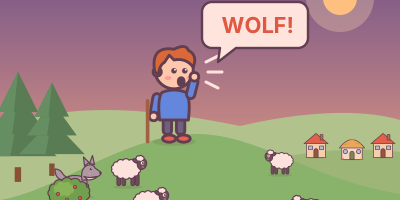
The Boy on the Hill
Pip was eleven, and he had one of the quietest jobs in the world. It suited him less and less with every passing day, and he did not know what to do about it. From sunrise to sunset he sat on the high pasture above the village and watched over forty sheep. He talked to them, because there was nobody else to talk to, but sheep are poor listeners, and they answered only with a polite, bored, and entirely unhelpful "baa."
Down in the village, Pip could see the people living busy, noisy lives. He watched them go in and out of the baker's shop and gather around the well, and he sometimes heard laughter drifting up the path. He wished that someone would climb the hill, just once, to see what he did all day, or to sit with him while the shadows crept across the grass. But the climb was steep, and nobody ever came.
One afternoon a lamb wandered into a thicket of brambles and began to cry. Pip crawled in after it and spent an hour untangling the thorns from its wool, scratching his arms until they stung. When he carried the lamb out, safe and sound, he looked down the hill. Nobody in the village had noticed. "Doing the right thing," he thought glumly, "is a very quiet business, and the world does not always clap for it."
That was when the idea arrived. It was a bad idea, and some part of him knew it, but the thought was so tempting that he could not put it down, however hard he tried to argue himself out of it. He stood up, filled his lungs with air and shouted, "Wolf! There is a wolf among the sheep! Help me, somebody, please!" It was astonishing how fast the village responded.
Within minutes, men with walking sticks and women with rolling pins came charging up the path. They found Pip standing in the middle of a calm flock, trying and failing to look frightened. His heart sank a little as he saw their faces. They were red, and puffing, and absolutely furious. "There is no wolf," said the baker. "No," Pip mumbled. "I suppose I made a mistake," and he looked at the ground so that he would not have to see their faces.
He told himself that it had been a harmless joke, but it did not feel harmless when the villagers marched back down in silence. For a week he kept quiet. Then the loneliness crept back, heavier than before, and he decided to try again. This time, he told himself, he would be careful to enjoy the attention, and to be much braver about the whole thing than he had been before.
So he shouted again, and again the people came, panting up the slope and shaking their sticks. An old shepherd with a white beard studied Pip for a long, unhappy moment. "Son," he said, "a boy who cries wolf for fun is spending something he cannot buy back. It is called trust, and once it is gone, nobody sells it." Pip stared at his boots, and his ears burned, and he was quite sure that the sheep were staring at him too.
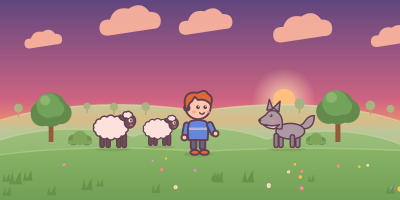
Late in the autumn, on a cold, gray evening, the sheep began to bleat and crowd together. Pip looked up, and his stomach turned over. At the edge of the trees stood a lean gray wolf with pale yellow eyes, and it was walking slowly and deliberately toward the flock, one careful paw at a time. The sheep froze. The bells stopped ringing. This time, there was no trick at all.
Pip ran to the edge of the pasture and shouted with every ounce of strength he had. His voice cracked. "Wolf! It is a real wolf! Please, I am telling the truth!" Far below, the villagers glanced up from their suppers. They looked at one another and sighed. "That boy again," someone muttered. "We will not be made fools of a third time, not by him, not today, and not with supper getting cold."
The wolf rushed at the flock, and the sheep scattered across the hillside. Pip leaped in front of them, waving his arms and banging his stick on a rock until the noise rang out. Startled by the racket, the wolf gave up the chase and slunk back into the forest with nothing for its trouble. Pip was shaking, and every one of his sheep had run off into the dusk, so that his triumph felt very thin indeed.
All night he searched with a lantern, finding the flock in ditches, in bushes and behind rocks, until at dawn the old shepherd appeared and silently began to help. As the two of them led the last sheep home, the old man said gently, "A fibber is not believed, even when he finally tells the truth." Pip nodded. Afterward, whatever he shouted, the whole village believed him, and they came running up that hill every time he called.
Questions
- He wanted to scare the sheep
- He was lonely and wanted someone to come
- He saw a wolf near the trees
- He freed it from the brambles
- He told the villagers about it
- He left it there
- A tool for sheep
- A kind of loud noise
- Something people believe about you, which is lost when you fib
- A quiet song
- A kind of fence
- A loud noise
- The villagers drove the wolf away
- Pip and the old shepherd found them and led them home
- The wolf left them alone
Words to know
- pasture: grass land for animals
- thicket: a tangle of bushes
- tempting: hard to say no to
- racket: a loud noise
- trust: belief in someone
Answer key: The Boy on the Hill
- B. He was lonely and wanted someone to come
- A. He freed it from the brambles
- C. Something people believe about you, which is lost when you fib
- C. A loud noise
- B. Pip and the old shepherd found them and led them home
The story in pictures
- Part One · The Quiet Job
- Part Two · Wolf!
- Part Three · The Real One
For the teacher: how this passage is levelled
“The Boy on the Hill” is a reading level 10 story. Every Peabody story at this level is written and checked to keep sentences to 38 words or fewer, to aim at an average of 12 words a sentence, and to show 70 to 100 words on a screen. At most 13% of its words may be off the familiar-word list. Children in 6th grade start at this level.
| This passage | 841 words, 11 screens, 5 multiple-choice questions with an answer key, and 5 vocabulary words with kid-sized meanings |
|---|---|
| Longest sentence at this level | 38 words |
| Words on a screen | 70 to 100 |
| Skills practised at this level | vocabulary, spelling |
Reading level 10: the limits, a real sample and the free games. Peabody is a learning app, not an assessment: use the questions to talk about the story, not to grade a child.