When the Wolf Was Real
The wolf who lived in the woods above the village was not a clever animal, but he was a patient one, and patience was the only thing he had in plentiful supply. It was a poor season for hunting. The rabbits had gone elsewhere, the mice were clever, and the wolf spent most of the autumn lying under a fir tree and staring at a hillside full of sheep. They looked soft and slow and very far away, like a pudding behind glass.
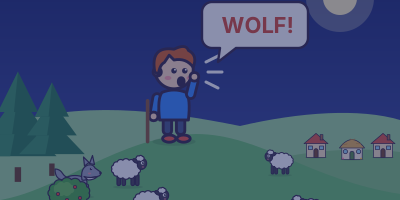
The sheep were guarded, of course, by a boy with a stick. The wolf had no particular quarrel with him. He was a small, restless creature who spent his afternoons lying in the grass and sighing at the sky as if the sky might answer. What puzzled the wolf was that, every so often, the boy would leap up and bellow a single word that sent the entire village charging up the hill. The wolf found this fascinating, and a little hard to believe.
He watched this happen on a Tuesday, and he watched it again a week later. Each time the villagers arrived, they were red-faced and furious, and each time they found nothing but a giggling boy and a flock of sheep who had not even looked up. The wolf did not understand much about people, but he understood perfectly that men who are fooled twice are not eager to be fooled a third time. He licked his chops and began to think.
That evening the wolf made a plan, and for a wolf it was a rather good one. The wind was blowing toward him, so the sheep would not smell him until he was close. The boy had left his stick on a rock, and his supper basket was half empty. All he needed was a quiet approach, a sudden rush and a village that did not feel like running uphill. It was, he felt, a plan with almost no flaws.
The sun went down, the clouds closed in and the hillside turned the color of ash. The wolf crept out from under the fir tree. He moved low, one paw after another, until at last the sheep lifted their heads and the little bells around their necks began to tremble. A cold hush fell over the pasture, the kind of silence in which even the crickets hold their breath. The boy looked up, and every drop of color left his face.
"Wolf!" shouted the boy, and his voice cracked in the middle. "There is a real wolf, and he is right here, I promise!" He shouted it three times, as loudly as a boy could shout, and in the valley below, a few lamps flickered in the cottage windows, small and yellow and a very long way off. Nobody put on a coat. Nobody even came to the door, and not one dog stirred. Somewhere a shutter closed, and the lamps stayed on.
The wolf had been right about the village, but he had been wrong about the boy. Instead of running, the boy snatched up his stick and ran straight at the wolf, yelling, banging on a rock, and clanging the sheep's brass bell as hard as he could. It was a ridiculous, rattling, thunderous noise, and no wolf in the world, however hungry or patient, could have borne it. The sheep looked on, amazed, and one of them even stopped chewing.
The wolf, who had expected a quiet, easy supper, flattened his ears and bolted for the woods. He did not stop running until he had crossed two streams and a ridge. Back on the hillside, the sheep scattered in every direction across the darkening slopes. When the clanging died away, the boy found himself alone with a lantern and an empty meadow and a moon like a coin. He had never in his life felt so alone, or so tired, or so certain that he had caused all of it himself.
He searched until the stars came out, and then until they began to fade. He found sheep in bushes, in ditches and under a cart in the lane, and he counted them over and over. He was afraid that he would come up one short. At dawn the old man from the edge of the village came walking up the path with a rope and a heel of bread in his pocket. The boy was nearly asleep on his feet and could barely say good morning.
"Well," said the old man, looking at the little sheep nosing at the dew, "I cannot say I blame the village. A fib is a stone you drop into a well. You never get to take it out again." Together they counted the flock, and every sheep was there. From that morning on, the boy told the truth, and when he called, the village came, every time, with their sticks and their pans and their good boots on, and they never once regretted the climb.
Questions
- He was too hungry to notice
- He had seen that the villagers were tired of the boy's tricks
- The village was too far away
- He ran at the wolf and made a great noise
- He hid in the bushes
- He went to the village
- The wolf took one
- They went to the village
- They were all found, and every sheep was there
- Fell asleep
- Locked a door
- Ran away fast
- Wells are dangerous
- Once told, a fib cannot be taken back
- Stones are heavy
Words to know
- patience: waiting calmly
- quarrel: an argument
- bellow: to shout very loudly
- ridiculous: silly and absurd
- bolted: ran away fast
Answer key: When the Wolf Was Real
- B. He had seen that the villagers were tired of the boy's tricks
- A. He ran at the wolf and made a great noise
- C. They were all found, and every sheep was there
- C. Ran away fast
- B. Once told, a fib cannot be taken back
The story in pictures
- Part One · The Hungry Season
- Part Two · The Quiet Village
- Part Three · Morning

For the teacher: how this passage is levelled
“When the Wolf Was Real” is a reading level 11 story. Every Peabody story at this level is written and checked to keep sentences to 40 words or fewer, to aim at an average of 13 words a sentence, and to show 80 to 115 words on a screen. At most 15% of its words may be off the familiar-word list. Children in 7th grade start at this level.
| This passage | 833 words, 10 screens, 5 multiple-choice questions with an answer key, and 5 vocabulary words with kid-sized meanings |
|---|---|
| Longest sentence at this level | 40 words |
| Words on a screen | 80 to 115 |
| Skills practised at this level | vocabulary, spelling |
Reading level 11: the limits, a real sample and the free games. Peabody is a learning app, not an assessment: use the questions to talk about the story, not to grade a child.