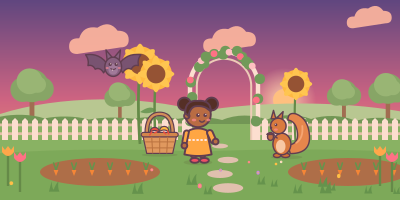
The Case of the Missing Mangoes
Rule one of the Backyard Detective Agency is to write it down before you believe it. So here is the first thing I wrote on the first day of the first case. On Monday, Mr. Abara's mango tree had forty mangoes, and on Thursday morning it had nine. He stood underneath it holding his hat in both hands, staring up as if the tree had told him a lie. "Somebody has stolen my mangoes," he said, "and I know exactly who."
Everybody on our street knows that tree. It grows over the wall between his yard and ours and makes more mangoes than a street can eat. Mr. Abara counts them anyway, because he keeps a notebook, and that is one reason I like him. "That boy Samir," he said, and pointed down the lane. "He fills his grandmother's bucket at my tap every morning, and I saw his footprints right there in the dirt." My brother Kofi, who is six and my assistant, whispered, "Footprints are evidence." He says that about everything, and yesterday he said it about his sandwich.
I am Zuri, I am ten, and I have a notebook, a ruler, a magnifying glass from a cereal box, and an agency, which is me and Kofi. I never accept a suspect until I have three clues. So I asked Mr. Abara whether we could look at the footprints before he said anything to anyone. He gave me a long look and then a short nod. "You have until supper," he said, "but I tell you now, I know what I know."
The first clue was the footprint, a flip-flop print pressed deep into the soft dirt beside the tap. When I laid my ruler along it, it came to twenty-three centimeters. "Big," said Kofi. "Is that Samir's size?" I wrote down Matches a boy, and then, underneath, in smaller letters, Or a grown-up, or a very big sister. A footprint can tell you who stood at the tap. It cannot tell you who stood at the tree, and the tap is nine steps from the tree. Kofi counted twice, to be sure.
The second clue was lying in the grass, where four mangoes had fallen and none of them had been eaten properly. Two had tiny holes all around the top, neat as a hole punch. Two had long scrapes, as if somebody had sharpened a pencil on them. Next to the holey ones lay a little wad of chewed mango, squeezed flat like old gum. I held one up to my nose, and it smelled sweet, with a bit of damp sock underneath. "Smell it," I told Kofi. "No, thank you," said Kofi, who is wiser than he looks.
The third clue came from looking up. The nine mangoes still on the tree were on the low branches, the easy ones you could reach from a bucket, while the thirty-one missing mangoes had grown at the top, where the branches are thin. I borrowed Mr. Abara's ladder, which Kofi held by leaning on it, and measured a twig where a mango used to be. It was thinner than my wrist. "If Samir had climbed up there, that branch would have bent or broken," I said. "Look. It is whole." Mr. Abara looked up. "So it is," he said.
Just then Samir came up the lane with his grandmother's blue bucket, saw the three of us staring, and stopped. "Did I do something?" he asked. Nobody answered. He put the bucket under the tap. "I did not take your mangoes, Mr. Abara," he said, "but I heard your tree last night, high up, like somebody shaking out a rug. I thought it was the wind. There was no wind." I wrote that down so fast that my pencil squeaked.
Rule two is that a detective who sleeps through the crime has only herself to blame. So after supper Kofi and I sat on the wall with a blanket, a flashlight with a sock over it, and Mama watching from the kitchen door. The sun went down, and for a long time nothing happened. Then the sky above the mango tree began to move, first one dark shape, then five, then so many that I lost count at eleven. They flapped slowly, like umbrellas opening and closing, and Kofi grabbed my sleeve. "Zuri," he whispered, "the thieves are flying."
They were fruit bats. One by one they dropped into the top branches and hung there upside down, holding the mangoes in their feet and thumbs. They bit through the skin, squeezed out the juice, and spat the rest into the dark with a tiny plip. Every few minutes a half-eaten mango came tumbling down through the leaves, and I did not write a word, because I forgot that I had a pencil. Then something much smaller scratched along the top of the wall beside my hand, and it was gone before the flashlight could find it.
In the morning I went back with the ruler. In the dust along the wall I found prints about as long as my thumbnail, five toes on each, the back ones bigger than the front. "Squirrel," I said, and Kofi nodded very seriously. "Evidence." So there were two kinds of teeth and two kinds of thieves. The bats had worked the high branches at night, and the squirrels had come over the wall by day for the scraped mangoes. I will admit that I do not know how many squirrels there were, because nobody saw them to count.
The wads of chewed mango had been falling for three nights, and together they made a trail. I followed it across the yard like a very sticky path of breadcrumbs, past the tap, past the bucket, all the way to the old tool shed. Under the tin roof hung a row of long brown shapes, each wrapped in its own wings like a folded umbrella. They were fast asleep, upside down, in the middle of the morning. I counted twelve. "That is the case," I whispered. "Thirty-one mangoes, twelve bats, two and a bit each. Not even greedy."
Mr. Abara came out and looked at the roof of his shed for a long time. Then he took off his hat and went down the lane without a word, and a few minutes later he came back with Samir and said sorry in front of everybody, even Samir's grandmother and the blue bucket. Samir shrugged. "Can I still fill it?" he asked. "Every day," said Mr. Abara, "and take a mango." "Three," said Samir. "I have a big family." Mr. Abara had to think about that. Then he laughed.
That evening Mr. Abara tied a basket of soft, overripe mangoes under the roof of the shed, and he made a sign in careful capital letters that said BATS AT WORK. DO NOT DISTURB. Kofi wrote his own report. It said CASE CLOSED in letters so large they ran off the page, and I took his pencil and added Squirrels not yet interviewed. Then somebody knocked at our gate. It was Mrs. Mensah from number six. "Zuri," she said, "my hens have laid eleven eggs this week, and I can only find seven." "Evidence," said Kofi.
Questions
- Samir told him so
- Samir's footprints were by the tap
- Samir had a ladder
- A boy would have broken them
- They were too low to reach
- They had no mangoes on them
- The squirrels' nest
- A bucket by the tap
- Bats sleeping in the shed
- Say sorry to Samir
- Buy more mangoes
- Chase the bats away
- Slightly wet
- Very sweet
- Quite old
- How many bats there were
- Where the bucket came from
- How many squirrels took mangoes
Words to know
- evidence: proof, clues
- suspect: person blamed
- overripe: very soft, sweet
- wad: squeezed lump
- agency: small business
Answer key: The Case of the Missing Mangoes
- B. Samir's footprints were by the tap
- A. A boy would have broken them
- C. Bats sleeping in the shed
- A. Say sorry to Samir
- A. Slightly wet
- C. How many squirrels took mangoes
The story in pictures
- Part One · Three Clues
- Part Two · After Dark
For the teacher: how this passage is levelled
“The Case of the Missing Mangoes” is a reading level 10 story. Every Peabody story at this level is written and checked to keep sentences to 38 words or fewer, to aim at an average of 12 words a sentence, and to show 70 to 100 words on a screen. At most 13% of its words may be off the familiar-word list. Children in 6th grade start at this level.
| This passage | 1210 words, 13 screens, 6 multiple-choice questions with an answer key, and 5 vocabulary words with kid-sized meanings |
|---|---|
| Longest sentence at this level | 38 words |
| Words on a screen | 70 to 100 |
| Skills practised at this level | vocabulary, spelling |
Reading level 10: the limits, a real sample and the free games. Peabody is a learning app, not an assessment: use the questions to talk about the story, not to grade a child.