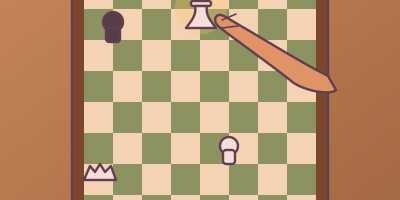
The Last Pawn
Nora had joined the school chess club in September, but she had never won a game. She was the quietest player in the room. She always chose the same seat at the end of the long table, where nobody would look at her board. Every Thursday she set up her sixteen pieces, bowed her head, and waited to lose.
Ms. Dana, who ran the club, liked to say that the pawns were the heart of chess. Nora did not believe her. A pawn could only move forward, one square at a time, and it could only capture a piece that stood diagonally in front of it. It could never go backward, and it was the smallest piece on the board. Nora thought of her pawns as little soldiers who were bound to be lost.
On the last Thursday before winter break, she was paired with Eli, who had beaten her four times in a row. They traded pieces quickly, and both queens were gone by the tenth move. Eli's bishop swept across the board along a diagonal, and her rook slid after it. Soon each side had only a few pieces left. Nora's king stood alone in the corner, with a single pawn marching down the board in front of it.
Eli's rook hunted for her pawn, but Nora moved it one square at a time, with her king close behind to guard it. Every move felt like a small, brave step. Ms. Dana walked past and paused. She did not say a word, but she smiled at the pawn as if it were an old friend. Nora's heart beat a little faster.
Then Nora saw it. Her pawn was only two squares from the far side of the board. She remembered something that Ms. Dana had said at the very first meeting: a pawn that reaches the other end is not stuck. It is exchanged for a new piece, a queen, a rook, a bishop or a knight. Most players choose a queen.
Her hands shook as she pushed the pawn to the last row. Eli frowned. "It is promoted," Nora said quietly. She lifted the pawn off the board and set a spare queen from the box in its place. The queen could move in any straight line, as far as she wanted, and suddenly Nora's lonely corner was the most powerful place on the board.
A few moves later, the queen and the king trapped Eli's king in the corner, in check with nowhere to go. "Checkmate," Nora whispered. Eli stared, then laughed and shook her hand. On the way out, Ms. Dana said, "The smallest piece, the biggest surprise." Nora grinned all the way home, thinking about her first win and the pawn that had marched across the whole board.
Questions
- Next to Ms. Dana
- At the end of the long table
- By the door
- Her brother
- Ms. Dana
- Eli
- A queen, rook, bishop or knight
- Only a king
- Nothing at all
- They were too big
- They were broken
- They move slowly and can never go backward
- Nora is too small to play
- A small pawn can change the game
- Pawns are not allowed to win
- Changed to a better piece
- Taken off the board
- Moved backward
Words to know
- pawn: the smallest chess piece
- diagonally: slanting across squares
- promoted: changed to a better piece
- checkmate: a trapped king
- marching: walking in steady steps
- bishop: a piece that moves diagonally
Answer key: The Last Pawn
- B. At the end of the long table
- C. Eli
- A. A queen, rook, bishop or knight
- C. They move slowly and can never go backward
- B. A small pawn can change the game
- A. Changed to a better piece
For the teacher: how this passage is levelled
“The Last Pawn” is a reading level 9 story. Every Peabody story at this level is written and checked to keep sentences to 32 words or fewer, to aim at an average of 11 words a sentence, and to show 55 to 85 words on a screen. At most 11% of its words may be off the familiar-word list. Children in 5th grade start at this level.
| This passage | 464 words, 7 screens, 6 multiple-choice questions with an answer key, and 6 vocabulary words with kid-sized meanings |
|---|---|
| Longest sentence at this level | 32 words |
| Words on a screen | 55 to 85 |
| Skills practised at this level | vocabulary, spelling |
Reading level 9: the limits, a real sample and the free games. Peabody is a learning app, not an assessment: use the questions to talk about the story, not to grade a child.