
The Nightingale
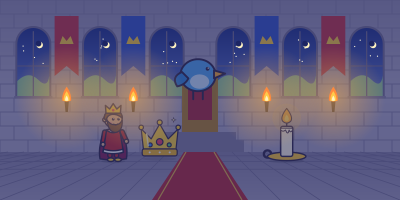
A long time ago, in an empire on the far side of the world, there was an emperor whose palace was built entirely of porcelain; it was so fine and so brittle that anyone who walked through it had to take great care not to break something. In the garden outside, the most extraordinary flowers grew, and to the most beautiful ones tiny silver bells were tied, so that nobody could pass without hearing them chime. The garden was so large that the gardener himself had never found its end. Beyond it lay a forest of tall trees and deep lakes that reached all the way to the sea, and in the branches of that forest lived a nightingale.
This bird sang so sweetly that a humble fisherman, who had plenty to do, would stop hauling in his nets at night just to listen. "How lovely," he would sigh, and then he would go back to work and forget it, until the next night when the song began again. Travellers came from every country to marvel at the emperor's city and his palace and his garden, but when they heard the nightingale, they all agreed that it was the best thing of all. They carried the news home, and scholars wrote books about the city and the palace and the garden, but they always gave the nightingale the highest admiration.
One of those books found its way to the emperor, who sat in his golden chair and nodded with satisfaction at every magnificent description of his own city, and then he reached a line that made him sit up. "The nightingale is the finest thing of all." "What is this?" he cried. "A nightingale in my empire, in my own garden, and nobody has told me? I must learn it from a book?" He summoned immediately his chief courtier, a man so proud that he spoke to nobody of lower rank, and ordered him to bring the bird to sing at court that very evening. "If it does not come," said the emperor, "I shall have the entire court punished."
The chief courtier hurried anxiously up and down staircases and through every hall, with half the court at his heels, but not one of them had heard of the nightingale. At last, in the kitchen, they found a poor, overworked little girl who scrubbed the pots. "Oh, the nightingale," she said. "I know it well. Each evening I take the scraps from the table to my sick mother who lives by the sea, and on the way home I rest in the wood, and I hear it sing. It makes me cry, because it feels as if my mother were kissing me." The courtier promised her a place in the kitchen for life, and leave to watch the emperor dine, if she would lead them to the bird.
So they all set off into the wood, and as they went a cow began to moo. "There it is!" cried a young courtier. "What extraordinary power for such a tiny creature! I am sure I have heard it before." "No, sir, that is only a cow," said the kitchen girl. "We are still far from the place." Then the frogs began to croak in the marsh. "Charming and delightful," said the court preacher. "It sounds like little church bells." "Those are frogs," said the girl, trying not to laugh, and then, high in the branches, the real song began, and she said, "Listen! There it sits!" She pointed to a small, grey bird.
"Is it possible?" said the chief courtier. "I never imagined it would look so plain. It must have lost its colour from seeing so many fine people." "Little nightingale," called the kitchen girl, "our most gracious emperor wishes you to sing for him." "With the greatest pleasure," said the nightingale, and it sang so beautifully that it was a joy to hear. They carried it back to the palace, where every wall and floor had been polished until it gleamed in the light of a thousand golden lamps. In the middle of the great hall, a small golden perch had been set up for the bird to sing from.
The whole court was there, in their most elaborate clothes, and even the kitchen girl was allowed to stand behind the door. When the emperor nodded, the nightingale began, and its voice was so sweet that tears rose in the emperor's eyes and rolled down his cheeks; he was so overwhelmed that he offered to hang his own golden slipper around its neck, but the nightingale politely refused. "I have already been rewarded," it said. "I saw tears in the emperor's eyes, and to me there is no richer treasure." After that it lived at the palace in a cage of its own, with leave to go out twice by day and once by night, with twelve servants to hold the silken ribbons tied to its leg.
Then one day a large parcel arrived for the emperor, marked with a single word: Nightingale. "Here is another book about our famous bird," he said, but it was not a book. In a box lay an artificial nightingale, made to look like the real one but covered all over with diamonds, rubies and sapphires. When it was wound up, it sang one of the real bird's songs, while its golden tail overwhelmed up and down and sparkled. The court was delighted. "Now they must sing together," they said, but the duet went badly, for the real nightingale sang whatever came to it, and the clockwork bird could only follow its wheels.
So the clockwork bird sang alone, and it was as great a success as the real one, and much prettier to look at; it sang the same tune thirty-three times and was never tired. Everyone would have gladly heard it again, but the emperor said that the living bird should have a turn. Where was it? Nobody had noticed that the nightingale had flown out of an open window, back to its green wood. "What an ungrateful creature!" said the courtiers. "The clockwork bird is the better one." The music master agreed. "With a real nightingale, one can never tell what will come out, but with this one, everything is determined beforehand. One can open it and see where the music comes from."
The real nightingale was banished from the empire, and the clockwork bird took its place on a silk cushion by the emperor's bed, with all its gifts of gold and jewels around it. The music master wrote twenty-five long volumes about it, full of the hardest words, and everyone said they had read and understood them, for otherwise they would have been thought stupid. The fisherman, who had heard the true song, said, "It sounds pretty and somewhat similar to it, but something is missing, and I cannot say what." So a whole year passed. The people learned every note of the clockwork bird's song by heart, and the street boys sang it, and so did the emperor.
But one evening, when the bird was singing its best and the emperor lay in bed listening, something inside it went "Whizz!" A spring had snapped, and the wheels whirred round and the music stopped. The emperor sent for his doctor, who could do nothing, and then for the watchmaker, who after much talk and tinkering put it half right, but he warned that the bird must be used very seldom, because its works were worn out, and nobody could guarantee its song. That was a great disappointment. After that, the bird sang just once a year, and even that was a strain, though the music master gave a speech full of long words, saying it was as good as ever.
Five years passed, and then a real sorrow came to the land, for the emperor fell ill and was not expected to recover. A new emperor had already been chosen, and when the people asked the chief courtier how the old one was, he only shook his head. Pale and cold, the emperor lay in his great bed. The whole court thought him gone, and every one of them hurried away to greet the new ruler. In all the halls and passages, cloth had been laid down to muffle the footsteps, and everywhere it was very, very quiet, but the emperor was not dead yet.
Stiff and white he lay in the huge bed with its velvet curtains and heavy gold tassels. High above him, a window stood open, and the moon shone upon the emperor and on the clockwork bird at his side. He could hardly breathe, and it felt as if something were sitting on his chest, and when he opened his eyes, he saw that it was Death, wearing the emperor's golden crown and holding his sword and his magnificent banner. From among the folds of the curtains, strange faces were peering out, some hideous and some gentle; they were all his good deeds and his bad deeds, looking at him now that Death sat upon his heart.
"Do you remember this?" whispered the faces, one after another. "And do you remember that?" They told him so many things that the sweat ran down his forehead. "Music!" cried the emperor. "Bring the great drum, so that I cannot hear what they are saying!" But they went on, and Death nodded at every word. "Golden bird, sing!" the emperor begged. "I gave you gold and jewels, and I hung my own slipper around your neck. Sing, sing!" But the bird stood silent, for nobody was there to wind it, and without that it could not sing a note; death went on staring with his great hollow eyes, and the room was fearfully quiet.
Then, close to the window, there came a burst of lovely song; it was the little living nightingale, perched on a branch outside; it had heard of the emperor's illness and had flown back to sing him comfort and hope. As it sang, the faces grew paler and paler, the blood ran faster through the emperor's weak limbs, and even Death listened. "Go on, little nightingale," he said. "Will you give me the golden sword?" asked the bird, and Death gave it. "Will you give me the banner? Will you give me the emperor's crown?" And Death gave up each treasure for a song, and then the nightingale sang of the peaceful churchyard, where white roses bloom and the grass is wet with the tears of those who stay behind.
Death was suddenly overcome by a longing for his own peaceful garden, and he floated out of the window like a cold white mist. "Thank you, thank you," said the emperor. "Heavenly little bird, I know you now. I drove you from my land, and yet you have chased those faces from my bed and Death from my heart. How can I reward you?" "You have rewarded me already," said the nightingale. "The first time I sang, I drew tears from your eyes, and I shall never forget it. Those are the jewels that make a singer glad. Now sleep, and wake up well and strong, and I will sing you to sleep." And it sang, and the emperor sank into a gentle, refreshing slumber.
The sun was shining through the window when he woke, perfectly healthy and strong. None of his servants had come back, for they all imagined him dead, but the nightingale still sat there singing. "You must stay with me always," said the emperor. "You shall sing only when you wish, and I will break the clockwork bird into a thousand pieces." "Do not," said the nightingale. "It did its best, so keep it. I cannot make my home in a palace, but let me come when I like. I will sit on the branch by your window in the evening and sing to you, of the happy and of those who suffer, of the good and the evil hidden all around you.
"I fly to the fisherman and the farmer's hut, to everyone far from your court. I love your heart more than your crown. Only promise me one thing: tell nobody that a little bird tells you everything." Then it flew away. Soon afterwards, the servants crept in to look upon their dead emperor. The sun lay across the great bed, the clockwork bird sat silent on its cushion, and from the garden below came the first small notes of a living song. The servants stood in the doorway with their mouths open, because the emperor sat up against the pillows, with colour returned to his cheeks and a smile on his face, and he said, "Good morning!"
Questions
- The chief courtier
- A little kitchen girl
- A fisherman
- Nobody noticed it leave while everyone was busy with the new bird
- The emperor drove it out with a stick
- It was tired of its cage
- Its wheels broke and nobody could wind it up in time
- The emperor told it to stop
- It forgot the tune
- sent away for good
- welcomed with a feast
- painted bright colours
- A true song is only given freely, never locked in a cage
- It did not like the emperor
- It wanted to go to Japan
- He gave back the crown and the sword and floated out the window
- He laughed and stayed
- He took the nightingale away
Words to know
- porcelain: fine china
- courtier: palace official
- artificial: made, not real
- banished: sent away
- clockwork: wound-up machine
- hollow: empty inside
Answer key: The Nightingale
- B. A little kitchen girl
- A. Nobody noticed it leave while everyone was busy with the new bird
- A. Its wheels broke and nobody could wind it up in time
- A. sent away for good
- A. A true song is only given freely, never locked in a cage
- A. He gave back the crown and the sword and floated out the window
The story in pictures
- Part One · The Porcelain Palace
- Part Two · The Kitchen Girl
- Part Three · The Song at Court
- Part Four · The Golden Slipper
- Part Five · The Jewelled Bird
- Part Six · The Better Bird
- Part Seven · A Broken Spring
- Part Eight · The Emperor Falls Ill
- Part Nine · Death at the Window
- Part Ten · The Nightingale Returns
- Part Eleven · Good Morning










For the teacher: how this passage is levelled
“The Nightingale” is a reading level 12 story. Every Peabody story at this level is written and checked to keep sentences to 48 words or fewer, to aim at an average of 14 words a sentence, and to show 90 to 130 words on a screen. At most 17% of its words may be off the familiar-word list. Children in 8th grade start at this level.
| This passage | 2131 words, 18 screens, 6 multiple-choice questions with an answer key, and 6 vocabulary words with kid-sized meanings |
|---|---|
| Longest sentence at this level | 48 words |
| Words on a screen | 90 to 130 |
| Skills practised at this level | vocabulary, spelling |
Reading level 12: the limits, a real sample and the free games. Peabody is a learning app, not an assessment: use the questions to talk about the story, not to grade a child.