
The Snow Queen
There was once a goblin who made a mirror with an extraordinary power. Whatever was good and lovely, when it was reflected in the glass, shrank to almost nothing, and whatever was insignificant and hideous seemed bigger and worse. The finest landscape looked like boiled spinach, and the most compassionate face looked cruel. The goblin's apprentices carried the mirror all over the world, laughing. Eventually they attempted to fly up to the sky to make fun of the angels, but the higher they climbed, the harder the mirror shook, until it slipped out of their hands, fell to the earth and shattered into countless fragments.
The pieces were no bigger than grains of sand, and they were worse than the mirror, because the wind blew them everywhere. When a speck flew into a person's eye, that person began to see the whole world crooked and notice only what was wrong with it. When a speck embedded itself in someone's heart, the heart turned cold, like a solid lump of ice. The malicious goblin laughed himself nearly sick as the minute splinters went on flying through the air, looking for someone to hurt. Nobody could see them, and nobody could stop them.
In a large city, where houses are crowded closely together and few people have gardens, there lived two poor children; they were not brother and sister, but they cherished each other as dearly as if they had been. Their families lived in attics on opposite sides of a narrow lane, and the roofs almost touched. Along the gutter between the windows, each family had a wooden box of earth, where herbs grew and a rose bush bloomed, and in summer the children could climb across and sit together under the roses. In winter they warmed copper coins on the stove and pressed them firmly against the frosted windowpanes to make a round peephole.
The boy was Kay, and the girl was Gerda; one evening, their grandmother told them about the snowflakes swarming like white bees. "Do they have a queen?" asked Kay. "They do," explained the grandmother. "She is the largest of them all, and she flies wherever the swarm is thickest. On cold nights, she looks in at the windows, and then the glass freezes over in the shape of flowers." "I would let her in," said Kay, "and she would melt on the hot stove." That night, as he looked out through his peephole, a snowflake grew into a tall woman in a gown of white gauze, whose eyes were as brilliant as stars but had no warmth in them. She beckoned to him, and he jumped down from the window.
Spring came, and the roses bloomed, and the children were sitting happily in their little garden when Kay suddenly exclaimed. "Something has pricked my heart! And something has flown into my eye!" Gerda put her arms around his neck, but there was nothing to see. "I think it is gone," he said, but it was not. A tiny splinter of the goblin's mirror had gone into his eye, and another into his heart. "Why are you crying?" he snapped at Gerda. "It makes you ugly, and look at those roses! That one is eaten by a worm, and that one is crooked. What ugly flowers!" He kicked the box and tore off two of the blossoms.
From that day, Kay was a completely different boy; he ridiculed his grandmother's stories and copied the way she talked, and he found something ridiculous in every neighbour. He had no time for Gerda's games, and he preferred to examine snowflakes through a magnifying glass, because every flake was so flawless and every living flower looked imperfect. When winter came again, he took his big sledge to the square, where the adventurous boys tied their sledges to farmers' carts and were pulled along behind. A large white sledge swept majestically in, driven by someone in a white fur coat and cap, and Kay quickly tied his little sledge to it. Faster and faster they flew, out through the city gate and into a blinding blizzard of snow.
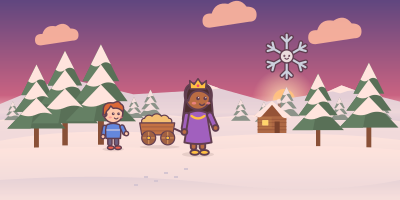
At last the great sledge stopped, and the driver stood up; it was a tall woman, shining white, and she was the Snow Queen. "You are trembling," she said. "Come under my bearskin." She enveloped him in her fur, and it was like sinking into a drift, and then she kissed him on the forehead. Her kiss was colder than ice, and it went straight to his heart, which was already half frozen. For a moment he thought he would die, but then he felt well again and no longer noticed the cold, and he completely forgot Gerda, and his grandmother, and everyone at home. The Snow Queen kissed him once more, and he forgot everything else, and she transported him to her palace in the distant north.
Kay did not come home, and nobody knew where he had gone. When spring came, Gerda said to the sunshine, "Kay is dead and gone." "I do not believe it," said the sunshine, so Gerda put on her new red shoes and went down to the river. "Have you taken my companion?" she asked. "I will give you my red shoes if you give him back." The waves seemed to nod, so she threw her shoes into the water, but they were washed straight back to her. Thinking she had not thrown them far enough, she climbed into a boat among the reeds and tried again from the end of it, and the boat, which was not tied, drifted slowly away from the bank.
The current carried Gerda rapidly downstream, and she was terrified and wept, but nobody heard her except the sparrows, who could not carry her ashore. At last the boat drifted to a cherry orchard with a little red house, where an extremely old woman came out, leaning on a crooked walking stick, in a large hat painted with flowers. "You poor child," she said. "How did you ever come down this river, so far out into the wide world?" She hooked the boat with her stick and drew it in. When she heard Gerda's story, she said, "Hm, hm," and asked her to come in and taste her cherries.
The old woman was an enchantress, though not a wicked one, and she wanted a little girl to provide her with company. As Gerda ate the ripe cherries, the woman carefully combed her hair with a golden comb until Gerda forgot Kay completely. Then the witch went into the garden and pointed her stick at all the rose bushes, and they vanished into the black earth, because she was afraid that one sight of a rose would remind Gerda of her friend. Gerda played among the flowers of every season of the year, all blooming simultaneously, and slept in a soft bed with red silk pillows. Many days passed, and she felt happy, but it seemed to her that some flower was missing.
One afternoon, she was looking at the painted flowers on the old woman's hat, and the prettiest of them was a rose, which the witch had forgotten to hide. "Are there really no roses here?" cried Gerda, and she ran through the flowerbeds, searching desperately, but found none; she sat down on the ground and wept, and her warm tears fell on the exact spot where a rose bush had sunk. At once it sprang up as fresh as ever, and Gerda remembered the roses at home, and then Kay. "How long I have been here!" she cried. "Where has he gone? Is he dead?" "He is not dead," said the roses. "We have been under the ground, where the dead lie, and he is not there."
Gerda ran to the garden gate, which was locked, but she pushed the rusty bolt until it gave way, and she ran out into the wide world barefoot. It was late autumn, though she had not noticed the seasons passing in the garden. The willow leaves were yellow and dripping, and her feet were bruised; on the road a large crow hopped up to her, and Gerda told him her story and asked if he had seen Kay. "Perhaps," declared the crow. "In this kingdom there lives a princess, so clever that she has read every newspaper in the world, and she has chosen a husband who can talk as well as he listens. He came on foot, with bright eyes and long hair, in shabby clothes."
"That is Kay!" cried Gerda. "Take me to him." So the crow led her to the palace, in at a back door, and up a winding stair, where a tiny lamp burned on a cupboard. In the great hall, the princess and her husband lay asleep in beds shaped like lilies, but when Gerda held up the lamp and looked at the sleeper's face, he was not Kay. He woke up, and the princess woke up, and when they had heard Gerda's story, they were kind to her. They gave her a warm coat and a golden coach with a coachman and footmen, and they sent her on her way, wishing her good luck.
The golden coach blazed like a torch through the enormous dark forest, and it was too bright for the robbers who lived there. "Gold!" they shouted, and they dragged out the footmen and Gerda. An old robber woman with a bristly beard said she looked as plump and delicious as a lamb. But her little daughter, who was as wild and extraordinarily spoiled as any child could be, bit her mother's ear, and she exclaimed, "Ow!" "I want her to play with me," said the robber girl. "She will give me her muff and her pretty dress, and sleep in my bed." Gerda told the robber girl her story, and how much she loved Kay.
The robber girl nodded. "They shall not harm you," she said. In the corner of the robbers' room sat a hundred wild wood pigeons, and beside them a reindeer was tied by a shining brass ring. In the morning Gerda told the pigeons about Kay. "We saw him," they cooed. "The Snow Queen's sledge swept over our nest, travelling toward Lapland." "Yes, there is snow and ice there," said the reindeer, who was a native of that country. "The Snow Queen has her palace on an island near the North Pole." The robber girl untied the reindeer and lifted Gerda onto his back. "Here are your boots and my mother's big gloves. Now off with you, and take good care of her."
Over marsh and plain, through the forest, past howling wolves and under the flashing northern lights they raced, until they reached a miserable little hut where an old woman was cooking fish over an oil lamp. She sent them on to a wiser woman farther north, and that woman studied Gerda. "I cannot give her any power greater than she already possesses," she told the reindeer. "Do you not see how far she has come on her bare feet, and how men and animals serve her? She must not learn of her strength from me; it is in her heart, because she is a sweet, innocent child. Take her to the Snow Queen's garden, and set her down by the bush with red berries, and come back quickly."
The reindeer set Gerda down and kissed her, and enormous tears ran down his face, and he ran back. Gerda stood alone, with no shoes and no gloves, in the unbearable cold. She ran forward with all the speed she could muster, and then she met a whole regiment of snowflakes that did not fall from the sky but raced along the ground. They looked like peculiar creatures: some like hedgehogs, some like tangles of snakes, some like bears with bristling fur. They were the Snow Queen's loyal guards. Gerda began her evening prayer, and her breath rose before her mouth like smoke, and it took the shape of little angels with spears and shields. They struck the snowflakes, which burst into pieces, and Gerda walked on, safe and bold.
The enormous walls of the Snow Queen's palace were drifted snow, and the windows and doors were cutting winds. There were more than a hundred halls, lit by the northern lights, and every one of them was enormous and deserted and glittering and cold. In the middle of the largest hall lay a frozen lake that had broken into a thousand pieces, and the pieces were all alike. There sat Kay; he was blue with cold, almost black, but he did not notice, because the Snow Queen's kiss had taken away his trembling. He was pushing flat, sharp fragments of ice around, trying to arrange them into a particular word. It was the game of reason, and in his eyes the shapes were remarkable.
The word he wanted was Eternity. The Queen had said, "If you can lay that word, you shall be your own master, and I will give you the whole world and a new pair of skates." But he could not do it. The Queen had flown off to the warm countries, and he sat alone, contemplating until his head creaked. Just then Gerda came in through the great gate, which was made of cutting winds, but when she said her evening prayer, the winds fell asleep; she saw Kay, and she knew him at once, and she ran and threw her arms around him. "Kay! Dear Kay! I have found you at last!" But he sat quite still, stiff and cold.
Then Gerda wept hot tears that fell on his chest and went into his heart, where they dissolved the lump of ice and washed away the little splinter of glass. He looked at her, and she sang the ancient hymn about the roses. Kay burst into tears, and he sobbed so violently that the splinter was washed right out of his eye. "Gerda!" he said. "Dear Gerda, where have you been all this time? And where have I been?" "How cold it is here, and how large and empty!" He held her tight, and she laughed and cried for joy. It was so extraordinary that the pieces of ice danced joyfully around them, and when they were tired, they lay down in the very shape of the word Eternity.
Gerda kissed his cheeks, and they grew rosy, and she kissed his eyes, and they shone like hers; she kissed his hands and feet, and he was strong and well again. The Snow Queen might return home whenever she liked, for his liberty stood written there in shining pieces of ice; they took each other affectionately by the hand and departed from the great palace, conversing about their grandmother and of the roses on the roof. Wherever they went, the winds were calm and the sun came out, and by the bush with the red berries the reindeer was waiting, with a young reindeer beside him. They rode home through the beautiful green countryside, and the robber girl waved to them from the forest.
At last they came to the city gate, and climbed the stairs to the little attic. Everything was just as they had left it; but as they passed through the door, they realised that they had become grown-ups. The roses were blooming from the gutter into the open window, and there stood their two little stools, and Kay and Gerda sat down on them, holding each other by the hand. They had forgotten the cold, empty glory of the Snow Queen's palace, like a terrible dream. Their grandmother sat in the sunshine, reading aloud, and they looked into each other's eyes and finally understood the ancient hymn; they were grown up, and yet they were children in their hearts, and it was summer, blessed summer.
Questions
- Made good things look small and bad things look worse
- Made everything look bigger
- Turned everything to ice
- He was tired of her games
- A splinter of the mirror had gone into his eye and heart
- The Snow Queen had told him to
- She stayed there forever
- She cried until a rose grew back, and then she remembered Kay
- She went home
- clever and quick
- pure and without harm
- tired and cold
- The warm sun
- The Snow Queen's kiss
- Gerda's tears
- A loving heart can be stronger than any magic of ice
- You should never leave home
- Only clever people can win
Words to know
- goblin: small mean spirit
- splinter: tiny sharp piece
- peephole: small round window
- gauze: thin, light cloth
- regiment: army group
- eternity: time without end
Answer key: The Snow Queen
- A. Made good things look small and bad things look worse
- B. A splinter of the mirror had gone into his eye and heart
- B. She cried until a rose grew back, and then she remembered Kay
- B. pure and without harm
- C. Gerda's tears
- A. A loving heart can be stronger than any magic of ice
The story in pictures
- Part One · The Goblin's Mirror
- Part Two · Kay and Gerda
- Part Three · The Splinter
- Part Four · The White Sledge
- Part Five · The River
- Part Six · The Garden of Flowers
- Part Seven · The Open Gate
- Part Eight · The Crow and the Palace
- Part Nine · The Robber Girl
- Part Ten · The North
- Part Eleven · The Snow Guards
- Part Twelve · The Ice Palace
- Part Thirteen · Eternity
- Part Fourteen · The Tears
- Part Fifteen · The Way Home
- Part Sixteen · The Roses









For the teacher: how this passage is levelled
“The Snow Queen” is a reading level 12 story. Every Peabody story at this level is written and checked to keep sentences to 48 words or fewer, to aim at an average of 14 words a sentence, and to show 90 to 130 words on a screen. At most 17% of its words may be off the familiar-word list. Children in 8th grade start at this level.
| This passage | 2657 words, 22 screens, 6 multiple-choice questions with an answer key, and 6 vocabulary words with kid-sized meanings |
|---|---|
| Longest sentence at this level | 48 words |
| Words on a screen | 90 to 130 |
| Skills practised at this level | vocabulary, spelling |
Reading level 12: the limits, a real sample and the free games. Peabody is a learning app, not an assessment: use the questions to talk about the story, not to grade a child.