
The Princess and the Goblin
There was once a little princess named Irene, whose father was king over a magnificent country of mountains and valleys. Because her mother was not strong, the baby had been sent away from the grand palace to be raised in an enormous old house, half castle and half farmhouse, on the slope of a mountain, and there she had lived ever since, eight years old and extraordinarily sweet. Her eyes were the deep blue of the night sky, and she frequently gazed at the ceiling of her nursery, which had been painted blue and sprinkled with stars, because she had hardly ever been permitted to see the real ones. The mountain was hollow, you see, and the dark caverns beneath it were inhabited by goblins.
The goblins, people said, had originally lived above ground like everyone else, until an ancient king had taxed them so heavily and imposed such harsh laws that they had descended into the caverns and never again appeared in the daylight. Generation after generation, in the cold and the darkness, they had grown crooked and clever. They could accomplish things that no miner could imagine, and they detested everyone who lived in the sunshine overhead, particularly the royal family. Their greatest delight was to torment the people above with ingenious tricks, and their own king spent most of his time inventing new ones. That was why the princess's nurses never allowed her out of doors after sunset.
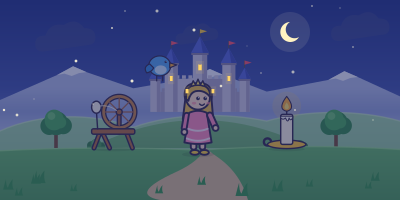
One wet afternoon, when she had grown tired of all her toys, Irene slipped out of the nursery and discovered a staircase of worm-eaten oak that she had never climbed. Up she went, through endless passages lined with doors, until she was completely bewildered. She cried a little, wiped her face, and noticed a steep, narrow stair in a corner that led still farther up. At the top, from behind the third of three doors, she heard a gentle humming, like a bee that has found a flower full of honey. She opened the door cautiously and saw a beautiful old lady with hair as white as snow, sitting at a spinning wheel.
"Come in, my dear," said the lady. "I have been expecting you." She washed Irene's tear-streaked face with a soft towel, and she explained, with a charming smile, that she was her great-great-grandmother, who had come to look after her. Her name was Irene too, she said, and she had generously allowed the princess to have it. Then she led the astonished child out onto the roof, where a hundred white pigeons were bowing to one another and murmuring in a language that Irene could not understand. "These are my poultry," said the old lady, "and I eat their eggs." She escorted Irene to the top of the first stair, sent her running down to her nurse, and returned to her spinning with a mysterious smile.
When Irene described the lady to her nurse Lootie, Lootie did not believe a single word. "Princesses are in the habit of telling make-believes," she said, "but you are the first I ever heard of who expected to be believed." Irene burst into tears, because a real princess cannot tell a lie and does not enjoy being doubted. All evening she scarcely spoke, and at bedtime she turned her face to the wall, until poor Lootie began to cry as well. "You cannot help it, Lootie," said Irene gently, "so I will not be vexed with you any more." She kissed her nurse affectionately and went to sleep. But when she climbed the stairs again the next day, she could not find the way.
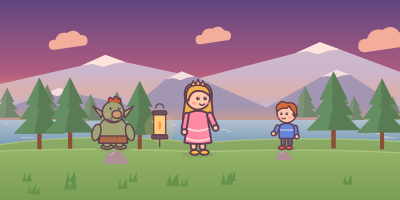
After a week of rain the sun reappeared, and one golden afternoon Irene begged Lootie to walk a little farther up the mountain. They wandered so far that the sun sank behind an enormous peak, and Lootie, remembering the strict orders about the goblins, began to run. Irene ran beside her, chattering about the peculiar faces she could see peeping out from behind the rocks, until she tripped and grazed her knees. Somewhere in the gathering dusk a harsh voice sniggered, "Lies! Lies!" and Lootie wailed that they were hopelessly lost. At that moment they heard someone whistling, and a boy in a miner's cap came striding confidently up the path, singing a curious song.
His name was Curdie. He was twelve years old, the son of Peter the miner, and he was a little pale, like a plant that grows in a cellar, because he spent his days underground. "Do not be afraid," he told them cheerfully. "Goblins cannot endure singing, and this is the song they hate most. If you are not afraid of them, they are afraid of you." He walked between them, holding the princess's hand, and when a lump in the road suddenly extended four long limbs and scuttled up a rock like an enormous spider, he merely laughed and sang a rhyme after it. Irene thought the song rather rude. "It is a custom among miners," said Curdie, "and we sing it because they hate it."
At the door of the house, Irene wanted to give Curdie the kiss that she had promised him on the road, but Lootie snatched her hand away. "A princess must not kiss a miner's boy," she said severely. "But I promised," said Irene, drawing herself up very straight, "and a princess must not break her word." Curdie settled the argument politely. "Never mind," he said. "I will come another time, and then you may keep your promise." He departed, whistling, into the darkness. Lootie declared that she would like to see him again, but she did not explain why, and for the next few weeks she was more anxious than ever that the princess should be indoors before sundown.
That night, a crowd of goblins gathered under Curdie's window, and he sent them scurrying away with a rhyme. But he began to wonder what they were planning, so a few evenings later he stayed alone in the mine to investigate. With his ear pressed against the rock, he overheard a goblin family quarreling about their furniture, because the miners had been digging dangerously close to their cave. From their conversation he learned that the goblins' heads were as hard as granite but their feet were extremely soft, and that was their only weakness. He also heard the father say that an important plan was about to be decided that very night in the king's palace.
Curdie removed the loose stones from the wall, wriggled through the opening, and followed the family along a winding passage to the edge of an immense cavern. At the far end, on a throne carved from green copper ore, sat the goblin king, while one of his lords made a pompous speech. The goblins had two plans, he declared. First, they would kidnap the princess and marry her to the king's son, so that her father would be compelled to keep the peace. If that failed, they would release the underground rivers and drown the mines. Curdie crept back to tell his father, and Peter decided that the miners should quietly build a thick wall of stone against any flood.
That week Irene pricked her thumb on an old brooch, and her whole hand swelled and burned, so that in the middle of the night she crept out of bed to cool it in the moonlight, and she found herself climbing the silvery stair toward the tower. The old lady was waiting for her, and without a word she rubbed a marvelous ointment, which smelled of roses and lilies, on the burning hand, so that the pain disappeared at once. Then she took Irene into a wonderful bedroom, with a great lamp like a ball of moonlight, a bed with pale blue curtains, and walls spangled with silver stars. "On the night of next Friday," said the lady, tucking her in, "you must come back to me. It will depend entirely upon yourself whether you believe that I am anything but a dream."
Irene came, and the lady had lit a fire of red roses, and she herself shone like a young queen with a silver crown. She had been spinning a ball of fine thread from spider-webs, thread so delicate that Irene could not see it, and she fastened one end to a ring set with a fire-opal on the princess's finger. "If you are ever in danger," she said, "take off your ring and put it under your pillow. Then lay your finger on the thread and follow it wherever it leads you, however roundabout the way may seem. Do not doubt the thread, for while you hold it, I hold it too."
Curdie, meanwhile, continued watching the goblins every night, with a long ball of string tied to his pickaxe so that he could find his way back, until one night the string became tangled among their strange animals and led him astray in the dark. He wandered into the great cavern, where the goblin queen, who wore heavy stone shoes because she was extremely proud of them, pounced on him, and the entire court assembled to decide what to do with him. They imprisoned him in a small cell behind a great slab of rock, and he heard the king and queen calmly discussing how long it would take to starve him. Curdie, shut in the darkness, did the only thing he could think of. He began to sing, and the louder he sang, the more the goblins hated it.
The following morning, Irene woke in a terrible fright, because the cook's cat and the housekeeper's terrier had burst into her bedroom and were fighting furiously across the floor. She remembered what her grandmother had told her. She slipped off her ring and put it under her pillow, and she felt a finger and thumb gently take it from her palm. A cloak of sky blue lay over a chair, as though it had been left for her, so she put it on, found the thread with her forefinger, and followed it. It led her out of the house, up the mountainside in the early dawn, and straight into the mouth of a cave where a little stream ran out, babbling.
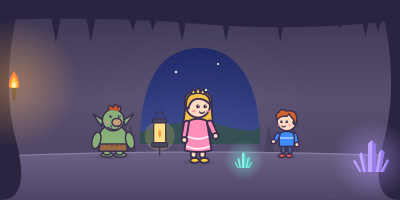
In the black passages the thread guided her down steep stairs and rough ladders and through holes scarcely large enough to crawl through, and sometimes she heard the dull thud of hammers or the gurgle of water inside the rock. At last she climbed a heap of stones in a cavern lit by a few glowing embers, and the thread vanished into the heap. Irene was dreadfully afraid that her grandmother had forsaken her, and she threw herself down and cried. But after a while she remembered that her grandmother would never have brought her so far merely to abandon her. So she began to pull the stones away, one by one, wherever the thread turned, until her fingers bled.
From behind the stones, quite close, a familiar voice began singing a very rude rhyme. "It is Curdie!" cried Irene. "Hush!" he whispered. "They know that I am here, but they do not know that you are." Irene cleared the front of a great flat slab that stood against the wall, and Curdie gave it a tremendous shove from inside, and it toppled out onto the heap, and he crawled over it, free. "You have saved my life!" he said. "We are not out yet," said Irene, "but we soon shall be, because my grandmother's thread is going to take us." Curdie did not understand a word of that, but he followed her anyway.
She led him through a narrow hole into another cavern, where the goblin king and queen lay fast asleep on a platform of sheepskins. Curdie noticed his pickaxe beside the queen, and he also noticed one of her enormous stone shoes sticking out from under the covers, so he could not resist pulling it off to see what was underneath. It was exactly as he had hoped, for her bare foot was as soft and tender as any goblin's. The queen woke with a bellow, and Irene dashed their torch to the floor and cried, "Take my hand, Curdie!" They ran through the darkness, following the thread down into a rushing stream, through the rock, and out into the sunshine.
To Curdie's astonishment, they were standing in the garden of Irene's own house, beside the little brook. "Now will you believe me?" asked Irene, laughing, and she took him up to the tower to meet her grandmother. But when she opened the door, Curdie saw nothing except a bare garret with a heap of musty straw, a withered apple, and a single sunbeam falling through a hole in the roof. "You are making a fool of me," he said, deeply hurt, and he went down the stairs and out of the house. Irene wept in her grandmother's arms. "Seeing is not believing, my child," said the lady. "You must be fair to him, and wait. If you are not fair to others, you are not worth being understood yourself."
A few nights later the goblins broke into the house. They had decided, after the princess and Curdie escaped, to waste no more time, and they came swarming up through the cellar by the hundred. Curdie, who had warned the guards and been laughed at for his trouble, woke to the clatter of battle and snatched up an old hunting knife. He charged into the great hall, stamping on goblin feet and singing his rhymes, and wherever he stamped a goblin howled and fled. He freed the soldiers from the heap of goblins that had pinned them down, and then he searched the entire house for the princess. But her room was empty, and she was nowhere to be found.
Just as Curdie was about to follow the goblins into the cellar, something touched his hand, and when he looked he saw nothing, but his fingers closed on a taut thread. He did not say a word, for he knew nobody would believe him, and he followed it with his finger out of the house and up the mountain. It did not lead into the mine. It led straight up to his own mother's cottage, and there, in the firelight, sat his mother, with the princess fast asleep in her arms. "Irene," said Curdie, kneeling down, "I am very sorry I did not believe you." "Oh, never mind," said Irene. "You could not, you know."
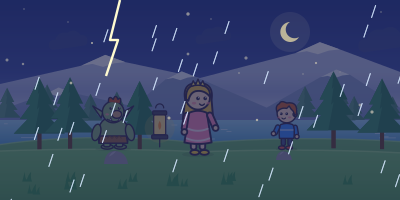
Then Curdie remembered the miners. He raced to the mine, woke his father, and found Peter and the others already completing the great wall of stone in the gallery, so that no water could break through. By the time they finished that evening, a tremendous thunderstorm was rattling the mountain, and the brooks had swollen into torrents, which kept the princess in the cottage for the night. Curdie's mother lit a fire, and they all told stories until Irene grew sleepy. Through the little window under the roof she could see her grandmother's lamp, shining like a silver ball far below, and she gazed at it until she slept.
The next morning the king rode up the valley with his men, white-faced, for he had heard that his daughter was missing. Curdie ran in at the gate with Irene in his arms, and the king lifted her from his shoulder with a cry, while the whole household cheered. Irene told them how Curdie had saved her, and then she remembered an old debt. "King-papa," she said, "I promised Curdie a kiss, and Lootie would not let me give it to him." "A princess must keep her promise," said the king, "unless it is wrong." So she threw her arms around Curdie's neck and kissed him, and the king gave a magnificent feast for the miners.
In the middle of the feast Irene walked into the hall, with her finger stretched out as if she were feeling for something, and whispered to her father that she could hear a noise. Soon everyone heard it, a rumble like distant thunder, growing closer. Curdie put his ear to the floor. "Please, Your Majesty," he said quickly, "leave the house at once, and go up the mountain!" The king believed him and led everyone out, and they were barely through the gate when a flood of water poured from the doors behind them. The goblins had let loose their underground rivers, but the mine was walled up, so the water found its way out through their own tunnel to the king's house.
High above the house a silver light was shining, and a white pigeon flew down, circled the king and Curdie and the princess, and rose again, and the light and the bird vanished together. Irene smiled. "You see," she said, "my grandmother knows all about it." The king wished to make Curdie one of his guard, but Curdie said that he could not leave his father and mother, and asked, instead, for a red petticoat for his mother, who felt the cold. The goblins who had not fled the mountain grew milder as the years went by, and gradually made friends with the miners. And the little thread, which only Irene could see, stayed spun between the princess and her great-great-grandmother.
Questions
- They had been driven from their homes by a harsh old king
- They enjoyed the dark
- They were hiding from the princess
- By singing rhymes they hated
- By lighting torches
- By running quickly
- Burn the king's house
- Drown the mines with underground water
- Block the road to the palace
- He was not yet ready to believe in what he could not understand
- The lady hid from him
- He had a bad eye
- Believing takes more than just looking
- Seeing is the same thing as believing
- Eyes cannot be trusted at night
- The path might be indirect and strange
- The thread was very short
- Irene should not follow it
Words to know
- goblins: cave-dwelling imps
- miner: digger of ore
- ointment: healing cream
- torrents: rushing streams
- forsaken: left behind
Answer key: The Princess and the Goblin
- A. They had been driven from their homes by a harsh old king
- A. By singing rhymes they hated
- B. Drown the mines with underground water
- A. He was not yet ready to believe in what he could not understand
- A. Believing takes more than just looking
- A. The path might be indirect and strange
The story in pictures
- Part One · The Great-Great-Grandmother
- Part Two · The Miner Boy
- Part Three · The Thread
- Part Four · The Mountain
- Part Five · The Night of the Goblins

For the teacher: how this passage is levelled
“The Princess and the Goblin” is a reading level 13 story. Every Peabody story at this level is written and checked to keep sentences to 62 words or fewer, to aim at an average of 15 words a sentence, and to show 100 to 145 words on a screen. At most 19% of its words may be off the familiar-word list. Readers reach this level by climbing, not by grade.
| This passage | 2903 words, 24 screens, 6 multiple-choice questions with an answer key, and 5 vocabulary words with kid-sized meanings |
|---|---|
| Longest sentence at this level | 62 words |
| Words on a screen | 100 to 145 |
| Skills practised at this level | vocabulary, spelling |
Reading level 13: the limits, a real sample and the free games. Peabody is a learning app, not an assessment: use the questions to talk about the story, not to grade a child.