Odin at Mimir's Well: the full story
Part One · The Wanderer
Odin was the eldest and most powerful of the gods of Asgard, yet he understood, with a certainty that disturbed his sleep, that power alone would never be sufficient. The entire world rested upon an enormous ash tree, whose roots were being gnawed by dragons while frost crept steadily upward through the soil; hostile giants were gathering in the east, and a fire giant was waiting in the south with a sword that blazed like a furnace. Odin could sense a final, catastrophic battle approaching from the distant future, and he knew that no spear in all creation would win it for him. What he required was wisdom, and the deepest wisdom in existence lay in a single place, a well beneath the tree's greatest root, in the territory of the giants.
So Odin did something that astonished everyone in Asgard, because he told no one about it, and quietly abandoned everything that made him recognizable as a king. He removed his golden armor and his helmet shaped like an eagle, left his spear in its rack, and turned his remarkable eight-legged horse out into the pasture. Wrapped in a plain blue cloak and carrying a traveler's staff, he descended into the world of men under the name of Vegtam, an ordinary wanderer with dusty boots and an unremarkable face. Farmers greeted him politely from their fields and promptly forgot him; not one of them suspected that this weary old stranger was the king of the gods. He still possessed two perfectly good eyes, though not for much longer.
Near the frontier of the giants' country he encountered an immense rider on an immense stag, and the rider appeared to know the road far better than Odin did. This was Vafthrudner, the wisest of all the giants, and he was notorious throughout the mountains for a dangerous hobby, because every traveler who passed his way was obliged to answer his riddles, and anyone who failed forfeited his head. Odin had no desire to lose his, yet he recognized a splendid opportunity to learn something from a creature so remarkably clever. He smiled courteously and agreed to play, whereupon the giant roared with laughter, displaying every one of his enormous teeth. The stakes, Vafthrudner announced cheerfully, would be head against head.
Part Two · The Riddle Game
Vafthrudner took the first turn, and he began with a question that seemed to be merely a warm-up for the contest: which river separated the dwelling of the gods from the land of the giants? "Ifling," answered Odin without any hesitation, "which is bitterly cold and never freezes over." The giant next demanded the names of the horses that drag Day and Night across the sky, and Odin supplied them instantly, Skinfaxe and Hrimfaxe. Vafthrudner leaned forward in alarm, because those names were closely guarded secrets, known only to the gods and a handful of the very oldest giants. For his final question he asked where the last battle of the world would be fought, and Odin calmly replied that it would take place on the plain of Vigard, which stretches a hundred miles in every direction.
Now it was the wanderer's turn, and he put a question to the giant that sounded perfectly innocent. "What will Odin whisper into the ear of his son Baldur, at the very end?" Vafthrudner sprang down from his stag so abruptly that the huge animal staggered sideways, for he understood the question at once. No living creature could possibly know such a thing, he said in a hushed voice, except Odin himself, and nobody else in the universe would have thought of asking it. "You are Odin," he declared. "I cannot answer you, and my head belongs to you." But Odin had not journeyed so far to collect heads, and he wanted only one more piece of information. "Tell me honestly," he said, "what price will Mimir demand if I come to his well and ask to drink?"
For a long moment Vafthrudner said nothing at all, and the forest around them seemed to grow quieter. "He will demand your right eye," the giant finally admitted, "and not a fraction less. Plenty of travelers have approached that well, and every one of them turned around when he heard the price. Not a single one has ever agreed to pay it." Odin released him from the wager, and Vafthrudner rode away through the pines, thoroughly relieved to be keeping his head. Odin remained exactly where he was, thinking about his right eye. For the rest of his immortal existence, one whole side of the world would be dim and shadowy, and he realized that he was standing perfectly still, and that for the first time in many centuries he was afraid.
Part Three · The Price
He very nearly turned back toward Asgard and the comfortable halls of his own palace. Instead he forced himself to continue, and as he walked he examined the world around him with unusual attention. Far to the south, a dull red glow marked the place where the fire giant stood waiting with his flaming sword, and far to the north he could hear the roar of a black river pouring out of a realm of ice and darkness. Between those two enemies his world was trapped, he understood, and sooner or later one of them would devour it entirely. Somebody had to discover how to prevent that disaster, and as the eldest of the gods, he knew exactly who that somebody was. His expression grew stern, and he went on toward the well.
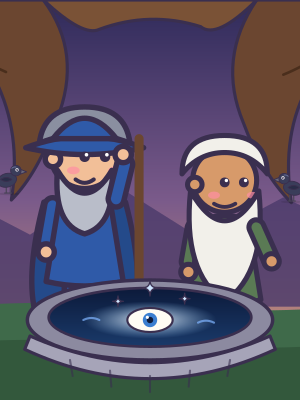
It lay beneath the greatest root of the ash tree, in a hollow where the ground was cool and the light filtered down green and gold through the leaves. Mimir sat beside the dark water exactly as he had sat since before the gods were born, his deep, patient eyes fixed upon the surface as though he were reading an enormous book. Every morning he drank from the well, and that was the reason he knew everything there was to know. He did not ask the stranger's name. "Welcome, Odin, oldest of the gods," he said gravely. "A drink from this well has a price, and every other visitor has refused to pay it. Will you pay it?" "I will not shrink from the price," said Odin.
Mimir filled an enormous horn with the water and placed it carefully in Odin's hands, and Odin drank and drank. As the water went down his throat, the future unrolled before him like a map spread across a table, and he saw every sorrow and misfortune that was approaching for gods and for people, one after another, without looking away from any of them. But he also saw why those sorrows had to come, and he glimpsed something more. If gods and people met their darkest days with courage, that courage would remain in the world long after they were gone, like a fire that no storm could extinguish, and someday, in the far distance, it would grow strong enough to overcome the darkness.
When the horn was empty, Odin raised one hand to his face and pulled out his right eye. The pain was more terrible than any wound he had ever received in battle, and yet he made no sound whatsoever; he simply lowered his head, drew his cloak across his face, and held out the eye, and Mimir accepted it and let it sink beneath the surface of the well. It drifted slowly down and down through the clear water, and then it came to rest, a bright round light at the very bottom. For all the ages that followed, anyone who came there to drink would see it shining upward, and would understand exactly what the father of the gods had paid.