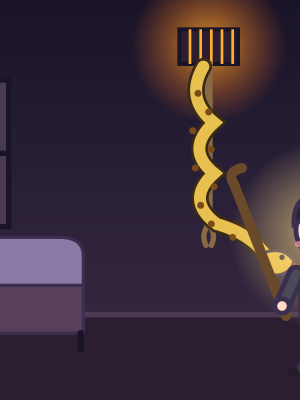
The Speckled Band: the full story
The Case
One morning in early April, I was awakened by a sharp rap at my door, and I discovered Sherlock Holmes standing beside my bed, completely dressed, although it was only a quarter past seven. A young lady had arrived, he informed me, in a state of extreme agitation, and he considered it necessary that I should hear her extraordinary story. In the sitting-room, a woman dressed in black, with a thick veil, rose from her chair as we entered. She was shivering, not from the cold, but from terror, and when she lifted the veil, I observed that her face was gray and drawn, and her eyes had the hunted expression of a frightened animal. Holmes calmed her gently and ordered a cup of hot coffee.
Her name was Helen Stoner, and she lived with her stepfather, Dr. Grimesby Roylott, in an ancient manor house called Stoke Moran, in the county of Surrey. The Roylotts had formerly been one of the wealthiest families in England, but the estate had gradually decayed, and the only part of the house that was still inhabited was a single wing. The doctor was a man of ferocious temper, who had spent many years in foreign countries, and since his return he had seldom left the grounds. He kept a pet cheetah and a baboon, which wandered freely about the property, and the villagers were so frightened of him that they would hurry away whenever he appeared on the road, while Miss Stoner herself never felt secure unless her bedroom door was locked at night.
Miss Stoner explained that her mother had been killed in a railway accident eight years earlier, and that she and her twin sister, Julia, had been left in the care of their stepfather. Two years before, Julia had become engaged to be married. A short time before the wedding, she informed Helen that she had been hearing a low, clear whistle in the middle of every night, at about three o'clock, although Helen herself had heard nothing. On the final night, however, Helen was awakened by a terrible scream, and she ran into the corridor to discover her sister staggering out of her room, swaying like a drunken woman, with her face white and distorted with horror, and her hands groping helplessly in the air as though she were searching for something to hold.
Julia stretched out her arms, crying, "Oh, Helen! It was the band! The speckled band!" She pointed toward her stepfather's room, but she was unable to say anything more, and within a few moments she was dead. The doctors who examined her could find no explanation, because her door had been locked from the inside, and her windows were closed by heavy shutters with iron bars. Now, Miss Stoner informed us, she was herself engaged to be married, and her stepfather had consented. But a few days earlier, workmen had commenced some repairs to part of the house, and she had been obliged to move into her deceased sister's bedroom. Last night, for the first time, she had heard the low whistle in the darkness.
Holmes listened attentively, and then he requested permission to examine the bedroom, and promised that he would call at Stoke Moran that very afternoon. Miss Stoner left, comforted, but she had barely departed when the door of our sitting-room was flung open. An enormous man stood in the doorway, wearing a high hat and a long black coat, with a hunting crop in his hand, and his face was so crossed with wrinkles and burned yellow by the sun that he resembled some fierce bird of prey. "I am Dr. Grimesby Roylott," he roared, "and you will not interfere in my family's affairs." Then he seized our poker, bent it into a curve with his tremendous hands, and flung it clattering into the fireplace.
Holmes only laughed, picked up the poker and, with a sudden effort, straightened it again. After the doctor had stormed out, Holmes took a cab to Doctors' Commons, where he consulted the will of the girls' deceased mother, and he carefully calculated that the estate had once produced a yearly income of eleven hundred pounds, which had fallen to seven hundred and fifty. Each daughter was entitled to a sum of two hundred and fifty pounds a year if she married, and Holmes announced that his morning had not been wasted. "If both girls had married," Holmes explained, "Dr. Roylott would have been left with almost nothing. He has an extremely strong motive for preventing a wedding, and one daughter has already died under mysterious circumstances."
That afternoon we traveled to Surrey, and Miss Stoner met us at the manor house, where we were relieved to learn that the doctor had gone to London. Holmes examined the three bedrooms in the quiet wing with a magnifying lens, studying the windows, which were closed by heavy shutters, and he discovered no possible way for any person to enter from outside. Then he noticed a bell-rope hanging above the bed, which seemed oddly out of place. It was not attached to a wire, and it was fastened above a small ventilator that opened, not to the outside air, but into the next room, which belonged to Dr. Roylott. "What a foolish builder," Holmes murmured, "to construct a ventilator between two bedrooms, when the same trouble would have connected it to the open air."
He also discovered that the bed itself was clamped to the floor, so that it could not be moved from its position beneath the ventilator and the dummy rope. In the doctor's room, we observed an iron safe, a wooden chair, a dog's leather leash tied in a loop, and a saucer of milk on top of the safe, and Holmes examined each object with the greatest attention. Then he asked Miss Stoner to return to her room and lock herself in, as though she had a headache. That evening, when the doctor had retired, she was to open her window, place a lamp upon the sill as a signal, and slip quietly away to her old room, while we concealed ourselves in the chamber that she had just left.
At dusk we observed Dr. Roylott drive past the inn where we were waiting, and we heard him shouting furiously at the boy who struggled to open the heavy iron gates. When the lamp gleamed from Miss Stoner's window, Holmes and I crept across the lawn, carefully avoiding the baboon, and climbed into the bedroom. "You must not fall asleep," Holmes whispered, "because your life may depend upon it." We sat in the darkness, listening to the village clock chime the quarters, and we heard a night-bird cry and a long catlike whine outside the window, which informed us that the cheetah was loose. Eleven struck, and then twelve, and one, and two, and every quarter of an hour seemed to last a lifetime, until at last the clock struck three.
Suddenly there was a gleam of light from the ventilator, and a strong smell of burning oil, because someone in the next room had lit a lantern. I heard a gentle sound of movement, and then silence, and then a low, soft hiss, like steam escaping from a kettle. Holmes sprang from the bed, struck a match and lashed furiously at the bell-rope with his cane. "You see it, Watson?" he cried. But I could see nothing, because the glare of the match dazzled my eyes, and I only heard a low, clear whistle. Then a hideous cry rang through the house, a cry of terror and pain, which grew louder and louder until it seemed to echo through the entire village.
We hurried along the passage and into the doctor's room. Dr. Roylott was sitting in his chair beside the open safe, wearing a long dressing-gown, with his bare ankles thrust into slippers, and the loop of whipcord lay upon his lap. He did not move, and he did not speak, and he would never speak again. I shall not describe what I observed, except to say that he had been struck down by the very creature that he had trained to harm other people, and that this creature, a swamp adder, the most dangerous snake in India, was still in the room, coiled quietly in the shadows beyond the lamp. His own cruelty had returned upon him, and he was beyond all possible help.
Holmes drove the snake back into the safe with the loop of cord and locked it in, and we led the trembling Miss Stoner away to a place of safety, where her aunt received her. Afterward, on the train back to London, he confessed that he had at first suspected the wrong thing. "It is always dangerous," he said, "to reason from insufficient evidence." But the dummy rope, the ventilator, the whistle and the saucer of milk had finally revealed the truth to him. The whistle was the signal that called the snake home, and the milk was its reward. "In a way, I caused it," Holmes added quietly, "yet I do not think that the doctor's fate will trouble my sleep."