Skip to the main content
PeabodyMake a free story

Ruby and the Rainy Picnic: reading passage and questions

A free printable short story reading passage, written at a grade 1 reading level (Peabody level 6; 153 words) with 4 comprehension questions and an answer key. No sign-up.

Name: ____________________Date: ____________

Ruby and the Rainy Picnic

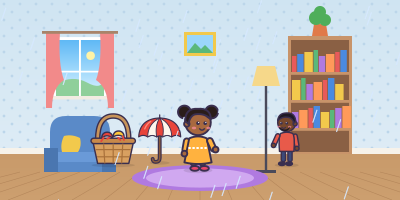
Ruby had a plan for the day. She would have a picnic in the park.

She filled a basket with bread and plums. Dad packed a big red blanket, too.

Then they looked out of the big window. Gray clouds were rolling in fast.

Drip, drip, drop went the rain. Ruby felt her smile fall off.

"No picnic," she said. "The grass will be wet." She sat down on the stairs.

Dad looked at the full basket. Then he looked at the clean floor.

"Why not have it here?" he said. "The floor is not wet at all."

Ruby sat up. "A picnic inside!" she said. She ran to get the blanket.

They spread it out by the window. The rain tapped on the glass.

Ruby ate bread and a plum. She felt warm and dry and happy.

"This is the best picnic yet," she said. Dad smiled. The rain kept on tapping.

Questions

1. What does Ruby plan?
  1. A picnic
  2. A swim
  3. A trip
2. Why can't they go to the park?
  1. It is night
  2. It rains
  3. It is cold
3. Where is the new picnic?
  1. In the car
  2. On a boat
  3. On the floor
4. How does Ruby change?
  1. From sad to happy
  2. From happy to sad
  3. She stays the same

Words to know

  • picnic: a meal outside
  • blanket: a soft cover
  • plums: sweet purple fruit

Answer key: Ruby and the Rainy Picnic

  1. A. A picnic
  2. B. It rains
  3. C. On the floor
  4. A. From sad to happy
For teachers: standards and questions with an answer key

Common Core standards

  • RL.1.1 · Grade 1 · Key details and evidence in a story. Asks and answers questions about key details: what is in the basket and where the picnic ends up.
  • RL.1.3 · Grade 1 · Characters, settings and events. Asks about a character’s feelings and how they change, and how the problem is solved.

All the Common Core reading standards, and the pages that work toward each

Right there (The answer is stated in the book.)

  1. What did Ruby put in the basket?
    Show answerBread and plums. The book says: “She filled a basket with bread and plums.”
  2. Where did Ruby and Dad have the picnic in the end?
    Show answerInside, by the window. The book says: “They spread it out by the window.”

Think and search (Put clues from the book together.)

  1. Why did Ruby feel her smile fall off?
    Show answerThe rain started, and she thought the grass would be too wet for a picnic. The book says: “"No picnic," she said. "The grass will be wet."”
  2. How did Dad fix the problem?
    Show answerHe saw the basket was full and the floor was dry, so they could have the picnic inside. The book says: “"Why not have it here?" he said. "The floor is not wet at all."”

On my own (Use the book to think further.)

  1. What would you do on a rainy day if your plan had to change?
    Show answerAnswers will vary. Ruby and Dad changed the place and still had a happy picnic. The book says: “"This is the best picnic yet," she said.”

Written and checked by hand against the book. Standards codes are the Common Core’s own; the lines are ours.

For the teacher: how this passage is levelled

“Ruby and the Rainy Picnic” is a reading level 6 story. Every Peabody story at this level is written and checked to keep sentences to 10 words or fewer, to aim at an average of 6 words a sentence, and to show 12 to 20 words on a screen. At most 7% of its words may be off the familiar-word list. Readers reach this level by climbing, not by grade.

This passage153 words, 11 screens, 4 multiple-choice questions with an answer key, and 3 vocabulary words with kid-sized meanings
Longest sentence at this level10 words
Words on a screen12 to 20
Skills practised at this levelphonics (sounding words out), first sounds, sight words

Reading level 6: the limits, a real sample and the free games. Peabody is a learning app, not an assessment: use the questions to talk about the story, not to grade a child.