Skip to the main content
PeabodyMake a free story

The Little Lantern: reading passage and questions

A free printable short story reading passage, written at a grade 1 reading level (Peabody level 6; 167 words) with 4 comprehension questions and an answer key. No sign-up.

Name: ____________________Date: ____________

The Little Lantern

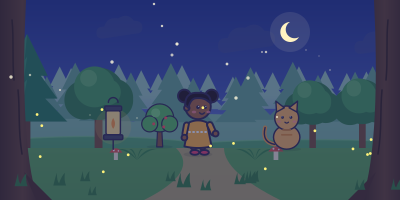
Lila's cat did not come home. The sun had set and the woods were dark.

She took her little lantern from the shelf. It made a small, warm circle of light.

"Here, kitty, kitty," she called. Her voice sounded small in the big, dark woods.

An owl looked down from a branch. "Who goes there?" he asked in a soft voice.

"It is just me," said Lila. "I am looking for my cat. Have you seen her?"

"I heard a meow by the creek," said the owl. "It was near the stones."

Lila walked to the creek. The lantern lit the water and made it shine.

A baby rabbit sat on a stone. It was lost and shaking. Lila knelt beside it.

"I will light your way home," she said. The rabbit hopped to its burrow.

Then, from behind a log, came a soft meow. Out walked the cat, with moss on her tail.

Lila hugged her cat. They walked home under the stars. The lantern glowed.

Questions

1. What does Lila look for?
  1. Her dog
  2. Her cat
  3. A lantern
2. Who tells her where to look?
  1. A rabbit
  2. A fox
  3. An owl
3. Who else does Lila help?
  1. A baby rabbit
  2. A bear
  3. A mouse
4. Why is the lantern important?
  1. It is loud
  2. It lights the dark
  3. It is heavy

Words to know

  • lantern: a carried light
  • creek: a small stream
  • burrow: a tunnel home

Answer key: The Little Lantern

  1. B. Her cat
  2. C. An owl
  3. A. A baby rabbit
  4. B. It lights the dark
For teachers: standards and questions with an answer key

Common Core standards

  • RL.1.1 · Grade 1 · Key details and evidence in a story. Asks and answers questions about key details: what Lila carries and what the owl heard.
  • RL.1.3 · Grade 1 · Characters, settings and events. Asks the child to describe a character’s actions and feelings: why Lila stops to help the rabbit.

All the Common Core reading standards, and the pages that work toward each

Right there (The answer is stated in the book.)

  1. What did Lila take from the shelf?
    Show answerHer little lantern. The book says: “She took her little lantern from the shelf.”
  2. Where did the owl hear a meow?
    Show answerBy the creek, near the stones. The book says: “It was near the stones.”

Think and search (Put clues from the book together.)

  1. Why did Lila stop to help the baby rabbit?
    Show answerIt was lost and shaking, so she lit its way home with her lantern. The book says: “A baby rabbit sat on a stone. It was lost and shaking.”
  2. How did the lantern help in the dark woods?
    Show answerIts light made a small warm circle, lit the water and showed the way. The book says: “It made a small, warm circle of light.”

On my own (Use the book to think further.)

  1. What does Lila show about being kind, even when she is worried?
    Show answerAnswers will vary. A good answer: she is looking for her own cat but still helps the lost rabbit. The book says: “"I will light your way home," she said.”

Written and checked by hand against the book. Standards codes are the Common Core’s own; the lines are ours.

For the teacher: how this passage is levelled

“The Little Lantern” is a reading level 6 story. Every Peabody story at this level is written and checked to keep sentences to 10 words or fewer, to aim at an average of 6 words a sentence, and to show 12 to 20 words on a screen. At most 7% of its words may be off the familiar-word list. Readers reach this level by climbing, not by grade.

This passage167 words, 11 screens, 4 multiple-choice questions with an answer key, and 3 vocabulary words with kid-sized meanings
Longest sentence at this level10 words
Words on a screen12 to 20
Skills practised at this levelphonics (sounding words out), first sounds, sight words

Reading level 6: the limits, a real sample and the free games. Peabody is a learning app, not an assessment: use the questions to talk about the story, not to grade a child.