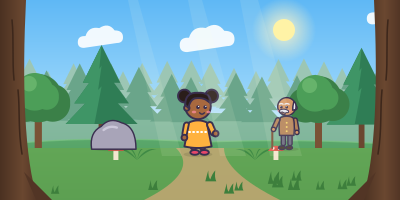
The Fossil in the Creek
On Saturday morning, Maya and her little brother Eli went walking with their grandpa along the creek at the edge of the park. The water was low and clear, and the stones along the bank were every color you could imagine. Eli kept stopping to pick one up, and Grandpa kept saying, "Look with your eyes first."
Then Maya noticed something strange. Half buried in the gravel was a gray stone, curled into a spiral like a snail's shell, with tiny ridges running across it like the lines on a fingerprint. She knelt down, brushed the sand away with her fingers, and called to her brother. "Eli, come look. I think this might be a fossil."
Grandpa crouched beside them and pushed his glasses up his nose. "It sure looks like one," he said, "but I don't know what it is, and I don't want to guess." He took out his phone. "My friend Ruth works at the natural history museum. Let's send her a picture and see what she thinks."
A few minutes later the phone rang, and Grandpa put it on speaker. "What you found is called an ammonite," said Ruth. "It was a sea animal with a coiled shell. Fossils like that form when a shell gets buried fast and slowly turns to stone. That can take a very long time, thousands or even millions of years."
"But we're nowhere near the sea," said Eli. Ruth laughed. "That's the best clue," she said. "Rock that formed under an ancient sea can hold sea animals. So long ago, this creek bed was probably under water. You are standing on the floor of a sea that is gone." Maya looked at the ground differently after that.
"Can we keep it?" asked Maya. Grandpa pointed to the sign by the path. It said that nothing in the park may be taken home, not even a stone. "Rules like that help every visitor see what we saw," he said. So they took photographs from every side, and Maya laid her hand next to it to show how big it was.
They set the ammonite back in the gravel, just as they had found it. That night at the kitchen table, Maya drew the spiral shell in her notebook, ridge by ridge, while Eli wrote the label in big letters: AMMONITE. Under it Maya added a line of her own. "Found by us. Left for the next person."
Questions
- A stone spiral that was a fossil
- A dinosaur tooth
- A snail
- A park sign
- Ruth, who works at a museum
- Their teacher
- It showed the stone was fake
- It showed the creek was deep
- It showed the rock was once under an ancient sea
- Eli was afraid of it
- The park rules say nothing may be taken home
- It was too heavy
- Bent low with knees bent
- Ran fast
- Fell asleep
Words to know
- fossil: stone-like remains
- ammonite: coiled sea animal
- spiral: a curling shape
- gravel: small loose stones
Answer key: The Fossil in the Creek
- A. A stone spiral that was a fossil
- B. Ruth, who works at a museum
- C. It showed the rock was once under an ancient sea
- B. The park rules say nothing may be taken home
- A. Bent low with knees bent
For the teacher: how this passage is levelled
“The Fossil in the Creek” is a reading level 9 story. Every Peabody story at this level is written and checked to keep sentences to 32 words or fewer, to aim at an average of 11 words a sentence, and to show 55 to 85 words on a screen. At most 11% of its words may be off the familiar-word list. Children in 5th grade start at this level.
| This passage | 406 words, 7 screens, 5 multiple-choice questions with an answer key, and 4 vocabulary words with kid-sized meanings |
|---|---|
| Longest sentence at this level | 32 words |
| Words on a screen | 55 to 85 |
| Skills practised at this level | vocabulary, spelling |
Reading level 9: the limits, a real sample and the free games. Peabody is a learning app, not an assessment: use the questions to talk about the story, not to grade a child.