
Holger Danske Under Kronborg
In Denmark there is an old castle called Kronborg, which stands on the shore of a narrow stretch of water known as the Sound of Elsinore. Every day, enormous ships sail along the Sound, English ships and Russian ships and Prussian ships and many others, and when they pass the castle, they salute it with a cannon. "Boom!" go the ships, and the castle answers with a cannon of its own. "Boom!" It is merely a polite way of saying "Good day!" and "Thank you!" across the water, exactly like two neighbors who wave to each other over a fence.
In winter, no ships can pass, because the Sound is covered with thick, solid ice. Then it becomes a broad highway that leads from Denmark to Sweden, and the people of both countries walk and drive across it. They encounter one another in the middle, where the Danish and Swedish flags flutter together over the ice. They do not say hello with cannons. They shake hands warmly and say "Good day!" and "Thank you!" in their own languages, and they buy wheat bread and biscuits from each other, because everyone is completely convinced that foreign bread tastes best.
But the greatest thing about Kronborg is not on top of the rock, and nobody has ever seen it. Far below the castle there are huge, dark vaults, so deep and so cold that nobody has ever explored them. In those vaults sits a hero named Holger Danske, which means Holger the Dane. He is dressed from head to foot in iron and steel, and he rests his head on his powerful, folded arms. His long beard has spread out across a marble table, and over the centuries it has become so firmly attached into the stone that it cannot be pulled loose.
This is what an old grandfather told his little grandson one winter evening. The old man was a carver, and he had spent his whole life making the magnificent wooden figures that decorate the front of a ship, the faces and the dragons and the sailors with their caps. His hands were broad and scarred and remarkably gentle, and his workshop smelled of fresh shavings. The boy listened with his chin on his knees, and he believed every word, because his grandfather had never told him anything except the truth.
"He is sleeping," said the carver, "but he is not dreaming of himself. He is dreaming of Denmark. In his sleep he sees everything that happens throughout the entire kingdom, the fields and the harbors and the villages and the children in their beds. As long as Denmark is safe, he sleeps on. But if the country were ever in real danger, then Holger Danske would stand up in his tremendous strength. His beard would tear loose, the marble table would split in two, and he would come out of the dark to help."
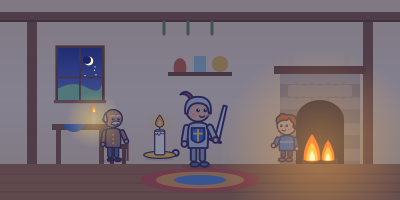
While he talked, the old man picked up a block of oak and began to carve. His knife moved quickly, and remarkable shapes appeared as if they had always been hiding inside the wood. He carved an impressive figure with a proud face and a long beard, holding a broad sword in one hand and resting the other on a shield decorated with lions and hearts. Wood curls fell around his feet. The boy watched until his eyes grew heavy, and the carver tucked him into bed and went back to his workbench to finish the figure alone.
The old man held the finished figure up to the candle, and he nodded with considerable satisfaction. It was an excellent carving, the best he had made in years. The painted armor appeared to gleam like real iron, and the lions on the shield seemed ready to leap. "The lions are for strength," he murmured thoughtfully, "and the hearts are for kindness." Then his daughter-in-law came in with a lamp and cried out in surprise, because she thought that she had seen that face somewhere before. "Holger Danske, and the old coat of arms!" she said.
They sat down to supper, and the old man talked on, because the carving had made him thoughtful. He explained that there is more than one kind of strength, and that a sword is only one of them. He pointed to a shelf of well-worn books written by a brilliant Danish author, who had carved people's silly habits out of words instead of wood. He mentioned a famous astronomer who studied the planets who had used his sharp intelligence like a blade to clear a road among the stars. "Holger comes to us in many different ways," said the old carver.
He told them about a sculptor who had been born in the same trade as himself, a carver's son with white hair and broad shoulders, whose statues had made Denmark famous in every country in the world. The sculptor worked in marble, and the old man only worked in wood, but they used the same kind of determination. "Holger Danske keeps coming back," said the grandfather, smiling over his soup, "in the shape of anyone who contributes honor and brilliance to our land. Now let us wish good health to the great sculptor, and then to bed."
In his little bed, the boy was not asleep after all. He lay with his eyes wide open in the dark, and he saw the castle of Kronborg in his imagination, standing proud above the Sound with the wind blowing around its towers. He saw the hero in the vaults below, sitting at the marble table with his head on his arms. In the quiet he imagined that the hero was listening. He pressed his chin into the pillow and imagined that his own beard was growing into the mattress, and he fell asleep with a smile on his face.
And in the deep dark under the castle, Holger Danske really did dream of the room where the carver and his family sat. He heard every word that they spoke. He heard about the lions and the hearts, and the books and the stars, and the sculptor. Majestically he bowed his iron head, and in his dream he spoke in a voice like distant, rumbling thunder. "Remember me, good Danish people," he said. "Keep me in your memories. I will not fail to come on the day when you genuinely need me."
The next morning, the sun shone brightly on the towers of Kronborg. A ship sailed into the Sound, and the castle greeted it with a friendly boom. Another ship passed by, and the castle answered again. But as loudly as the cannons roared, Holger Danske did not wake, for they only meant "Good day!" and "Thank you!" The sound that would rouse him would have to be something completely different. Nobody knows when he will rise. But people in Denmark are certain that he will, if the day ever comes, because strength and kindness exist together in him.
Questions
- In a tower at the top of the castle
- In dark vaults deep beneath Kronborg
- In the middle of the Sound
- Every winter
- When a ship fires its cannon
- When Denmark is in real danger
- Holger has many names
- People who bring honor and brilliance to Denmark carry something of Holger
- Holger has many brothers
- To greet with honor
- To argue loudly
- To sail away
- Money and luck
- Strength and kindness
- Speed and silence
Words to know
- vaults: underground rooms
- salute: greet with honor
- carver: wood shaper
- astronomer: star scientist
- sculptor: stone shaper
Answer key: Holger Danske Under Kronborg
- B. In dark vaults deep beneath Kronborg
- C. When Denmark is in real danger
- B. People who bring honor and brilliance to Denmark carry something of Holger
- A. To greet with honor
- B. Strength and kindness
The story in pictures
- Part One · The Castle by the Sound
- Part Two · The Ship Carver
- Part Three · Lions and Hearts
- Part Four · The Dreamer in the Dark



For the teacher: how this passage is levelled
“Holger Danske Under Kronborg” is a reading level 12 story. Every Peabody story at this level is written and checked to keep sentences to 48 words or fewer, to aim at an average of 14 words a sentence, and to show 90 to 130 words on a screen. At most 17% of its words may be off the familiar-word list. Children in 8th grade start at this level.
| This passage | 1167 words, 12 screens, 5 multiple-choice questions with an answer key, and 5 vocabulary words with kid-sized meanings |
|---|---|
| Longest sentence at this level | 48 words |
| Words on a screen | 90 to 130 |
| Skills practised at this level | vocabulary, spelling |
Reading level 12: the limits, a real sample and the free games. Peabody is a learning app, not an assessment: use the questions to talk about the story, not to grade a child.