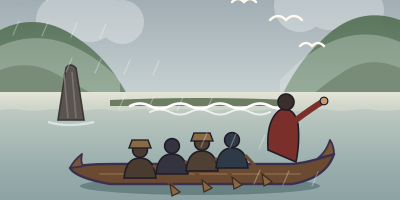
The Ocean in View
In May of 1804, a party of travelers left a camp near the Mississippi River and started up the Missouri River in boats. They were led by two captains, Meriwether Lewis and William Clark, and they were heading west. They hoped to reach the Pacific Ocean. The country ahead was not an unoccupied wilderness. Many nations lived there, each with its own language, its own towns, and its own extensive knowledge of the rivers and the mountains. The travelers depended on that knowledge, and they were about to find out exactly how much it would matter.
One member of the party was a Shoshone woman named Sacagawea. Her husband was one of the party's interpreters, and she traveled with him, and with the captains, all the way to the coast. In August of 1805, in the mountains, Captain Lewis met a Shoshone chief who was her brother. Lewis wrote about the meeting in his journal. Lewis wrote that he bought five good horses from the Shoshone for a very fair price, for the hard trip over the mountains, and a Shoshone guide went along to show the party the way.
On the far side of the mountains, the travelers came down into the country of the Nez Perce people. A leader whom the journals call the Twisted Hair sat with Clark and drew the river for him, in lines on a white elk skin. He showed where the river forked, how many days of travel lay between the places, and where the falls were. Clark did not speak the language, and the Twisted Hair did not speak English. They communicated entirely in signs, and the careful map did the rest.
In October, the travelers finally reached the Columbia River. At one place, Clark and a few men went ahead of the canoes, and the people stayed where they were and did not come out to meet them. Then Captain Lewis came down the river with the canoes, and the people saw Sacagawea. Clark wrote in his journal that the sight of a woman with the party told them that the travelers had come in peace, because no woman ever goes along with a war party. The people came out, sat down, and smoked with the visitors.
Now the travelers descended the Columbia in their canoes. The river grew wider every day, and it began to feel the tide. On November 2, Clark wrote that the river was five to seven miles across in places. He saw swans, geese, brants, cranes, and white gulls on the water, and great numbers of sea otters. Rain fell almost continually. The hills on both shores were high and steep, and the shore was bold and rocky. The river, the birds, and the weather all suggested to the travelers that the sea was near.
On the morning of November 7, a thick fog lay on the river, so thick that the travelers could not see across it. Two canoes of local people came to meet them and led them to a village of four houses, hidden behind a cluster of marshy islands, along a narrow channel of the river. The people gave their guests a welcome meal of fish, and sold them roots, three dogs, and otter skins. Clark wrote that they called themselves the Wahkiakum, and that the travelers paid in fishhooks, which the people liked very much, and he set down their name the way it sounded to him.
Clark wrote down what he saw in the village, because it was different from the villages upriver. Clark described the houses carefully, as a traveler describes something new. They were built entirely above the ground, with their eaves about five feet high. Inside, the beds were raised high above the dirt floor, and under them were stored baskets of dried fish, berries, and a root called wappato, which the people traded for and used as food. Clark noticed that their language was not the same as the language of the people upriver, with whom they traded.
After an hour and a half, the travelers set out again. A man dressed in sailor's clothes went with them as a pilot, showing the way through the maze of islands to the main channel. Clark wrote that the tide was coming in, and that without a pilot they would have had real trouble getting through. The river was wide and covered with islands. Water birds filled the marshes. By evening, the high hills had come right down to the water's edge, and the river had opened out into something like a bay.
They stopped at a second village that day, at the foot of some high hills, and bought a dog, some fish, and more wappato roots. Clark also bought beaver skins to make a new robe, because his own robe was rotten and good for nothing. Then they paddled twelve more miles before dark. The shore was rocky and bold, and the only place to camp was on a narrow strip of round stones. They laid their mats on the stones, above the line of the tide, and the rain kept falling.
The small canoe that had been lost in the fog that morning joined them in the evening, and the whole party was together again. Clark sat down to write his journal. He wrote that in the morning, when the fog cleared away just below the last village, they had seen the ocean. That night in camp he could hear it, too: the roaring noise of waves breaking on rocky shores, somewhere ahead. In another notebook he wrote a shorter note, that the ocean was in view, and what joy it brought.
Clark was looking at the wide mouth of the Columbia, where the river meets the tide, and there was still a considerable distance to go. The next day the swells were too high to go on, and the camp was cold and wet. The water was too salty to drink. But within days, Captain Lewis and a few men had traveled past Point Disappointment and some distance along the open ocean coast, and Clark wrote that, in spite of the weather, everyone in the party was cheerful and eager to see more of the sea.
Here is Clark's own sentence about that evening, from his journal of November 7, 1805. Clark spelled many words by ear, and so did many people at the time. His word Ocian means ocean, and Octean means ocean as well. The word anxious, in his sentence, means eager. He is writing about the Pacific, and about the people in his party who had come so far to see it. “Great joy in camp we are in View of the Ocian, this great Pacific Octean which we been So long anxious to See.”
Questions
- A leader called the Twisted Hair
- A Shoshone chief
- A pilot in sailor's clothes
- That the travelers had come in peace
- That the travelers were lost
- That the travelers wanted horses
- The river was full of islands and the tide was in
- They did not have a map
- The canoes were too big
- Eager
- Afraid
- Angry
- They knew the land better than anyone
- People who lived there shared what they knew
- They followed the birds
Words to know
- interpreter: language helper
- pilot: guide through
- tide: sea's rise
- anxious: eager
- Ocian: ocean
Answer key: The Ocean in View
- A. A leader called the Twisted Hair
- A. That the travelers had come in peace
- A. The river was full of islands and the tide was in
- A. Eager
- B. People who lived there shared what they knew
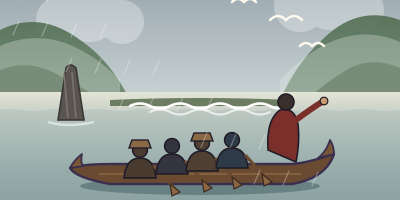
The story in pictures
- Part One · The Long Way West
- Part Two · The Wide River
- Part Three · Great Joy in Camp
For the teacher: how this passage is levelled
“The Ocean in View” is a reading level 12 story. Every Peabody story at this level is written and checked to keep sentences to 48 words or fewer, to aim at an average of 14 words a sentence, and to show 90 to 130 words on a screen. At most 17% of its words may be off the familiar-word list. Children in 8th grade start at this level.
| This passage | 1134 words, 12 screens, 5 multiple-choice questions with an answer key, and 5 vocabulary words with kid-sized meanings |
|---|---|
| Longest sentence at this level | 48 words |
| Words on a screen | 90 to 130 |
| Skills practised at this level | vocabulary, spelling |
Reading level 12: the limits, a real sample and the free games. Peabody is a learning app, not an assessment: use the questions to talk about the story, not to grade a child.