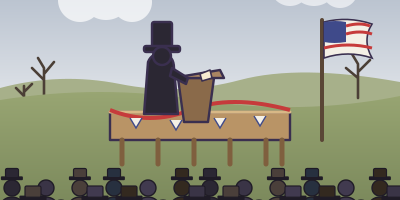
Two Minutes at Gettysburg
In the fall of 1863, the United States was in the middle of a civil war. Four and a half months earlier, a huge battle had been fought in the fields around Gettysburg, a small town in Pennsylvania, and a great many soldiers had died there. A new cemetery had been made for the soldiers who were killed on the Union side. It was called the Soldiers' National Cemetery, and it would be formally dedicated on November 19. A ceremony was planned, and a large crowd was expected to travel to the town.
The committee that planned the ceremony asked a famous speaker named Edward Everett to give the main speech, which people in those days called an oration. Then they invited the President. David Wills, who was helping to organize the day, wrote to Abraham Lincoln and asked him to set the grounds apart, after the oration, by saying a few suitable words. The letter said that the committee wished the head of the nation to set the grounds apart for their solemn purpose. Lincoln accepted. It was a great honor, but nobody expected his part to be the most remembered event of the whole day.
Lincoln left Washington on November 18, with three members of his cabinet beside him: William Seward, John Usher, and Montgomery Blair. He arrived in Gettysburg that evening. The ceremony was still a day away, but the town was already filling with crowds who had come for it. He spent the night in the home of David Wills. A crowd gathered outside, singing and calling for the President to speak. Lincoln stepped out to meet them, but he gave no formal speech. He said a few words, worked a while, and went to sleep around midnight.
The next day, November 19, about fifteen thousand people gathered on a hill near the town. Edward Everett spoke first. He was one of the best-known speakers in the country, and his speech was the kind that people expected for such an occasion: long, careful, and serious. It was thirteen thousand six hundred words long, and it lasted two hours. In 1863, lengthy speeches at the opening of a cemetery were common, a custom that had begun in 1831, at Mount Auburn Cemetery in Massachusetts. The crowd listened, and then the time came for the President to rise.
Lincoln stood up and spoke for only about two minutes. His speech was ten sentences long, with roughly two hundred seventy words in it. It did not describe the battle. It did not name a general, and it did not name the town. It did not even name the President who was speaking. Instead of saying I, the speech said we. It talked about a country, and about an idea, and about what the people standing there ought to do next. Then it was over, so quickly that the long afternoon seemed hardly to have changed.
His first words were Four score and seven years ago. A score is twenty, so he meant eighty-seven years. Count back from 1863 and you arrive at 1776, the year of the Declaration of Independence. Lincoln was reaching back to that moment. He reminded his listeners that the nation was born in liberty, and that it was dedicated to a simple idea: that all men are created equal. Then he said that the country was now in a great civil war, testing whether any nation built on such an idea could last.
Next he spoke about the ground they were standing on. He said that the people had come to set apart a part of the field as a final resting place for those who had given their lives so that their country might live. That was a fitting and proper thing to do, he said. But in a larger sense, no speaker could make the ground special. The soldiers who had struggled there, the living and the dead, had already done that, far beyond anything that anyone could add or take away.
Then Lincoln turned from the dead to the living, and this was the heart of the speech. He did not ask the people on the hill only to feel sad. He asked them to finish a job. The unfinished work, he said, was the great task still ahead of them. He asked everyone to promise that the soldiers would not have died for nothing, that the nation would have a new birth of freedom, and that a government of the people, by the people, and for the people would never vanish from the earth.
Lincoln wrote out the speech by hand more than once. Five copies are known today. He gave two to his secretaries, John Nicolay and John Hay. Later he wrote out three more, for people who asked and for good causes. The last of these, written for a man named Alexander Bliss, is signed and dated by Lincoln, and it is the one most people mean when they say the Gettysburg Address. It is on display in the White House, and its words are also carved into the wall of the Lincoln Memorial.
The day after the ceremony, Edward Everett wrote a kind note to the President. He said that he would be glad if he could flatter himself that he had come as near to the central idea of the occasion, in two hours, as Lincoln had done in two minutes. Everett was telling the President, kindly, that the short speech had been the better one. Lincoln wrote back that he was glad to know the speech had not been a total failure. The two men, one with a very long speech and one with a very short one, had shared the same afternoon.
Today, people read the Gettysburg Address in classrooms and at ceremonies around the world, and it has been printed, read aloud, and carved in stone. It has stayed alive because it says a great deal in a small space, in plain words that anyone can follow. It also leaves something out. Lincoln did not tell his listeners who had been right and who had been wrong in the battle. He told them what they still had to do. That is why one generation after another has been able to take the speech as its own.
Here are two sentences from the Gettysburg Address, in Lincoln's own words, from the copy he wrote for Alexander Bliss in 1863. He is speaking about the soldiers who fought at Gettysburg. The word dedicated means given completely to a purpose, as a person might promise to give their life to a worthy cause. “The world will little note, nor long remember what we say here, but it can never forget what they did here. It is for us the living, rather, to be dedicated here to the unfinished work which they who fought here have thus far so nobly advanced.”
Questions
- Edward Everett
- John Hay
- David Wills
- Two hours
- Two minutes
- Twenty minutes
- A point in a game
- A written song
- Twenty
- Go home and rest
- Remember the battle's winners
- Finish the unfinished work the soldiers had begun
- It says a lot in plain words anyone can follow
- It is the longest speech ever given
- It tells who won the battle
Words to know
- oration: long formal speech
- cemetery: burial ground
- dedicated: given to
- score: twenty years
- nobly: with honor
Answer key: Two Minutes at Gettysburg
- A. Edward Everett
- B. Two minutes
- C. Twenty
- C. Finish the unfinished work the soldiers had begun
- A. It says a lot in plain words anyone can follow
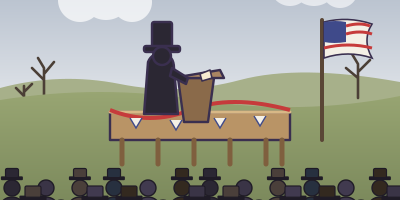
The story in pictures
- Part One · The New Cemetery
- Part Two · Two Speeches
- Part Three · What He Asked


For the teacher: how this passage is levelled
“Two Minutes at Gettysburg” is a reading level 12 story. Every Peabody story at this level is written and checked to keep sentences to 48 words or fewer, to aim at an average of 14 words a sentence, and to show 90 to 130 words on a screen. At most 17% of its words may be off the familiar-word list. Children in 8th grade start at this level.
| This passage | 1153 words, 12 screens, 5 multiple-choice questions with an answer key, and 5 vocabulary words with kid-sized meanings |
|---|---|
| Longest sentence at this level | 48 words |
| Words on a screen | 90 to 130 |
| Skills practised at this level | vocabulary, spelling |
Reading level 12: the limits, a real sample and the free games. Peabody is a learning app, not an assessment: use the questions to talk about the story, not to grade a child.