A New Nation Speaks
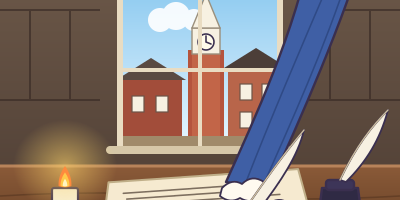
In the summer of 1776, thirteen colonies along the eastern coast of North America were ruled by Great Britain, and many of their people were angry about the way they were treated. Their leaders met in Philadelphia, in a building called the Pennsylvania State House. They were known as the Second Continental Congress, and they were already acting like a government. They had formed an army, started a post office, and printed their own money. But one enormous step was still left to take. Would they tell the world, in plain words, that they intended to be free?
On June 7, a delegate from Virginia named Richard Henry Lee stood up in the State House and read out a resolution. The colonies, it said, ought to be free and independent states, and every political connection with Britain ought to be ended. Not everyone was ready for that. Some delegates still hoped to make peace, and the vote was put off. Congress planned to take a break of three weeks. But before the delegates scattered, they chose five men to write a paper explaining to everyone why the colonies wanted to separate.
The five were John Adams, Benjamin Franklin, Roger Sherman, Robert Livingston, and Thomas Jefferson of Virginia. Years later, Jefferson remembered that the others pressed him to write the first draft by himself. He was thirty-three years old. He agreed, and he wrote it. Before he handed it in, he showed it to Franklin and Adams and asked for their corrections. After that the draft went to the full Congress, where every delegate would get a chance to argue with it, change it, and cut it down. Jefferson's rough draft, with the changes made by Franklin and Adams, still survives at the Library of Congress.
The paper had an enormous job to do. It was written for the whole world to read: for other countries, for ordinary people, and for the soldiers in the army. It opened by saying that when a people decide to separate from their ruler, they owe everybody an explanation. Then it gave a long list of complaints against King George the Third. That list is far too long to retell here, and it is left for the full text, which you can read for yourself. The part that people still remember comes right near the beginning.
There, Jefferson set down a few ideas that he thought were so plain that nobody should need proof of them. People are created equal. They have rights that no ruler can take away, such as the right to live, the right to be free, and the right to chase after happiness. Governments exist to protect those rights, and they get their power from the consent of the people they rule. And if a government stops protecting its people, the people have the right to change it. Those were very big ideas for 1776.
Congress took the ideas seriously. On July 2, the delegates voted for independence. Twelve colonies said yes, and New York did not vote. Right away, the delegates began to go over Jefferson's draft, line by line, changing some parts and cutting out others, and Jefferson kept notes of what they changed. They kept working through all of July 3 and into the late morning of July 4. When they were finished, the Declaration was officially adopted. Even after all that arguing, the basic paper was still Jefferson's, and the opening ideas were kept.
That same day, a printer named John Dunlap set the whole paper in type. Nobody knows for certain how many copies came off his press during that busy night, but the job had to be finished quickly. On the morning of July 5, members of Congress sent copies out to the assemblies of the colonies, to committees, and to the officers who commanded the army. Fresh paper, still smelling of ink, set out along the roads in every direction. This was how news traveled in 1776, and it had to move as fast as horses and people could carry it.
Three days later, at noon on July 8, the Declaration was read out loud in public, in three places at once. In Philadelphia, a man named John Nixon read it in the yard behind the State House. It was also read in Trenton, New Jersey, and in Easton, Pennsylvania. Many people in those days could not read well, or could not read at all, so hearing the words spoken in the open air was how a great many of them met the Declaration for the first time. The country was only a few days old.
The paper did not end the war. Months later, in December, British forces came so near to Philadelphia that Congress packed up and left. A light wagon carried the big new copy of the Declaration to Baltimore, where it stayed until the following spring. The new country had a long and uncertain road ahead of it, and it would go on fighting for years. But the idea was out in the world now, in print and in people's ears, and it was too late for anyone to take it back.
On August 2, a clean copy of the Declaration was signed on parchment. A man named Timothy Matlack, who worked for the Congress, probably wrote it out in a large, clear hand. John Hancock, the president of Congress, signed first, with a bold name in the middle of the page. In the end, fifty-six delegates signed. Many people think that everyone signed on July 4, but that is not what happened. The signing took place weeks later, and a few of the delegates who had voted for the paper in July never signed it at all.
The words were bigger than the men who wrote them. Jefferson held enslaved people, and so did many other men in that room. The promise of equal rights was not kept for the people they held, or for many others, in 1776. Some people noticed the gap even then, when the Declaration was first published. In the years since, many have pointed to those same words and said, keep your promise. That is a large part of the reason the sentence is still read, taught, and argued about so many years later, in classrooms and in courts.
Here is the famous part in Jefferson's own words, from the Declaration of Independence, 1776. A few of the words are old ones. Endowed means given, and unalienable means that cannot be taken away. In this sentence the word men is how people wrote in 1776, and the promise in it is the one the story has been about all along. “We hold these truths to be self-evident, that all men are created equal, that they are endowed by their Creator with certain unalienable Rights, that among these are Life, Liberty and the pursuit of Happiness.”
Questions
- Thomas Jefferson
- John Hancock
- Richard Henry Lee
- It voted on it without any changes
- It changed some parts and cut others
- It sent it to Britain to be fixed
- It had no title, so nobody knew about it
- Many people could not read well, or at all
- Only the army was allowed to have copies
- They say yes to it
- They pay it money
- They run for office
- It was kept for everyone right away
- The promise was bigger than the people who wrote it, and not yet kept for all
- It was only meant as a joke
Words to know
- delegate: chosen representative
- independence: being free
- consent: saying yes
- endowed: given
- unalienable: cannot be taken
Answer key: A New Nation Speaks
- A. Thomas Jefferson
- B. It changed some parts and cut others
- B. Many people could not read well, or at all
- A. They say yes to it
- B. The promise was bigger than the people who wrote it, and not yet kept for all
The story in pictures
- Part One · A Summer in Philadelphia
- Part Two · The Paper
- Part Three · Out into the Squares
For the teacher: how this passage is levelled
“A New Nation Speaks” is a reading level 12 story. Every Peabody story at this level is written and checked to keep sentences to 48 words or fewer, to aim at an average of 14 words a sentence, and to show 90 to 130 words on a screen. At most 17% of its words may be off the familiar-word list. Children in 8th grade start at this level.
| This passage | 1151 words, 12 screens, 5 multiple-choice questions with an answer key, and 5 vocabulary words with kid-sized meanings |
|---|---|
| Longest sentence at this level | 48 words |
| Words on a screen | 90 to 130 |
| Skills practised at this level | vocabulary, spelling |
Reading level 12: the limits, a real sample and the free games. Peabody is a learning app, not an assessment: use the questions to talk about the story, not to grade a child.