The Day Water Spoke
Helen Keller was born on June 27, 1880, in Tuscumbia, a small town in northern Alabama. As a baby she was bright and eager, and she copied everything she saw other people do. At six months she could say How d'ye, and one day she attracted everyone's attention by saying Tea, tea, tea quite plainly. She also learned the word water. Then, before she was two, an illness left her unable to see or hear. Her family loved her very much, but they did not know how to teach her, and she had only a few signs with which to communicate.
Helen invented those signs herself. A shake of her head meant no and a nod meant yes. A pull meant come and a push meant go. If she wanted bread, she would imitate the actions of cutting slices and buttering them. Through all of this, she kept one sound from her baby days. It was the sound wah-wah, which stood for the word water, and she went on making it after every other word was gone. She stopped making that sound only when she learned to spell the word with her fingers, and that was still ahead of her.
When she was about six, her parents took her to a doctor in Baltimore, who could not cure her but said that she could be educated. He sent them on to Washington, to Alexander Graham Bell, who knew about schools and teachers for deaf and blind children. Dr. Bell held Helen on his knee and let her examine his watch, and he made it strike for her. He understood her signs, and she understood that he did, and she loved him at once. He advised her father to write to the Perkins Institution in Boston, and in a few weeks a kind letter came back saying that a teacher had been found.
The teacher was Anne Sullivan, and she arrived in Tuscumbia on March 3, 1887, three months before Helen's seventh birthday. Helen later called it the most important day she could remember. On that afternoon she was waiting on the porch, with the warm sun shining through the honeysuckle onto her upturned face. She felt approaching footsteps and stretched out her hand, thinking that it was her mother. Someone took it, and she was caught up and held close in the arms of the person who had come to reveal the world to her.
The next morning, Miss Sullivan gave Helen a doll and slowly spelled the letters d-o-l-l into her hand, using the manual alphabet, which is a way of making every letter with the fingers. Helen was delighted with the finger game, and she imitated it right away. She did not know that she was spelling a word, or that words even existed. During the following weeks she learned to spell pin, hat, cup, sit, stand, and walk, and she learned them the way a person learns a pattern, without understanding what any of it was for.
Miss Sullivan wrote regular letters to a friend about her work. On March 31, she counted the words Helen knew, which came to eighteen nouns and three verbs, including doll, mug, pin, key, dog, hat, cup, box, water, and milk. A few of them, such as eye, finger, toe, and head, were words that Helen had asked for herself. But two of the words were still tangled together. Helen confused the nouns mug and milk with the idea of drinking, and she would act out drinking whenever she spelled either one of them.
Water caused the same kind of difficulty. Miss Sullivan tried to impress upon her that mug is the cup and water is what the cup holds, but Helen persisted in confusing the two. It was not an easy lesson, and it was not a short one. Helen later remembered that she grew impatient with these repeated attempts. In despair, her teacher dropped the subject for the time being. She did not give up on it, however. She planned to renew the lesson at the first opportunity, and that opportunity came sooner than either of them could have expected.
On the morning of April 5, 1887, while Helen was washing, she wanted to know the name for water. When Helen wants to know the name of anything, Miss Sullivan wrote that day, she points at it and pats her teacher's hand. So Miss Sullivan spelled w-a-t-e-r, and thought nothing more about it until after breakfast. Then it occurred to her that, with the help of this one new word, she might succeed in straightening out the entire confusion between the mug and the milk, once and for all.
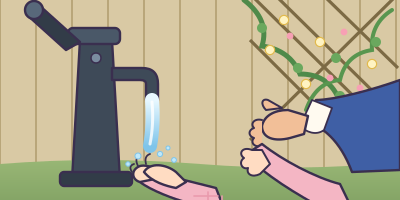
They walked out to the pump house, which stood over the well, with a trellis covered in sweet-smelling honeysuckle beside it. Miss Sullivan made Helen hold her mug under the spout while the pump was worked. As the cold water gushed forth, filling the mug and running over Helen's hand, Miss Sullivan spelled w-a-t-e-r into Helen's other hand, first slowly, and then rapidly. Helen stood perfectly still, with her whole attention fixed on the movements of the fingers against her palm. Years afterward, she remembered the cool stream pouring over one of her hands, and the fingers spelling into the other.
Miss Sullivan wrote that the word, coming so close upon the feeling of cold water rushing over Helen's hand, seemed to startle her. She dropped the mug and stood as one transfixed, and a new light came into her face. She spelled water several times. Then she dropped to the ground and asked what it was called, pointing to the pump and then to the trellis, and suddenly she turned around and asked for her teacher's name. Miss Sullivan spelled one word: Teacher. In that instant, Helen had understood that everything has a name.
Just then the nurse brought Helen's little sister into the pump house, and Helen spelled baby and pointed to her. All the way back to the house she was highly excited, and she learned the name of every object she touched, so that in a few hours she had added about thirty new words, among them door, open, shut, give, go, and come. That night, as Helen lay in her crib, she was happier than any child could have been, and for the first time in her life she longed for a new day to come.
Helen Keller went on to learn a great deal more. In 1890 she began lessons in speaking with a teacher named Sarah Fuller, and she was thrilled when she said her first connected sentence, It is warm. It took years of work with Miss Sullivan before most people could understand her. She went to college at Radcliffe, and she wrote the book from which this story is told. Here are two sentences from it, in her own words, about the morning at the pump. “As the cool stream gushed over one hand she spelled into the other the word water, first slowly, then rapidly.” “Everything had a name, and each name gave birth to a new thought.”
Questions
- Tea
- Water
- Doll
- The word doll
- The word water
- Helen's name
- Door and open
- The mug and what was inside it
- Her mother and her teacher
- Poured out quickly
- Dripped slowly
- Froze solid
- That everything has a name
- That water is cold
- That her sister was nearby
Words to know
- alphabet: set of letters
- trellis: vine frame
- gushed: poured out
- nouns: naming words
- opportunity: good chance
Answer key: The Day Water Spoke
- B. Water
- A. The word doll
- B. The mug and what was inside it
- A. Poured out quickly
- A. That everything has a name
The story in pictures
- Part One · A Teacher Is Sent For
- Part Two · Words in the Hand
- Part Three · At the Pump
For the teacher: how this passage is levelled
“The Day Water Spoke” is a reading level 12 story. Every Peabody story at this level is written and checked to keep sentences to 48 words or fewer, to aim at an average of 14 words a sentence, and to show 90 to 130 words on a screen. At most 17% of its words may be off the familiar-word list. Children in 8th grade start at this level.
| This passage | 1188 words, 12 screens, 5 multiple-choice questions with an answer key, and 5 vocabulary words with kid-sized meanings |
|---|---|
| Longest sentence at this level | 48 words |
| Words on a screen | 90 to 130 |
| Skills practised at this level | vocabulary, spelling |
Reading level 12: the limits, a real sample and the free games. Peabody is a learning app, not an assessment: use the questions to talk about the story, not to grade a child.