
Kintaro of Mount Ashigara
On the slopes of Mount Ashigara in Japan, far above the villages and beyond the last path that any traveler used, there stood an isolated cottage in a forest of tall pines. A boy named Kintaro lived there with his mother. Everyone who knew about him called him the Golden Boy, and the explanation was straightforward. He was so strong that people could scarcely believe it. By the time he was eight years old, he could chop down trees as quickly as the grown woodcutters, and his mother gave him a large axe of his own, specially sharpened so that he could help them.
The woodcutters called him the Wonder Child, and they called his mother the Old Nurse of the Mountains, because they did not know anything about her past. Kintaro liked to spend his free afternoons smashing boulders into pebbles, just to see how many pieces he could make. He had no brothers and no sisters, and he lived so far from the villages that there were no other children for miles. You might think that this would have made him lonely, but Kintaro had found a different kind of company, and he was thoroughly satisfied with it.
He had made friends with the animals of the mountain. Because he spent every day among them, he had learned to understand their language, and they in turn had learned to trust him completely. His four best friends were a bear, a deer, a monkey and a hare. The bear often brought her cubs over to tumble in the grass, and when it was time to go home, Kintaro would climb onto her broad back and ride all the way to her cave. The deer allowed Kintaro to throw both arms around its neck without worrying about the antlers.
One bright morning Kintaro set out for the high country, and the bear, the deer, the monkey and the hare followed behind him in an enthusiastic procession. They walked uphill and downhill, over rocky paths and through tall grass, until the trees opened and they stepped onto a wide, sunny plain covered in wildflowers. The deer rubbed his antlers against a tree for pleasure. The monkey scratched his back, the hare smoothed his long ears, and the bear gave a rumbling grunt of satisfaction. "What a magnificent place," said Kintaro. "Shall we have a wrestling match?"
Everybody enthusiastically agreed. The bear was the largest and the oldest, so she volunteered to build the platform, and she began to dig up the earth and pat it flat with her great paws. The others helped her, and soon there was a smooth round ring in the middle of the meadow. Kintaro announced that he would sit on a mossy stone and watch, and that he would give a rice dumpling from his lunch box to the winner of each round. The deer was chosen as the umpire, because he had the best view from his tall legs and the most impressive voice in the mountains.
The monkey and the hare went first. The deer stood between them with a leaf held high above his head. "Red-back, are you ready?" he called to the monkey, who had a red back, and then he asked the hare, "Long-ears, are you ready?" When he dropped the leaf, the two little wrestlers charged forward, shouting "Yoisho! Yoisho!" The bear cheered for the hare, the deer shouted warnings to the monkey, and they pushed and tugged back and forth near the edge of the platform until the hare gave one last shove and sent the monkey tumbling off with a bounce.
The monkey sat up rubbing his back, and he was extremely indignant. He complained that his foot had slipped and that it was not a legitimate victory, so Kintaro let them try a second round. This time the monkey, who was as cunning as monkeys generally are, grabbed the hare's long ear and tugged until the hare yelped, and then the monkey hooked his leg and sent him sprawling. Kintaro gave a dumpling to each of them, and the monkey was so pleased that he forgot his sore back entirely. Then the deer wrestled the hare, and the bear wrestled the deer, and the afternoon passed in a delightful blur of acrobatics.
At last Kintaro stood up and said that it was time to go home. They set off down the mountain together in the golden evening light, and before long they came to a deep river that rushed along between rocky banks, shouting "don, don" as it went. There was no bridge anywhere. The animals stood in a worried row and looked at the swift brown water, wondering how they could possibly reach their homes before dark. Kintaro only smiled. "Wait a moment," he said. "I will make you a bridge in a few minutes."
He examined the bank carefully, trees and roots and boulders, until he discovered an enormous tree that stood alone right at the water's edge. He wrapped both arms around the trunk and pulled with all of his might, once, twice, and then a third time. At the third pull the roots gave way with a great groan, and the whole tree toppled over with a crash and landed across the river, forming an extraordinary bridge. "There," said Kintaro, dusting off his hands. "It is completely safe. Please follow me." He walked across first, and the four animals came after him, whispering to one another about how strong he was.
None of them noticed that someone else had been observing the whole performance. A woodcutter was standing on a rock above the river, and he had seen everything. He rubbed his eyes twice to make sure that he was not dreaming, because he had just seen a small boy pull a tree out of the ground and lay it across a torrent as easily as another child might pick a flower. "That is no ordinary child," he said to himself. "I must find out who he is before the sun goes down." And he hurried quietly after the little group, keeping a safe distance behind them.
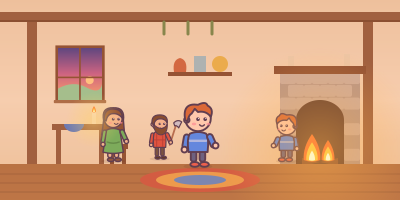
On the far bank the animals went their own ways to their dens and nests, and Kintaro walked on alone to the cottage in the pine woods, where his mother was waiting by the lamp. "Mother, I am home!" he called. She told him that he was late and that she had started to worry. He explained that he had been wrestling on the high plain with his friends, and then he added, with tremendous seriousness, that of course he himself was the strongest, and that the bear came next. His mother smiled and said nothing, because she was proud of him and did not want to make him arrogant.
Suddenly a voice came from outside the door. "Little boy, next time you go to the wrestling match, please take me along. I would love to join the fun!" It was the woodcutter, who had followed them all the way from the river. He slipped off his sandals and stepped inside, and then he laughed and said that he would like to find out who had the stronger arm. Kintaro, who had grown up in the forest and had never learned to be shy, answered that he was happy to try, as long as nobody got angry about losing.
So the boy and the woodcutter put their right arms on the table and gripped each other's hands. They pushed and strained for a considerable length of time, and neither one could bend the other's arm even a little. At last the woodcutter let go and burst out laughing. "A draw!" he declared. "I have not met a child like you in my entire career. When you are grown, you will be the strongest person in all of Japan. It is a pity that you are hidden away in these mountains, and I would like to take you to the capital to learn how a knight uses a sword."
Kintaro thought about it carefully, and his mother thought about it too, and in the end they decided that he should go. The next morning the four animals were waiting at the foot of the mountain to say goodbye. The bear sniffled, the deer stamped his hoof, and the monkey and the hare held on to each other's paws. "Behave yourselves," they told Kintaro, and he promised that he would be. Then he walked off along the road with his remarkable new companion, and the animals watched from the tallest tree until his shadow grew smaller and was gone.
Questions
- A bear, a deer, a monkey and a hare
- A wolf, a fox, a crow and a mouse
- Four woodcutters from the village
- He built a raft of reeds
- He pulled a tree out of the ground and laid it across
- He carried each of them on his back
- She did not hear him
- She wanted to wrestle him herself
- She was proud of him and did not want him to become arrogant
- Too proud of oneself
- Very tired
- Always hungry
- The woodcutter was far stronger
- The boy and the man were equally strong
- Kintaro was too tired to try
Words to know
- umpire: match judge
- platform: raised stage
- torrent: rushing stream
- woodcutter: tree chopper
- arrogant: too proud
Answer key: Kintaro of Mount Ashigara
- A. A bear, a deer, a monkey and a hare
- B. He pulled a tree out of the ground and laid it across
- C. She was proud of him and did not want him to become arrogant
- A. Too proud of oneself
- B. The boy and the man were equally strong
The story in pictures
- Part One · The Golden Boy
- Part Two · The Wrestling Match
- Part Three · The Tree Bridge
- Part Four · The Stranger at the Door



For the teacher: how this passage is levelled
“Kintaro of Mount Ashigara” is a reading level 12 story. Every Peabody story at this level is written and checked to keep sentences to 48 words or fewer, to aim at an average of 14 words a sentence, and to show 90 to 130 words on a screen. At most 17% of its words may be off the familiar-word list. Children in 8th grade start at this level.
| This passage | 1441 words, 14 screens, 5 multiple-choice questions with an answer key, and 5 vocabulary words with kid-sized meanings |
|---|---|
| Longest sentence at this level | 48 words |
| Words on a screen | 90 to 130 |
| Skills practised at this level | vocabulary, spelling |
Reading level 12: the limits, a real sample and the free games. Peabody is a learning app, not an assessment: use the questions to talk about the story, not to grade a child.