Väinämöinen and the Kantele
In the far north of the world, where the lakes are as numerous as the stars, there lived an old singer named Väinämöinen. He was said to be the wisest of all the heroes in the land of Kalevala, and he had been singing since before most people could remember. His songs could make a quiet lake rise in waves or make a stone sit down and think. One bright afternoon, after a long journey across the water with a crew of strong companions, he steered the boat to the shore and called everyone to a feast.
The centerpiece of the feast was an enormous pike, bigger than any fish that the companions had ever seen, with scales as broad as shields and teeth as long as a man's fingers. They cooked it over a great fire, and they ate until every plate was empty and every stomach was happy. When the meal was finished, Väinämöinen walked around the heap of bones in the evening light, and he stopped at the jaw. It was curved and smooth and very strong, and it gave him an idea that was the finest he had ever had.
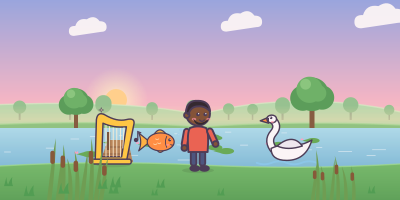
"I think," he said, "that a song deserves a proper instrument." He asked his friends who could make one, and nobody answered, so he decided to do it himself. He carved the great jawbone into a curved frame, and he used the long teeth of the pike for the pegs that hold the strings. For the strings themselves he gathered hairs from the tail of a horse, which he twisted together until they gleamed like threads of dark silver. At last the instrument was finished. It was called a kantele, and it was the first one in the world.
Word spread quickly, and soon people were walking from every direction to see the new instrument. Young men came, and old men came, and sisters and grandmothers and little children and farmers with mud on their boots. Väinämöinen invited each of them to take the kantele and play a tune. They sat down politely, one after another, and they plucked and pressed and strummed with all their might. But the strings only made a tangled, scratchy noise, and the crowd soon began to look at each other in confusion.
The most confident of the visitors was a lively young hero named Lemminkäinen, who declared that the others were simply not trying properly. He pulled the kantele onto his knees, cracked his knuckles, and spread his fingers wide. He twisted it this way and that way, and he tried to make it sing, and he pushed his chin out in determination. The kantele only whined like a gate in the wind. Lemminkäinen handed it back with a red face, and he muttered that a harp made of fish bones was a silly idea in the first place.
Väinämöinen was not discouraged. He carried the kantele to the far northern farmhouse, where all the people were famous for their music, and he asked them to try. They played boldly all evening long, but the result was the same. The strings tangled and complained, and the notes jangled like pots falling off a shelf. In the corner by the stove an old man who had been napping woke up with a terrible grumble. "Stop that dreadful noise," he said, "and throw the thing into the lake, because it has kept me from sleeping for a week."
At that moment the kantele spoke up for itself. In a clear small voice it answered that it would not be thrown into any lake, and it would not sink beneath any wave. It said that it was made to play for one person only, and that it would wait patiently for the hands that had made it. So the people carried it back with great care and set it on Väinämöinen's knees. The old singer smiled, because he had suspected all along that an instrument built with love might need to be played with the same kind of love.
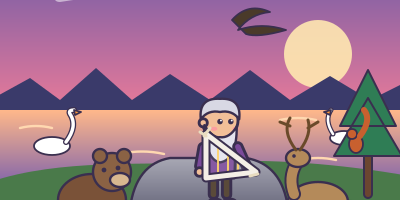
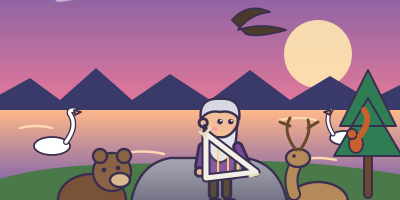
He washed his hands in the cold lake, and he walked up a hill to a flat gray rock that people called the singer's stone. The sun was nearly gone, and the sky was the color of a ripe peach. Väinämöinen sat down and rested the kantele on his knee. "Come and listen," he called gently, to anyone who could hear, "all you who have never heard me before." Then he lifted his fingers, and he touched the strings, and a sound rose up that was so sweet and so strong that the whole hillside stopped moving.
Squirrels came leaping from branch to branch, and ermines slid out of the stone walls to listen. Deer came bounding over the meadow, and lynxes crept from the thickets with their ears pricked forward. The wolf woke up in the marsh and the bear came out of the pinewood, and they both sat down side by side beside the gate, behaving as politely as two guests at a dinner. The birds heard it next. An eagle left her nest high on a cliff, and swans glided in from the white marshes, and a thousand small finches settled on Väinämöinen's shoulders.
The music climbed higher, and it reached the sky, where the daughters of the sun and the moon were sitting on a bright red cloud and weaving a cloth of gold and silver. When they heard the kantele, they forgot what they were doing. Their combs dropped out of their hands and their shuttles slid away, and the golden thread went loose in the air. Not a single creature in the forest, the lake, or the sky stayed away. Even the fish came swimming in from the deep places, pikes and salmon and perch, and they pushed their noses into the reeds to hear every note.
The old king of the waves rose up from the bottom of the lake with seaweed in his beard. He climbed onto a water lily and listened with his eyes closed. When Väinämöinen finished the last song, the old king said softly that in all his years he had never heard anything so wonderful. Everyone who had gathered there was weeping, from the smallest finch to the largest bear, and nobody was embarrassed about it, because the music had reached the place inside each of them where the best feelings live.
Väinämöinen cried too. Large tears rolled out of his eyes, bigger than cranberries, and they dripped down his cheeks and over his beard. They fell onto the hillside and rolled down into the water, and in the dark depths of the lake they hardened and glowed. By morning they had turned into blue pearls, the most beautiful that anyone had ever seen. The people of Finland say that this is how the first kantele taught the world something important, which is that a gift made with care can turn even sorrow into something precious.
Questions
- The jawbone and teeth of a great pike
- Wood from a singing tree
- A horn from a deer
- It had no strings
- It was too heavy to lift
- It would sound sweet only for the hands that made it
- Friends who travel together
- Strangers on a road
- Enemies in a contest
- The harp, which he thought was a silly idea
- The old man by the stove
- The wind in the trees
- Nobody should build things alone
- A gift made with care can turn even sorrow into something precious
- Music is best kept quiet
Words to know
- kantele: Finnish harp
- pike: long freshwater fish
- companions: traveling friends
- discouraged: losing hope
- shuttle: weaving tool
Answer key: Väinämöinen and the Kantele
- A. The jawbone and teeth of a great pike
- C. It would sound sweet only for the hands that made it
- A. Friends who travel together
- A. The harp, which he thought was a silly idea
- B. A gift made with care can turn even sorrow into something precious
The story in pictures
- Part One · The Great Jawbone
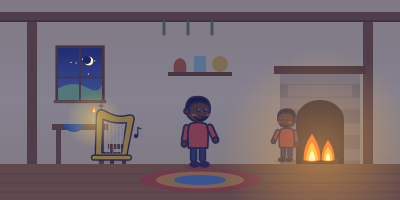
- Part Two · The Silent Strings
- Part Three · The Song on the Singing Stone
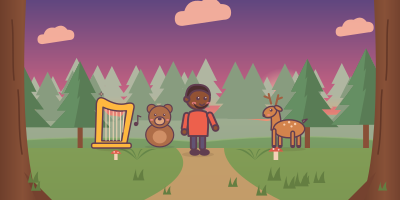
- Part Four · The Blue Pearls
For the teacher: how this passage is levelled
“Väinämöinen and the Kantele” is a reading level 12 story. Every Peabody story at this level is written and checked to keep sentences to 48 words or fewer, to aim at an average of 14 words a sentence, and to show 90 to 130 words on a screen. At most 17% of its words may be off the familiar-word list. Children in 8th grade start at this level.
| This passage | 1164 words, 12 screens, 5 multiple-choice questions with an answer key, and 5 vocabulary words with kid-sized meanings |
|---|---|
| Longest sentence at this level | 48 words |
| Words on a screen | 90 to 130 |
| Skills practised at this level | vocabulary, spelling |
Reading level 12: the limits, a real sample and the free games. Peabody is a learning app, not an assessment: use the questions to talk about the story, not to grade a child.